When thinking of a collision between 'Monster Hunter' and mobile platforms, worry comes to mind before excitement. After all, Monster Hunter has never been an easy game to control. Amid complex commands, intricate combos to memorize, and an array of items to use, monsters charge at hunters in an enraged frenzy. Even when holding a structured console gamepad in both hands, fingers get tangled and hunters end up carting. Is such control really possible on a flat smartphone glass screen without a single physical button?
While Monster Hunter is no stranger to mobile adaptations, asking for the mainline-style hunting action fans expect on mobile felt like wishful thinking. A core joy of Monster Hunter is the distinct feedback and feel of each weapon, an element that leaves little room for compromise. Thus, right up until tapping the 'Monster Hunter Outlanders' icon, doubt outweighed expectation.
To cut to the chase, the game delivers a clever and impressive answer to the trickiest question: 'How do you recreate satisfying combat feedback on a sheet of glass?' It successfully packs Monster Hunter's signature heavy impact and back-and-forth combat rhythm into the narrow, slick frame of a mobile device. Using just two thumbs, it sets up a convincing hunter experience. Naturally, while enjoying that snappy combat feel, one eventually encounters unexpected drawbacks unrelated to controls.
To clarify beforehand, this article reflects early impressions based on a brief hands-on session. It does not thoroughly analyze long-term progression structures, end-game content, or monetization balance. Instead, from the perspective of a longtime Monster Hunter fan, here are honest first impressions of how well this unfamiliar mobile hunt captures the feel of the mainline series and where its challenges lie.
Flows Naturally with Every Intuitive Press Simplified Controls Surpass Expectations
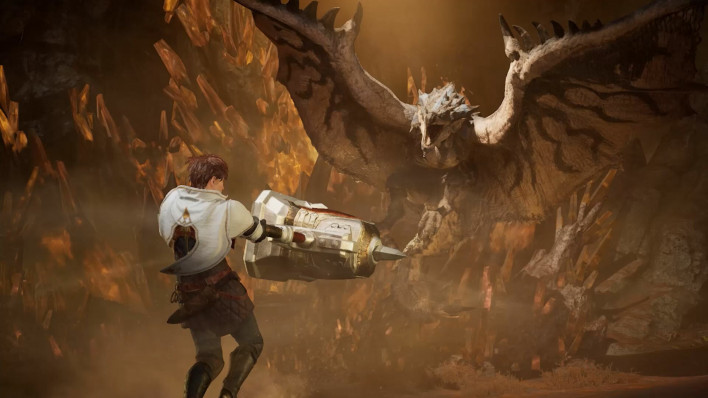
The launch version of 'Monster Hunter Outlanders' features a total of eight weapon types: Great Sword, Long Sword, Dual Blades, Hammer, Lance, Heavy Bowgun, Bow, and Charge Blade. Developers have announced plans to bring all 14 original weapon types to the game through future seasonal updates. The control system supports two modes: Classic controls, where players manually input detailed actions like in traditional entries, and Simplified controls, which bundle various attack motions onto fewer buttons.
During this hands-on test, hunting focused primarily on the Long Sword and Hammer using Simplified controls. While trying two weapons cannot represent the entire game, the feel of wielding the Long Sword and Hammer with Simplified controls turned out far better than expected.
The most surprising aspect was how seamlessly skills chained together. Rather than calculating complex combo paths in advance, pressing the attack button intuitively unleashed a variety of skills without interruption. Streamlining inputs often leads to choppy animations or unintentional moves, but here, standard combos and core skills linked fluidly using almost just two buttons. It left a strong impression of meticulous polish designed to keep fingers from getting lost on the touchscreen.
Other mechanics help reduce control fatigue: Lock-On and attack telegraphs. Part targeting and red glowing signals—previously featured in the mobile title 'Monster Hunter Now'—have been actively adapted for an open-world hunting environment. The part lock-on system eliminates the need for complex aim adjustments, allowing players to tap a target area once to keep attacks focused there. Locking onto a monster's head during a hunt made it easy to maintain hitpoints with both Hammer and Long Sword. In traditional Monster Hunter, hitting specific body parts often demanded high precision and good luck depending on the weapon. In Outlanders, a single tap lets players land continuous Hammer strikes on a monster's head with ease.
Visual telegraphs, where monsters glow red right before attacking, make combat even more approachable. Instead of reading subtle wind-up animations on a small screen, players can simply press dodge when the red light flashes. As an adaptation for mobile environments, this design choice succeeds. However, compared to console and PC titles where players memorize monster patterns through repeated carting, some may feel hunting has become overly hand-holding and easy. Since this accessibility was experienced using Simplified controls on the Long Sword and Hammer, switching to Classic controls with manual inputs or advancing to higher-tier hunts could offer a different feel.
'Adventurers' Instead of 'Hunters' Expanding the Scope Beyond the Hunt
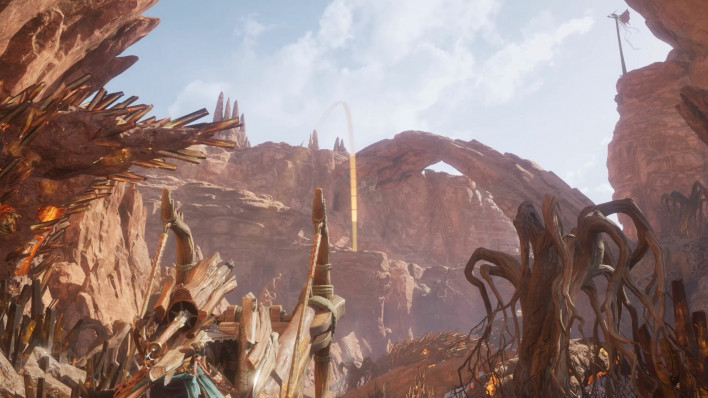
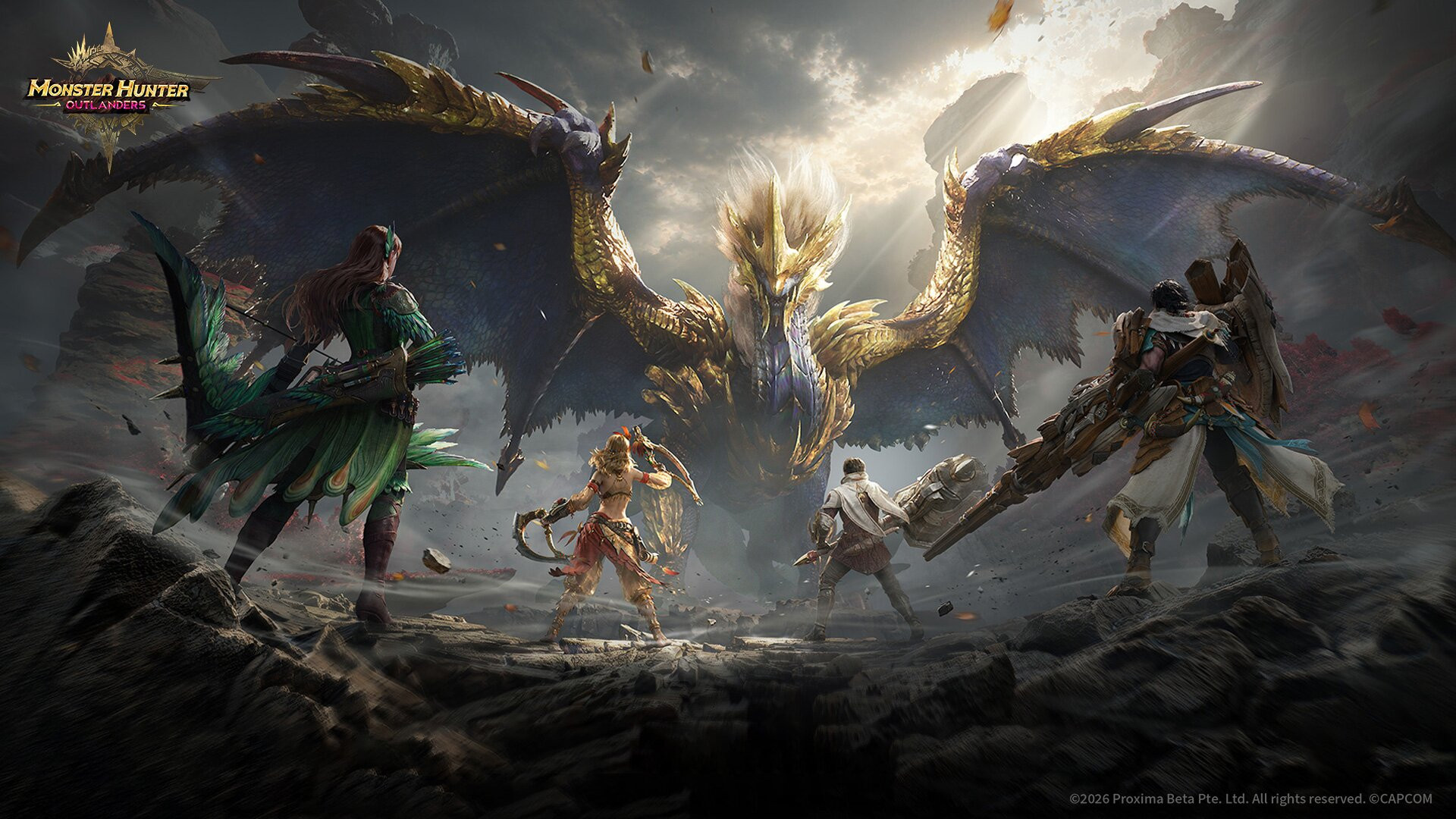
While core hunting action was distilled onto mobile screens, the game's broader foundation was redesigned from scratch. It expands its scope by combining open-world exploration with character-collecting RPG conventions. The setting is Isolesia, an isolated island in a parallel world distinct from original entries. While familiar monsters like Rathalos and Anjanath return, new threats appear as well—such as 'Radiant Species,' monsters made fiercer in pattern and presentation by the island's unique minerals, and 'Ruger Aidal,' an original Elder Dragon equipped with golden wings. Exploring town feels unmistakably like Monster Hunter, but stepping out into the open field offers a fresh experience that feels distinct from traditional entries.
Player status is also different. Instead of traditional Hunters, players take on the role of 'Adventurers' in a research commission. Players recruit companions at the tavern to hunt together. Companions are categorized into Assault types focused on offense, Disrupter types exploiting monster openings, and Support types aiding allies—each featuring unique weapons, skills, and ultimate 'Secret Arts.' Characters feature rarities and gacha-style collection mechanics, and recruited Adventurers can be played directly.
The environment blends Monster Hunter's ecosystem with open-world adventure elements. Players repair watchtowers in each region to uncover the map and use gliders to soar through the skies. Additionally, players can craft ziplines, set up wind devices to generate updrafts, and scale cliffs by consuming stamina.
Built on the traditional loop of hunting monsters for materials to forge gear, the game overlays mobile open-world RPG mechanics such as character recruitment and field progression. Bringing three companions creates the feel of a four-player party hunt, blending the joy of tackling monster patterns with character development and environmental expansion. Stepping beyond traditional Monster Hunter conventions, this novel approach combines hunting action with open-world adventure and exploration.
Performance in App Emulators and Resolution Optimization Drawbacks Missing the Overwhelming Presence of Giant Monsters...
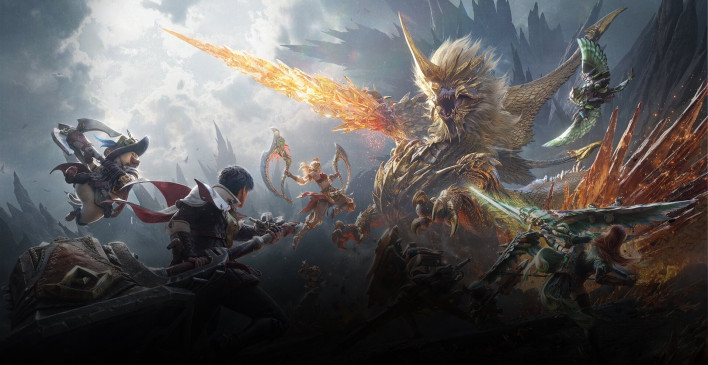
The main disappointment stemmed from performance environments and graphic optimization when rendering the game's crafted action and world. Resolution stability and thermal management on mobile devices left noticeable room for improvement.
To view the game on a larger display, testing initially began on PC via BlueStacks, an Android emulator. However, perhaps due to unoptimized background processes or emulator settings, severe frame drops and significant resolution drops hindered smooth gameplay. Since emulator compatibility or setting variances could not be ruled out, testing immediately shifted to mobile devices: a Galaxy S25 Ultra smartphone and a Lenovo Legion Tablet Gen 3.
On mobile and tablet hardware, the game ran smoothly at proper frame rates without noticeable drops. However, rendered visual quality felt underwhelming relative to device specifications. Likely due to dynamic resolution scaling or upscaling implemented to maintain frame rates, resolution dropped during combat and movement, causing jagged edges in certain areas. Occasionally, textures and pixel artifacts became visible, diminishing visual clarity, while smartphone testing resulted in noticeable thermal buildup quite rapidly.
As hunting continued across different devices, a fundamental question beyond technical optimization lingered: 'Does Monster Hunter truly suit small mobile screens?'
A core appeal of the Monster Hunter franchise is the awe-inspiring presence when towering beasts fill the display. The overwhelming difference in scale as a monster several times larger than the player character roars and charges builds tension during a hunt. On a palm-sized smartphone screen, however, even a full-screen monster fails to convey the scale experienced on PC or console monitors. Rationally knowing the target is massive does not overcome the reduced impact of a smaller visual representation.
Consequently, during play, one naturally reaches for larger displays like tablets instead of smartphones. This is not due to cumbersome controls—touch controls proved surprisingly comfortable. Rather, observing epic battles against giant monsters on a small handheld screen feels limiting. Because the core action framework is so solid, the physical limitations of mobile display size and thermal constraints feel all the more prominent.
Mobile Hunting Action That Surpasses Expectations Polishing Screen Presentation and Optimization Will Elevate Quality
In summary, 'Monster Hunter Outlanders' stands on solid fundamentals and satisfying combat feedback. Adapting complex hunting action onto mobile touchscreens—through Simplified controls that chain attacks naturally, part lock-on targeting, and intuitive red telegraphs—deserves genuine praise. Repeated hunts continuously impress with how well combat feedback translates to mobile.
Of course, resolving resolution stability, thermal optimization, and the diminished sense of scale on small screens remain ongoing tasks to support its well-crafted action. While fingers adapt smoothly to mobile hunting, eyes inevitably long for larger, clearer displays. If future updates refine graphical stability and device optimization, the game has clear potential to deliver an exceptionally polished mobile hunting action experience.