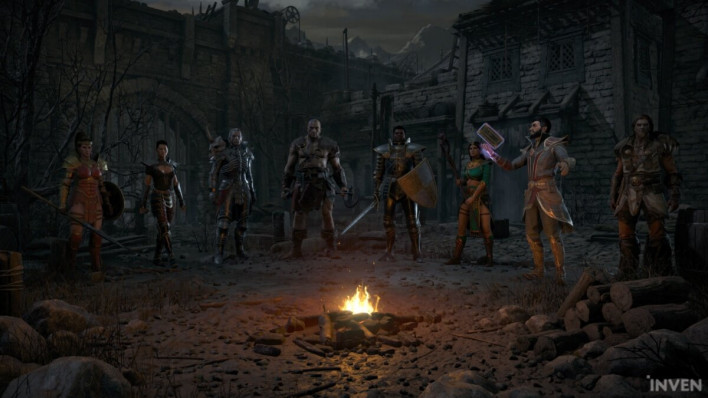
Blizzard Entertainment's 'Diablo II' remains a classic game beloved by many gamers to this day.
In 2021, it gained new life with the release of 'Diablo II: Resurrected', which improved graphics and quality of life. Recently, however, a rather strange transformation has been occurring around the game. Moving beyond simply adding new items or classes, a series of attempts are emerging that alter the game's perspective, controls, and even its core genre.
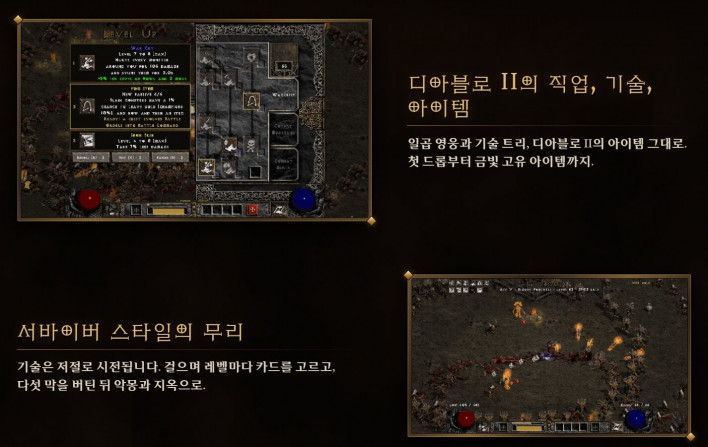
The most striking example is the recently revealed 'D2 Survivors'. As the name suggests, it is a fan game that reimagines Diablo II as a survivor-like in the style of 'Vampire Survivors'. While utilizing the graphics, sound, and characters of the original game, its gameplay is vastly different. Players move to dodge swarms of demons while slaying enemies with automatically triggered skills, powering up their characters by choosing new abilities each time they level up.
It doesn't merely borrow Diablo II's outer appearance, either. The seven classes, various skills, and item systems from the original game are all implemented, along with regions spanning five acts as well as Nightmare and Hell difficulties. D2 Survivors is an unofficial, free fan project that loads graphics and sounds directly from the Diablo II or Diablo II: Resurrected game files owned by the player. Thanks to this approach, anyone who owns the original game can play it not only through a standalone program but directly inside a web browser as well.
Meanwhile, another case has emerged that fundamentally changes how players view Diablo II. Released in September by developer emmericp, 'D2R-3D' is a mod that allows players to freely rotate and zoom the fixed quarter-view camera of Diablo II: Resurrected. Breaking away from the traditional isometric perspective looking down at the character, players can observe combat from behind or up close, taking in Sanctuary as a fully perspective-rendered 3D space. However, early standalone versions faced issues such as shutting down after about one minute due to game integrity checks, making it more of an experimental endeavor than a polished feature.
What is interesting is that this perspective modification led to yet another experiment. Evolving from ideas sparked by D2R-3D, the 'D2R VR' project enables Diablo II to be played using virtual reality headsets. Going beyond simply projecting the game screen into a VR space, it implements features such as swinging weapons or drawing bows in first-person view and aiming spells with hand motions. In effect, it turns a quarter-view hack-and-slash RPG into an immersive action RPG.
Attempts to make the graphics even more realistic have also been added to the mix. A recently shared video demonstrates Diablo II: Resurrected—modified to a 3D camera—with Nvidia's DLSS 5 neural rendering technology applied externally. It is an experiment to alter screen lighting and material textures without completely recreating the original game's terrain and characters. However, this is also closer to a tech demonstration achieved by modders combining existing technologies rather than an officially supported feature.
What makes these developments even more fascinating is that these distinct attempts have surfaced one after another in a relatively short period. On one side, Diablo II was converted into a survivor-like; on another, the camera was liberated, which in turn paved the way for VR controls. Unlike traditional modding that adds content or tweaks balance in the original game, experiments that reshape the very way players experience the game are now unfolding around a single title.
Of course, attempts to change the genre of classic games are not entirely new. 'Lambda Wars', which brought the 'Half-Life 2' universe into a real-time strategy game, was released in 2014, while 'Age of Doom', which recreated Doom using the 'Age of Empires II' engine, appeared in 2021. The culture of using a game's engine and assets to create an entirely different work has existed for a long time. However, the recent momentum surrounding Diablo II catches attention because individual experiments are connecting with one another to generate new possibilities.
That is not to say these projects have reached a level where they can immediately replace the original game. Forcibly modifying the game's structure can lead to stability or compatibility issues, and using original game assets requires careful consideration of copyright and terms of service. Moreover, changing the perspective alone does not automatically reshape the game's combat design to match, so being technically feasible is a separate matter from providing a polished gameplay experience.
Even so, the fact that a game over 25 years old is transforming in such diverse ways is quite remarkable. A game where players once endlessly clicked their mice to hunt demons is now becoming a survivor-like where they dodge horde after horde, or a game where they put on VR headsets to swing swords themselves. Blizzard's Diablo II may have been completed long ago, but it seems gamers are far from finished coming up with new ways to play with it.