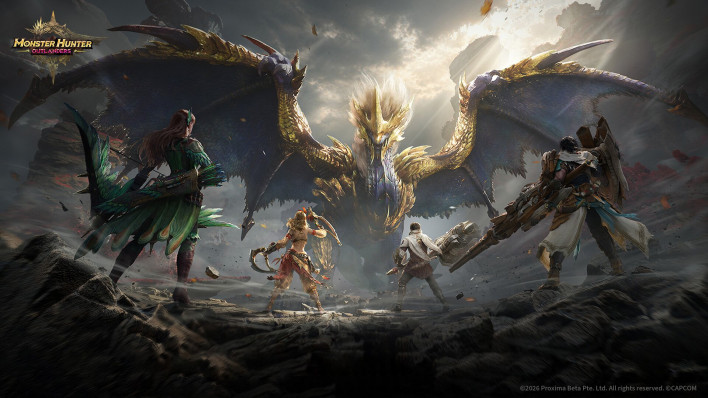
The marriage of 'Monster Hunter' and mobile platforms brings concerns before excitement. After all, Monster Hunter isn't exactly a game with easy controls. You need to know fairly complex inputs and combos, and amid the chaos of managing so many tools, the monster right in front of you charges madly toward the hunter. Even with a shaped console controller firmly gripped in both hands, it's easy to get fingers tied in knots and end up faint on a cart. Is such control really possible on the flat glass surface of a smartphone without a single physical button?
While it's not without precedent for Monster Hunter to appear on mobile, expecting the mainline-style hunting action we hope for on mobile felt like asking for too much. In Monster Hunter, the distinct tactile feel of each weapon is the game's greatest appeal, and that's an element hard to compromise on. So right up until tapping the icon for 'Monster Hunter Outlanders', doubt took precedence over anticipation.
To state the conclusion first, it provided a clever and excellent answer to the most troublesome question: 'How do you deliver tactile combat feel on a flat sheet of glass?' It successfully squeezed Monster Hunter's signature weighty hit feedback and back-and-forth combat rhythm smoothly into the narrow and slippery frame of mobile. It set the stage well so players can feel like a legitimate hunter using just two thumbs. Of course, while enjoying that crisp combat feel, I encountered another unexpected disappointment that had nothing to do with controls.
To clarify beforehand, this article is an initial hands-on impression based on playing the game for a short time. I wasn't able to deeply analyze long-term character progression systems, endgame content, or monetization balance as a mobile game. Instead, from the perspective of a fan who has enjoyed the Monster Hunter series, I aim to share honest first impressions on how well this unfamiliar mobile hunt captures the spirit of the mainline titles and where it leaves room for improvement.
Combos connect naturally, press as you feel Simplified controls exceeded expectations
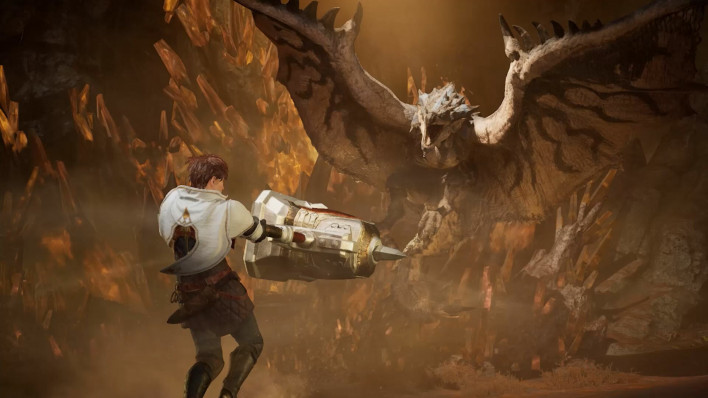
The launch version of 'Monster Hunter Outlanders' features a total of eight weapon types: Great Sword, Long Sword, Dual Blades, Hammer, Lance, Heavy Bowgun, Bow, plus Charge Blade. The developers have announced plans to fill out all 14 classic weapon types from the original series through future seasonal updates. The control scheme supports two options: classic controls, where detailed actions are input manually like in the original series, and simplified controls, which package multiple attack animations into fewer buttons.
In this preview, I picked two weapons—Long Sword and Hammer—and went hunting using simplified controls. While I couldn't test every weapon and control mode and thus cannot speak for the entire game, the feel of wielding the Long Sword and Hammer with simplified controls turned out far better than expected.
What surprised me most was the flow of combo chaining. Rather than calculating complex branching trees in my head before pressing buttons, simply tapping the attack button on instinct triggered various skills without a hitch. Drastically reducing inputs could easily lead to choppy animations or bizarre unwanted actions, but here, basic combos seamlessly flow into core techniques with barely two buttons. It was enough to give the impression of being meticulously refined so fingers wouldn't get lost on a touchscreen.
There are other features that alleviate control fatigue: target lock-on and attack telegraphs. The part-locking and red glowing signals previously shown in 'Monster Hunter Now' on mobile were actively brought in and adapted to the open-world hunting environment. The part lock-on structure in this game lets you pick a specific target spot without needing to constantly adjust your reticle, focusing attacks right there. In fact, locking onto a monster's head during a hunt allowed me to maintain my hit position automatically while delivering attacks with the Hammer and Long Sword. In traditional Monster Hunter games, hitting a specific body part often required immense focus and a bit of luck depending on the weapon. Here, a single lock-on easily lets you land consecutive Hammer hits directly on the monster's head.
The visual telegraph where a monster glows red right before launching an attack makes gameplay even smoother. Instead of trying to read subtle wind-up animations on a small screen, you simply press the dodge button when the red flash lights up. As an accommodation tailored to the mobile environment, it passes with flying colors. However, compared to console and PC titles where players faint dozens of times to memorize monster patterns through trial and error, some players might feel the hunting is overly forgiving and easy. Of course, this accessibility was experienced playing Long Sword and Hammer with simplified controls, so the feel may change when selecting classic controls with direct inputs or progressing to higher-tier hunts.
'Adventurer' instead of Hunter Expanding the stage beyond the hunt
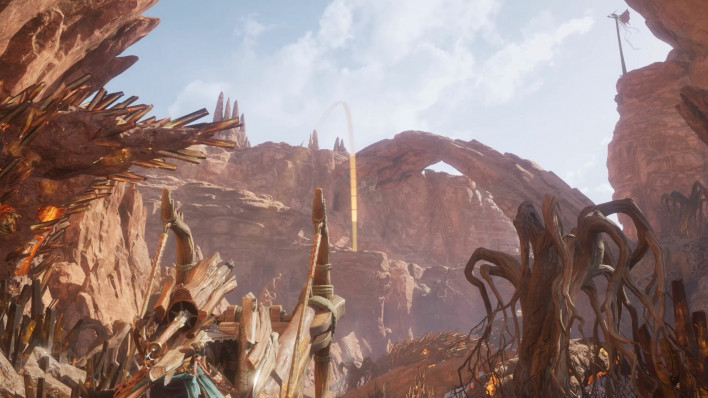
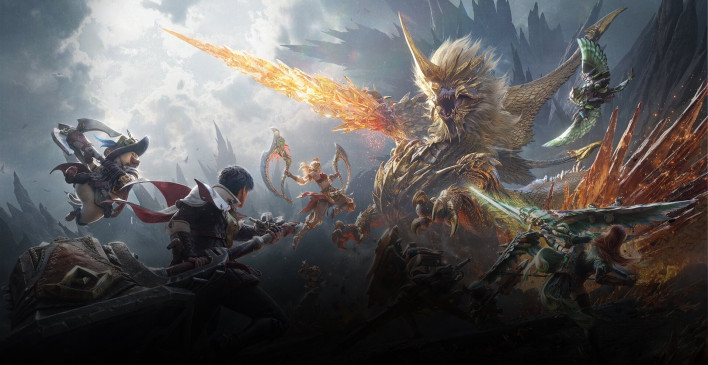
While squeezing the tactile action of hunting into a mobile screen, the underlying frame of the game was completely rebuilt. It expanded its scale by boldly mixing open-world exploration with the design grammar of hero-collector RPGs. The setting is 'Isolesia', an isolated island in a parallel world distinct from the original titles. While familiar faces like Rathalos and Anjanath greet you, there are also unfamiliar encounters like 'Radiant Species'—monsters made fierce in behavior and presentation after being coated in the island's special minerals—and 'Ruger Aidal', an original Elder Dragon draped in golden wings. Walking around the village feels unmistakably like Monster Hunter, but stepping out into the field often feels refreshingly distinct from the Monster Hunter we knew.
For starters, your role is different. Instead of a Hunter, you are an 'Adventurer' in the Research Commission. You recruit companions at the tavern and set out to hunt together. Companions are divided into Assault types focused on offensive attacks, Distraction types that exploit openings, and Support types that aid allies—each equipped with distinct weapons, exclusive skills, and ultimate 'Hunting Arts'. Every character features rarity tiers and collectible elements, and recruited characters can also be controlled directly in gameplay.
The field blends the ecosystem of Monster Hunter with a broad set of open-world adventure exploration mechanics. You repair towering watchtowers in each region to clear map fog and glide through the air using a glider. That's not all—you can set up ziplines across the map to ride around, install updraft devices to ride rising air currents, and scale cliff faces while consuming stamina.
Over the traditional framework of hunting monsters, gathering materials, and crafting gear, it layered mobile open-world RPG conventions like character recruitment and world development. Bringing three companions along creates the feel of a 4-player hunt, tying together the satisfaction of mastering monster patterns with the fun of developing characters and exploring the map. Stepping beyond the traditional Monster Hunter mold, it takes a fresh approach that lets players enjoy broad open-world adventure and exploration alongside hunting.
Disappointments in emulator performance and resolution optimization Wanting to see imposing giant monsters, but...
The disappointing aspect was the execution environment and graphic optimization housing this elaborately crafted action and world. Room for improvement was evident in maintaining resolution and managing heat on mobile devices.
Initially, wanting to inspect the game on a larger screen, I tried running it on the PC emulator BlueStacks. However, perhaps because I couldn't strictly configure the PC environment like background processes or emulator settings, I experienced severe frame drops that hindered smooth gameplay or caused resolution to drop significantly. Since compatibility or setting impacts on emulator environments are hard to rule out, I immediately switched testing to mobile devices: a Galaxy S25 Ultra smartphone and a 3rd Gen Lenovo Legion Tablet.
On the mobile smartphone and tablet, the game ran smoothly at proper speeds without frame drops. However, the graphical output quality on screen felt underwhelming considering the hardware specs. Whether due to dynamic resolution scaling or upscaling to maintain framerates, noticeably rough jagged edges appeared frequently as resolution dropped during combat or movement. At times, textures and pixel artifacts stood out, diminishing visual clarity, and device temperatures rose fairly quickly when playing on the smartphone.
As I continued hunting across different devices, a fundamental question beyond technical optimization lingered in my mind: 'Does a game like Monster Hunter truly belong on a small mobile device?'
One of the core appeals of the Monster Hunter series is the overwhelming sense of dread delivered when a massive beast fills the screen. That dizzying size disparity as a creature several times larger than your character roars and pounces creates the tension of the hunt. Yet on a palm-sized smartphone screen, even when a monster fills the display, that imposing presence felt on a PC or console monitor fails to come alive. You know in your head that you're fighting a colossal enemy, but with the scale entering your eyes being so small, the impact is halved.
Given this situation, throughout my play session I naturally wanted to put down the smartphone and reach for a device with a larger display, like a tablet. It wasn't because controls were uncomfortable—in fact, touch controls were surprisingly smooth. It was simply regrettable to view this fight to the death against colossal monsters through a palm-sized device. Because the core action foundation is so solid, the physical screen size and thermal limitations of mobile felt all the more frustrating.
Mobile hunting action beyond expectations Polishing resolution and optimization will elevate its quality
In summary, 'Monster Hunter Outlanders' is a title with solid fundamentals and satisfying combat feedback. From simplified controls that chain naturally on instinct, to part lock-on that pinpoints desired spots, to intuitive red attack telegraphs, the craftsmanship in porting complex hunting action to a mobile touchscreen deserves applause. Thanks to this, with every hunt, I repeatedly marveled at how satisfying the combat feel could be on mobile.
Of course, resolution stability and thermal optimization needed to support this well-crafted action, alongside the reduced sense of scale characteristic of Monster Hunter on a tiny screen, remain challenges to address moving forward. While fingers adapt perfectly to mobile hunting, eyes constantly crave a larger, sharper display. If graphical stability and device optimization are further refined through future updates, it has the potential to achieve far greater polish as a mobile hunting action title.