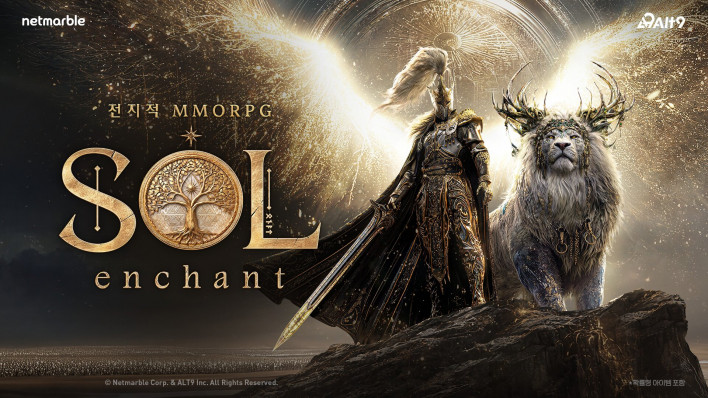
Netmarble has released 'SOL Inside,' an original documentary series on the official YouTube channel for its upcoming MMORPG, 'SOL: Enchant,' which is set to launch on the 18th. The four-part series, spanning from Episode 1 to the finale (Episode 4), features the development team from Alt9 explaining the origins of the game's core systems.
EP.01 'Relinquishing Developer Authority'
The first episode covers the starting point of 'SOL: Enchant's' development. The team acknowledged that while the MMORPG genre remains in high demand, it is also subject to significant criticism from players, leading to a sense of urgency that the traditional approach would no longer suffice for market survival.
They also noted a significant gap between the perceived success of popular games and the actual experience of players regarding how they are operated. The team concluded that a completely new approach was necessary to engage a competitive and experienced user base.
The result is the 'Divine Right' (Godly Authority) system. The developers remarked, "We wondered if it was even possible to let players take over the operator's authority. Servers ruled by a 'Master' are common, but the concept of giving users the power to shape the game itself was something we had never heard of." The ability to cancel scheduled updates through this system was designed not as a marketing gimmick, but as a functional, implemented feature.
Despite internal opposition—with some calling it "business insanity"—the team introduced the system to grant players a level of agency they had never experienced before, even at the cost of significant business risk.
EP.02 'Authority That Crosses the Line' - The Divine Right System
The second episode delves into the specifics of the 'Divine Right' system, the game's most prominent feature. The developers emphasized that they designed it not just to provide powerful items, but to grant users direct involvement in game operations.
The scope of player intervention is broad, ranging from skill usage and monster summoning to choosing business models, updates, and even considering server resets. The intention is not to offload operations onto the players, but to design a system where they can selectively enjoy these mechanics.
Furthermore, in terms of the economy, they have allowed the trading of gacha results. In this process, Alt9 and Netmarble opted for a bold policy to preserve the value of user assets and enable profit-oriented gameplay.
EP.03 'A Game That Doesn't Demand Your Presence'
The third episode addresses the direction of game operations, specifically tackling the issue of mandatory login. Recognizing that the 'chores' (repetitive, mandatory content) common in past MMORPGs cause player fatigue, the team aimed to create an environment where players can enjoy the game whenever they want, without being tied down by the demands of daily life, such as work or childcare.
To achieve this, they introduced a 24-hour offline progression system. While this policy could fundamentally shake the reward structure of a game, the developers insisted that characters should be able to grow and earn rewards even when the game is closed. They described this not as an extra feature, but as a "fundamental requirement for modern MMORPGs," calling "SOL: Enchant" a "game that doesn't demand your presence."
EP.04 Launch Delay and a Complete Economic Overhaul
The final episode takes a different tone, detailing how the team decided to completely redesign the economic system just before launch, based on feedback from company-wide testing, even after the final release date had been set.
Testers pointed out the complexity of the existing economic structure. With two currencies, 'Gold' and 'Nine,' coexisting, users found it difficult to distinguish their uses, leading to a lack of intuitive feedback. The team decided to remove 'Gold' and unify the currency under 'Nine'—a massive undertaking that involved rebuilding the system's foundation rather than just deleting a feature.
This decision, made just before launch, focused on simplifying the economy to provide intuitive fun and increasing economic satisfaction by sharing currency value. However, this required delaying the launch—a difficult choice that broke their initial promise to users and placed a heavy burden on both the development and business teams.
Nevertheless, they stated that they took the risk—likening it to changing the tires on a moving car—to avoid compromising the game's quality and essence. They viewed it as an unavoidable decision to prevent future distrust and present a sincere product.
The development team described their role as being like 'civil servants,' emphasizing that their primary goal is to create an environment where users can freely enjoy the game.

The message Netmarble and Alt9 aimed to convey through this documentary is a choice to break away from the inertial structures of the MMORPG genre. They intend to dismantle mandatory logins, developer-centric decision-making, and closed economies from the design stage. The goal is to give users new choices and invite them to be co-operators who help build the game, rather than mere consumers.
Given the unconventional nature of these decisions, the impact on actual service and operations will likely be significant. Whether the philosophy presented in the documentary translates into the actual service remains to be seen through player reactions after launch. 'SOL: Enchant' is set to take its first official step on June 18.

Sort by:
Comments :0