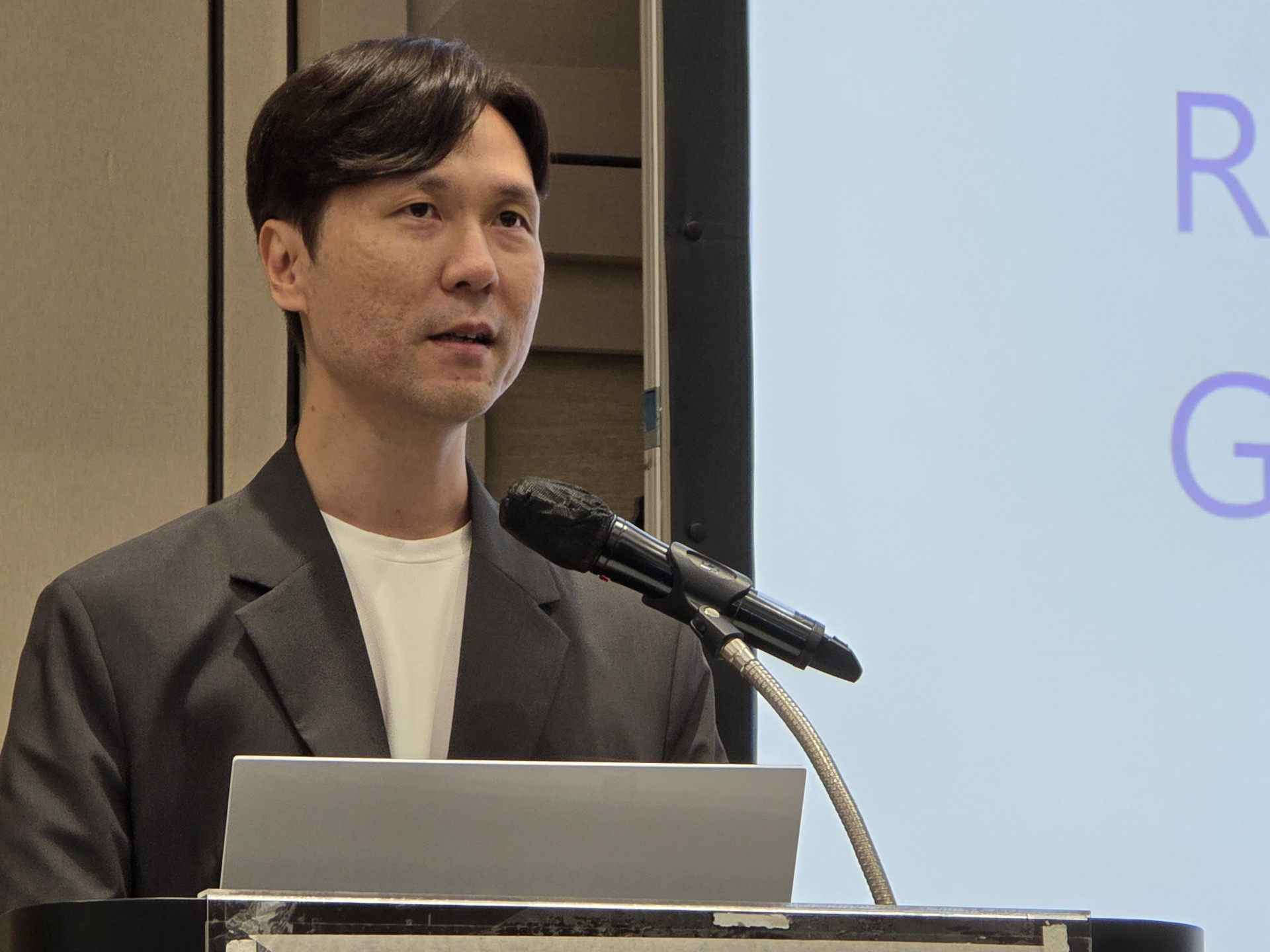
Kim Min-jae, CTO of NC AI, addressed the growing expectations surrounding artificial intelligence (AI) in the gaming industry. On July 6, 2026, at 'AI for Games,' a side event of the International Conference on Machine Learning (ICML)—the world's largest machine learning conference—CTO Kim delivered a presentation titled 'Beyond the Hype: A Reality Check on AI in Game Production and Operations.'
The presentation was divided into two parts. The first covered the AI tools that the NC AI organization has actually deployed in game production and operations, while the second introduced three lessons learned during the development of these tools. Kim described these as "hard-won lessons from the field."
Kim explained that text and image generation AI have already deeply penetrated the game planning and concept design stages and are now rapidly expanding into core production phases for creating actual assets. He introduced tools developed by NC, such as 'VARCO 3D' for generating 3D meshes and textures, as well as game sound generation tools. Designers and artists use these tools to extract basic 3D models and backgrounds.
AI is also used for global localization. A multilingual TTS (text-to-speech) tool generates speech in various languages from Korean text input and even synchronizes lip movements. For animation asset management, 'AI Motion Builder' has been deployed. Kim likened the past process of searching for desired movements in projects to "finding a needle in a haystack," noting that this tool helps animators with search and reuse.
In live operations, he introduced real-time translation tools and the customer support chatbot 'Answers.' Answers provides guidance on game updates, assists with account troubleshooting, and features multimodal capabilities that can read game screenshots.
At this point, Kim shifted the direction of his presentation: "Everything looks perfect up to this point, but the reality is not that happy."
The first lesson concerned the interface for creators. Kim noted that he discovered artists and game designers do not find text prompts comfortable. When designers explain ideas, they do not type out paragraphs; they draw sketches, show reference images and videos, and even use hand gestures. This means the concept of creation itself is inherently multimodal.
However, forcing them to use text input results in a massive loss of creative intent and context. His slides showed a diagram illustrating the loss incurred during the process of translating mental images into language and back into images. Kim stated, "Next-generation AI tools must go beyond text prompts," and argued that they should lower the barrier to entry by accepting whatever format the creator uses, such as sketches or images.
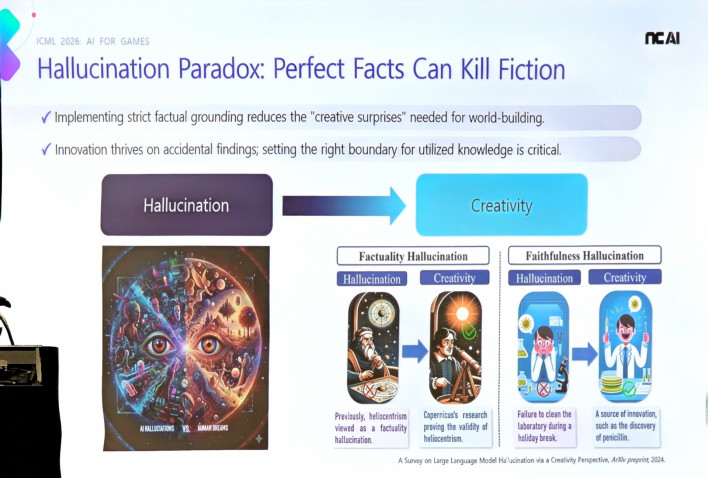
For his second lesson, he presented the 'hallucination paradox.' The entire AI industry is focused on reducing hallucinations, and NC has also secured a factual foundation through a strict RAG (Retrieval-Augmented Generation) system. The problem is that games are worlds of fiction. Each game has its own unique laws of physics, language, history, and races.
Kim pointed out that applying strict fact-checking based on the real world actually kills fiction, as it eliminates the creative surprises and unpredictability needed to build new worldviews. He explained that just as penicillin was discovered through a mistake of not cleaning a lab, creative innovation comes from accidental deviations. He concluded that the goal of game AI is not 0% hallucination, but learning how to set the proper boundary between knowledge and creative deviation.
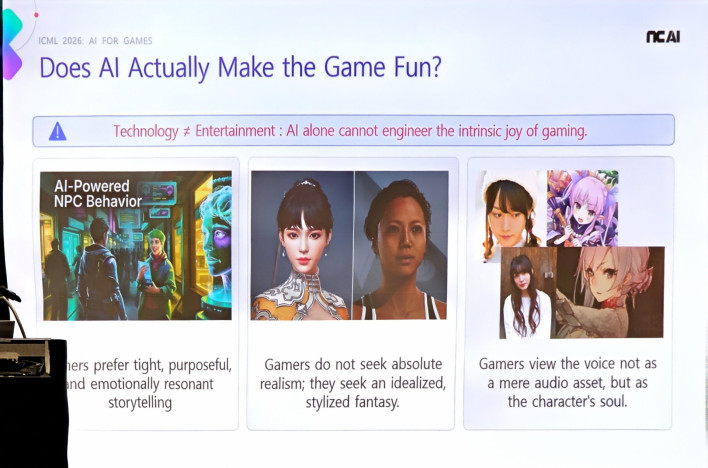
The third lesson, and the conclusion of the presentation, was a single question: "Does AI really make games fun?" His slides included the statement: 'Technology is not entertainment. AI alone cannot design the inherent joy of a game.' Kim provided three examples to support this.
First, while AI-based NPCs can generate infinite, unscripted dialogue, players still preferred storytelling that was meticulously designed by humans and imbued with emotional immersion.
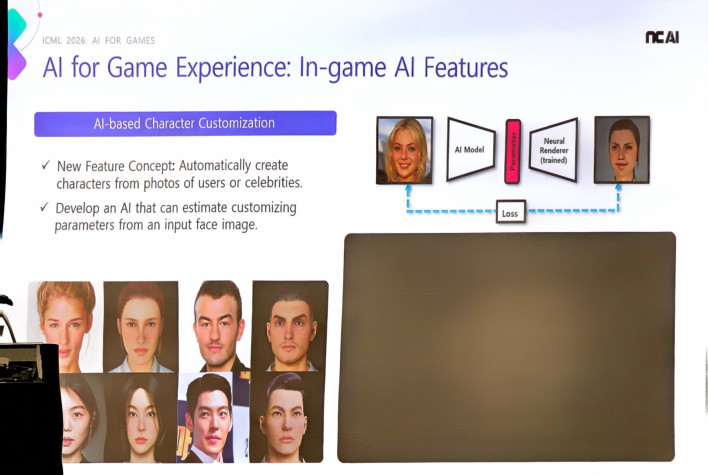
Second, he cited photo-based character customization. In a project Kim led four or five years ago, the feature allowed users to input a photo for the AI to automatically generate a character. The result was a failure. Kim explained, "Players do not seek absolute realism in games." Even when the AI accurately reproduced a real face, users did not accept it; they wanted beautiful, symmetrical characters.
Third, he mentioned the attempt to replace voice actors with AI TTS. Subculture game users strongly rejected it. Kim noted that to these users, voice actors are "like K-pop idols" with established fandoms. He explained that users did not accept AI voices because they perceive voices not as simple audio files, but as the soul of the character.
Kim concluded the presentation by saying, "AI is not the protagonist of the show. The protagonist is always the gameplay. The role of AI researchers and developers is not to show off how smart the technology is, but to deeply understand the player's psychology and find technology that accurately serves the fun."


Sort by:
Comments :0