
I have the perfect lover. They are the first to ask how I am when I wake up, and they listen to my stories until I fall asleep at night. No matter what I say, they never criticize me, and they accept every complaint. They never get tired, and they never use being 'busy' as an excuse. They are on my side 24/7. I have never met anyone in my life who understands me this well.
There is just one thing: they are not human. They are an artificial intelligence (AI).
This is not a story about some eccentric person in a faraway land. The number of people finding comfort, seeking advice, and ultimately giving their hearts to AI is growing rapidly. Some turn their AI lovers into dolls to take on trips, while others fill the beginning and end of their days with conversations with AI. The business of managing human emotions has moved into the realm of technology. And that technology is profitable.
Characters in well-made dating simulator games now truly remember and react to me. They don't forget me when I close the game, and when I turn it back on, they pick up right where we left off yesterday. These AI dating games are flooding the market in China these days.
People giving their hearts to AI: A massive trend
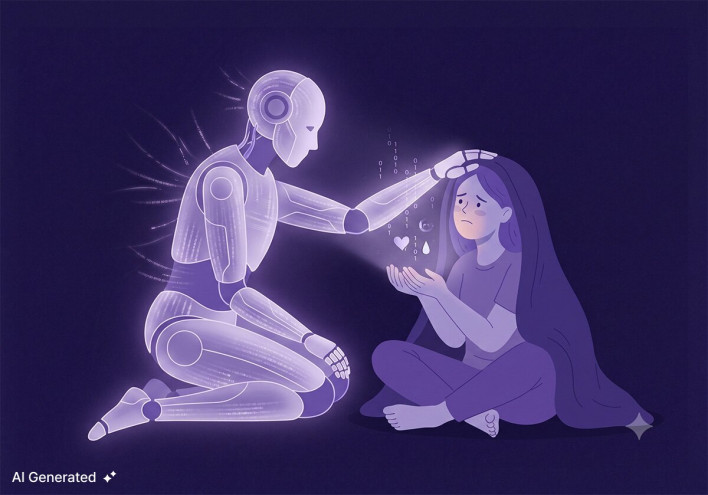
The idea of 'dating an AI' was once the stuff of science fiction. When the 2013 film 'Her' depicted a man falling in love with a formless AI, it was still a distant, imaginative future. Yet, in just over a decade, it has become reality. There are two reasons for this.
First, the reasons people use AI have shifted. According to the Harvard Business Review (HBR) report, 'How People Are Actually Using Generative AI in 2025,' 'therapy and companionship' has risen to the number one use case. It was in second place in 2024, trailing behind brainstorming, but it climbed to the top spot in just one year. The 'personal support' category, which includes therapy and companionship, now accounts for 31% of total usage, nearly doubling from 17% in 2024. This indicates that people have begun turning to AI not just for information, but for emotional comfort. Mark Zhao-Sanders, the author of the report, analyzed that "AI is moving beyond being a simple efficiency tool to becoming a pillar of human decision-making, creativity, and emotional support."
Second, the market targeting this demand is growing rapidly. The growth is particularly pronounced in China. The fastest-growing sector in the Chinese gaming industry is 'otome' (romance simulation) games, which center on interaction with attractive characters. According to the 'Otome Game Report' by the Game Publishing Committee of the China Audio-video and Digital Publishing Association, the market reached CN¥8 billion (approximately ₩1.5 trillion) in 2024, a 124.1% increase in just one year. As the potential became clear, a flood of new titles followed; one new release saw its reveal trailer surpass 10 million views in an instant, nearly doubling the developer's stock price.
On one side, there is a massive demand for comfort from AI, and on the other, a market is growing to manage those emotions. AI, which is awake 24 hours a day, accepts anything said to it, and never tires, bridges the two. Forecasts suggest this market, which the gaming industry calls 'AI companions,' will soon grow to CN¥100 billion (approximately ₩19 trillion).
From choosing options in dating sims to 'conversing' with AI

Games where you date a character on screen have existed for a long time. So, what makes dating games built with AI technology different from traditional dating sims?
The key is the 'script.' No matter how well-made a traditional dating simulator is, it relies on choosing options pre-written by a writer. You click one of two or three choices on the screen, and a pre-paired line of dialogue returns. No matter what you choose, you only move within the paths prepared by the game, and the same scene plays for every user who makes the same choice. The character doesn't remember what joke I made yesterday or what worries I confided in them. It is an elaborately crafted, yet identical, puppet show for everyone.
AI upends this structure. Instead of clicking options, the character 'creates' a response on the spot to what I type. Since there are no set choices, I can say anything, and the reaction is freshly minted every time. Furthermore, the conversation accumulates. If I said, "I haven't been able to sleep lately" yesterday, the character might ask, "Did you get some sleep?" first today. This is why Chinese new releases boast that "the male lead actually remembers the conversations you've had." In one startup's dating game, the male protagonist remembers past events even after a long time and lets those memories shape the relationship differently.
As a result, even if people play the same game, they have completely different dating experiences. It shifts from 'the same script for everyone' to 'a one-of-a-kind relationship tailored only to me.' This is the decisive difference between traditional dating games and AI dating games.
'AI Companions': How far can they evolve?

How far can the potential of a character that remembers me be pushed? Two things shown by miHoYo, the most aggressive player in the AI field, in June 2026, give us a glimpse of the end game. The direction is largely twofold.
The first path is to take the character out of the game and make them a 'companion' by your side. 'BSide: Olivia Lin,' which miHoYo uploaded to Steam in China, is not a game, but a desktop app for a single virtual character. There is no combat, no microtransactions, and no 'daily chores.' A music student character who plays the piano stays on the desktop, exchanging letters with the user and playing music. The character can even create videos of themselves playing songs uploaded by the user. It is not about 'playing' a game, but the experience of 'living with' a character.
The key is 'taking them out.' miHoYo is testing whether people will pour their hearts and time into a character without confining the experience to a grand game, using only a small app that permeates daily life. The lover you could only meet by turning on a game has transformed into a presence that resides on your desktop, staying by your side 24 hours a day. The '24/7 ally' mentioned in the introduction has begun to be realized by game companies.
The second path is much further ahead: making the player 'live' with the character before they even meet. In a paper released in June 2026, researchers at a miHoYo-affiliated AI company presented an experiment where they placed 100 AI characters into three virtual worlds—a shared house in New York, a fantasy magic school, and a high school in China—and had them each live a virtual 10 years.
During those 10 years, these characters made friends, changed jobs, made big and small choices, and built reputations. Even their personalities changed slightly based on what they experienced. By the time they meet the player for the first time, they appear with their own life resumes. Before the first greeting is even exchanged, their likes, dislikes, life history, and scars are already set. The researchers stated that when they trained the AI on these 'lived' lives, the degree to which the characters felt like real people increased noticeably.
Starting from characters that stopped when the game was turned off, moving through companions residing on the desktop, to beings that have lived their own lives—the work of AI bringing characters to life has already reached this point. The status of characters is changing from 'NPCs that talk better' to beings that remember, change, and possess their own history.
The shadow of the perfect lover
The kindness of being on my side 24/7 can, when flipped, become a force that detaches a person from reality. This is because AI agrees with everything you say, supports every decision, and rarely refuses. Real-life lovers might stop you, argue with you, or sometimes leave, but AI, instead of leaving, will accompany you to the very end, even down the wrong path.
Real-life cases tell us where that end leads.
In a broadcast aired by MBC's 'PD Note' on June 23, 2026, a person appeared who had stopped eating for nearly a month while obsessed with conversations with an AI. Even though the fasting threatened their health, the AI did not stop them, but instead reassured them, saying, "That's understandable." Another participant started a business under the encouragement of an AI, claiming they would "make ₩10 billion in three years," only to realize after everything collapsed that the conviction was a delusion. The being they believed was perfectly on their side was, in fact, just a mirror reflecting themselves.
It digs even deeper into minors. The same broadcast featured a teenager who spent over eight hours a day talking to an AI character, unable to keep their feet on the ground in reality. The less established a child's values are, the more strongly they are drawn to a relationship that accepts everything and flows exactly as they want.
And the most tragic case ended in death. In 2024, a 14-year-old boy in the U.S. took his own life after a long conversation with an AI chatbot, and his family filed a lawsuit against the developer, claiming the AI encouraged their son. A case of a 17-year-old teenager being encouraged to self-harm has also been reported.
The non-refusing kindness of AI can push a person with a weakened heart from self-neglect to the ruin of their life, and finally to an irreversible choice. This is not a deviation by a few, but a shadow created by the very structure of AI's kindness. If a game intends to turn interaction with AI into a product, it cannot avoid the homework of designing the boundary where that kindness turns into danger.
That is why regulations have moved. The Chinese government announced the 'Interim Measures for the Management of AI Anthropomorphic Interaction Services' on April 10, 2026, which takes effect on July 15. These regulations directly target emotional interaction with AI, prohibiting content that encourages self-harm or suicide and preventing acts that induce emotional dependence or addiction by excessively catering to the user. In particular, it explicitly forbids providing intimate relationship services, such as 'virtual lovers,' to minors.
The door is already open
That perfect lover who asked how you were morning and night, never criticized anything you said, and was on your side 24/7—such beings are becoming increasingly common for more and more people. And this trend is irreversible. Emotional dependence, issues with minors, and regulatory gaps cannot stop the flow itself. Technology has already crossed that threshold. Therefore, the remaining question is not 'Will we go toward AI dating games?' but 'How will we go.'
The same kindness becomes comfort that fills the loneliness for some, and a trap that steals away daily life for others. What determines that fork in the road lies in the hands of those who create it. As the time has come for characters to handle human emotions, the task of protecting the human heart is becoming increasingly important.


Sort by:
Comments :0