The pairing of Monster Hunter and mobile platforms brings worry before excitement. After all, Monster Hunter isn't known for easy controls. Between complex button inputs, combos to memorize, and an array of items to use, all while an enraged monster charges full tilt at the hunter—even holding a proper console gamepad with both hands often leads to tangled fingers and a ride back on the cart. Could such controls truly work on the flat glass pane of a smartphone without a single physical button?
While Monster Hunter on mobile is not entirely unprecedented, expecting the mainline-style hunting action we know and love on mobile felt like asking for too much. In Monster Hunter, the distinct tactile feedback of each weapon is the game's core thrill, an element hard to compromise on. That is why doubt outweighed expectation right up until tapping the icon for Monster Hunter Outlanders.
To get straight to the point, the game offers a clever and satisfying answer to the trickiest question of all: "How do you deliver tactile combat feedback on a flat sheet of glass?" It successfully crams Monster Hunter's signature weighty hit feedback and back-and-forth combat rhythm into the cramped, slippery frame of a mobile device. Using just two thumbs, the groundwork is laid out well enough to make you feel like a genuine hunter. Of course, while enjoying that crisp feedback, one eventually encounters unexpected disappointments outside of the controls.
To be clear upfront, this article is an initial hands-on impression based on a brief playthrough. It does not dig deep into long-term progression systems, endgame content, or monetization balance expected of a mobile title. Instead, from the perspective of a longtime Monster Hunter fan, this review shares honest first impressions on how well this unfamiliar mobile hunt captures the feel of the mainline games and where work remains to be done.
Combos Flow Even When Tapping by Instinct Simplified Controls Exceed Expectations
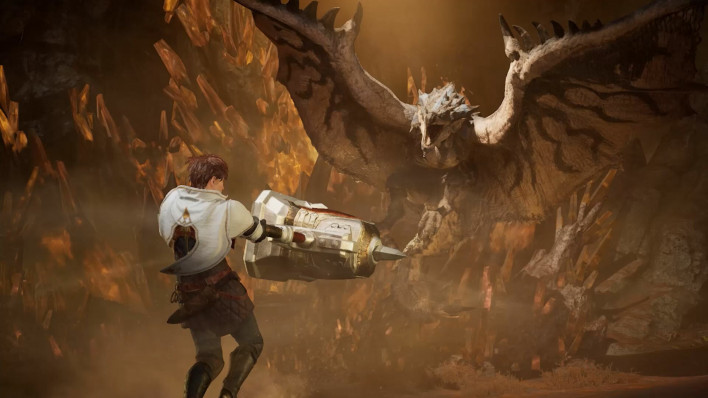
Monster Hunter Outlanders features eight weapon types at launch: Great Sword, Long Sword, Dual Blades, Hammer, Lance, Heavy Bowgun, Bow, and Charge Blade. The developers have announced plans to introduce all 14 original weapon types through future seasonal updates. The control system supports two modes: a classic mode where individual actions are input manually, and simplified controls that condense multiple attack motions into fewer buttons.
For this hands-on session, I picked the Long Sword and Hammer, focusing primarily on simplified controls for hunting. While I couldn't test every weapon and control mode—meaning this doesn't speak for the entire game—the feel of wielding the Long Sword and Hammer with simplified controls was surprisingly well executed.
The most surprising aspect was how smoothly skills chained together. Rather than calculating complex combo paths in my head before pressing buttons, simply tapping the attack button by instinct executed various skills seamlessly. Reducing inputs can often lead to clunky animations or awkward, stray motions, but here, standard combos flow naturally into signature moves using essentially just two buttons. It left a strong impression of being meticulously refined so fingers wouldn't get lost on the touchscreen.
There are other mechanics designed to reduce control fatigue: part lock-on and attack telegraphs. Features like part targeting and red glowing signals—previously introduced in the mobile title Monster Hunter Now—have been adapted into the open-world hunting environment. Part lock-on allows players to target a specific body part with a single tap, eliminating the need to manually adjust reticles. During hunts, locking onto a monster's head allowed me to easily maintain my hit position while landing attacks with the Hammer and Long Sword. In traditional Monster Hunter titles, hitting a target part often required high focus and sometimes a bit of luck depending on the weapon. In this game, a single lock-on allows you to repeatedly land Hammer hits on a monster's head with ease.
The visual telegraph where a monster's body glows red right before unleashing an attack makes gameplay even smoother. Instead of trying to read subtle wind-up animations on a small screen, you simply press the dodge button when the red light appears. As a feature tailored for mobile environments, it deserves full marks. However, compared to console and PC titles where players memorize monster patterns after carting dozens of times, some players might feel hunts have become overly forgiving or easy. Of course, since this accessibility was experienced while using simplified controls with the Long Sword and Hammer, the feel may change when opting for classic controls with manual inputs or advancing to high-rank hunts.
'Adventurers' Instead of Hunters Expanding the Scope Beyond the Hunt
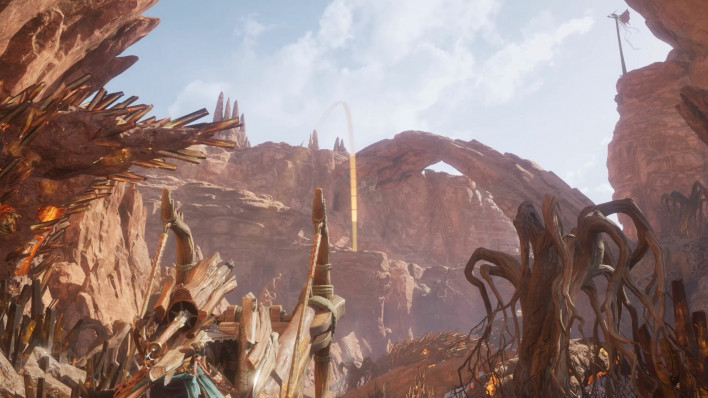
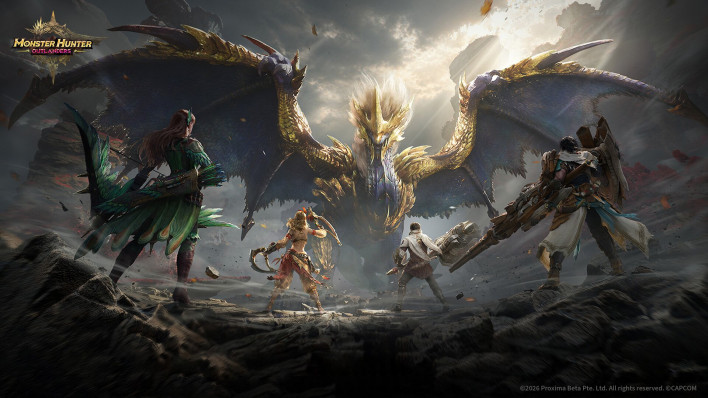
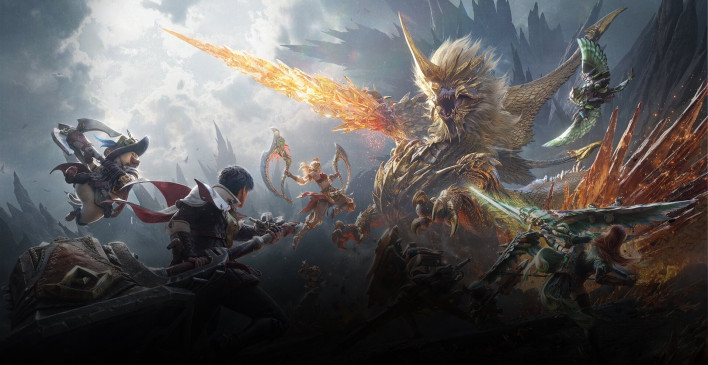
While combat feedback was adapted into mobile screens, the core structure of the game was built entirely from scratch. It expands its scope by boldly mixing open-world exploration with character-collecting RPG elements. The setting is Aesoland, an isolated island in a parallel world separate from the main series. While familiar faces like Rathalos and Anjanath greet players, there are also unfamiliar threats like "Radiant Species"—monsters rendered more ferocious in pattern and presentation by a special mineral on the island—and "Luga Ealda," an original Elder Dragon sporting golden wings. Walking around town feels unmistakably like Monster Hunter, but stepping out into the field occasionally feels refreshingly different from the Monster Hunter we know.
For starters, your role is different. Instead of a Hunter, you are an "Adventurer" of the research commission. You recruit companions at the tavern to set out on hunts together. Companions are categorized into offense-focused Assault, opportunity-exploiting Disruptor, and ally-assisting Support types, each equipped with different weapons, unique skills, and ultimate abilities. Every character features rarity tiers and collection elements, and players can directly control recruited characters in gameplay.
The world seamlessly blends Monster Hunter's ecosystem with expansive open-world adventure mechanics. Players uncover map sections by repairing towering watchtowers in each region and glide through the sky with a glider. That's not all—you can construct ziplines to traverse the environment, set up wind blowers to generate updrafts, and scale steep cliffs using stamina.
On top of the traditional loop of hunting monsters for materials to craft gear, the game overlays mobile open-world RPG mechanics such as character recruitment and field development. Bringing three companions along recreates the feel of a four-player hunt, blending the thrill of countering monster patterns with the satisfaction of developing your character and exploring the field. Stepping beyond the traditional Monster Hunter mold, this fresh approach lets players enjoy rich open-world adventure and exploration alongside core hunting action.
App Player Environment and Resolution Optimization Drawbacks Missing the Intimidating Scale of Massive Monsters...
The disappointing aspect was the performance environment and graphic optimization housing this elaborately crafted combat and world. Room for improvement was evident in resolution retention and heat management on mobile devices.
Initially, wanting to test the game on a larger display, I attempted to run it on BlueStacks, a PC app player. However, perhaps because background processes or detailed app player settings were not strictly optimized for PC, I experienced severe frame drops that made smooth gameplay difficult, as well as noticeable drops in resolution. Since compatibility issues or setting influences in an app player environment couldn't be ruled out, I immediately switched testing to mobile devices: a Galaxy S25 Ultra smartphone and a Lenovo Legion Tablet 3rd Gen.
On mobile and tablet devices, the game ran smoothly at proper speeds without frame drops. However, the visual quality rendered on screen fell short given the device hardware specifications. Likely due to dynamic resolution scaling or upscaling implemented to maintain frame rates, lower resolution and jagged edges were frequently noticeable during combat or movement. At times, textures and pixel artifacts stood out, reducing visual clarity, and device temperatures rose fairly quickly when playing on the smartphone.
As I continued hunting across different devices, a fundamental question beyond technical optimization lingered in my mind: "Does Monster Hunter truly belong on a small mobile screen?"
One of the primary appeals of the Monster Hunter series is the overwhelming sense of dread when a massive beast fills the screen. The terrifying scale difference when a monster several times larger than your character roars and pounces creates the tension of the hunt. However, on a palm-sized smartphone display, even when a monster fills the screen, that sense of presence felt on a PC or console monitor fails to materialize. While you logically know you are fighting a colossal foe, the visual scale is scaled down, dulling the impact.
Because of this, throughout the play session, I naturally felt inclined to set down the smartphone and seek out a device with a larger screen, such as a tablet. Not because controls were uncomfortable—in fact, touchscreen controls were remarkably comfortable. It is simply disappointing to view a battle against huge monsters on a palm-sized screen. Having such an excellent combat foundation makes its limitation by mobile physical screen sizes and thermal constraints feel all the more unfortunate.
Mobile Hunting Action Exceeding Expectations Refining Visuals and Optimization Will Elevate Polish
In summary, Monster Hunter Outlanders is a title built on solid fundamentals and satisfying combat feedback. Simplified controls that flow seamlessly by instinct, targeted part lock-on, and intuitive red telegraphs demonstrate commendable skill in adapting complex hunting action to mobile touchscreens. Consequently, as you hunt, you repeatedly marvel at how engaging tactile combat can feel on mobile.
Of course, resolution stability, thermal optimization to support well-crafted action, and the reduced sense of scale inherent to small screens remain challenges to address moving forward. While your fingers fully adapt to mobile hunting, your eyes continue longing for a large, crisp display. If future updates refine graphical stability and device optimization, the game promises to achieve an even higher level of polish as a mobile hunting action title.