Insomniac Games' 'Marvel's Wolverine' is another Marvel title from the studio following its 'Marvel's Spider-Man' series. However, compared to its predecessors, everything from the protagonist to the tone the game aims for is vastly different. Instead of Spider-Man zipping fast and briskly through the city, this game tells the story of Logan facing enemies head-on with his adamantium claws.
Because of this, during the development of 'Marvel's Wolverine,' finding the right balance of violence and movement that truly fit the character of Logan was crucial beyond simply making combat gory. Insomniac continuously refined the feeling of being 'true to Wolverine,' even throwing out completed action sequences at times, while designing combat to force players to adapt their playstyle depending on enemy types and situations.
The story also revolves around Logan's lost memories while interweaving familiar Marvel characters in fresh ways. Characters such as Nathaniel Essex, Team X, Mystique, Sabretooth, and Jean Grey make appearances, with the game choosing to rebuild relationships from Insomniac's own starting point rather than merely recreating familiar dynamics from the source material.
Ahead of its release on September 15, Insomniac Games' Senior Project Director Jess Reiner-Reed joined an interview. Managing overall production for 'Marvel's Wolverine,' she has worked at PlayStation Studios for over 15 years, participating in titles such as 'God of War,' 'Marvel's Spider-Man,' and 'Marvel's Spider-Man: Miles Morales'.
During the interview, we heard about how the team implemented Wolverine's signature violence, combat design, character interpretation, and how Logan's lost memories were woven into gameplay.

Compared to 'Marvel's Spider-Man,' Wolverine is a character capable of much more brutal action. Even so, were there any sequences during development that were cut because you felt, "This is too much even for Wolverine"? Or were there any finishers or violent cutscenes that unfortunately had to be removed?
" That was one of the major decisions made early on when transitioning from 'Marvel's Spider-Man' to 'Marvel's Wolverine.' Wolverine is a brutal character with a more mature tone, so we wanted to stay true to those traits.
However, Wolverine isn't someone who enjoys violence for the sake of it. He doesn't take pleasure in killing people. Instead, he is extremely efficient. He moves forward to get done what needs to be done and unravel the mysteries of his past.
In fact, during development, there were takedown moves and combat abilities that we built but removed because they felt out of character for Logan. One was a scene during a motorcycle sequence where Logan takes down an enemy; the sequence dragged on too long, and it felt as though Logan was enjoying watching the opponent suffer.
We decided that wasn't true to Logan, so we chose not to develop that sequence further. What we focused on was showing Logan 'focusing on the job' and 'taking enemies down efficiently.' The brutality naturally follows a gritty character with claws, rather than existing because he enjoys violence.
Wolverine must inherently feel like a formidable, powerful force. However, as players become accustomed to Logan's combat style, efficient play patterns will naturally emerge. What approach did you take when designing late-game enemies and encounters to break players out of established habits?

" As you progress through the game, you encounter different enemy factions. Early on, you fight Trask forces, which can be taken down relatively quickly. But soon you encounter the Reavers, a cyborg faction seeking to kill mutants, and from then on, players must think more strategically about when to parry, when to use charge kicks, or when to use other abilities.
With his claws, Logan is inherently very strong in one-on-one combat. But once he gets surrounded by large numbers of enemies, it becomes a completely different story.
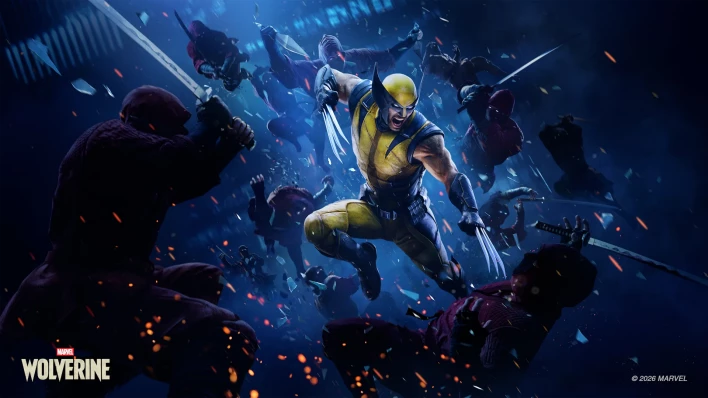
Later in the game, you also fight The Hand from Marvel Comics. They can pressure Logan by swarming him five or six at a time. Players need to adapt their parrying and dodging strategies, or choose to eliminate leaders who direct surrounding enemies first.
If you want to focus on crowd control, you can use tornado attacks, and personally, I also love a kick technique that pushes a single enemy far back.
Additionally, early in the game, Trask technology called 'inhibitors' is introduced. These are devices that suppress mutant abilities, neutralizing Logan's healing factor within their zone. Because the healing ability you normally take for granted disappears, players have to approach combat in an entirely different way.
Looking back, we haven't heard as much about why the development team chose Wolverine—Logan specifically—as the protagonist out of so many Marvel characters. Among all the possibilities, why did you decide to make Wolverine the lead of your game?
" That's a great question, and there are a few reasons. First off, Wolverine is such a beloved Marvel character. If you ask people to name a few Marvel characters, Wolverine is very likely one of the first that comes to mind. Everyone has memories of Wolverine—whether from comic books, TV, or cartoons they watched in their childhood.
Even though people might feel they know Logan well, in our game they can delve deeper into his background, his motivations, and the various figures in his life.
Also, Insomniac has always loved underdog stories about stepping up for those who can't fight for themselves. Peter and Miles are superheroes who save the city and help people as Spider-Man.
Logan, on the other hand, doesn't call himself a hero. He isn't particularly thrilled about being one either. Yet deep down inside, he feels he must fight for mutants who can't protect themselves. He doesn't want to be called a hero, but he has a sense of duty to do what's right.
Underneath that rough exterior with claws lies a strong emotional core. He was a fantastic character for crafting the kind of story Insomniac loves to tell.

'Essex' appearing in the game is a name that alone causes fans to be suspicious from the start. Was it your intention to make fans doubt his motives throughout the game? When writing his overall narrative, how enjoyable was the process of playing off fans' prior knowledge?
" Right from the beginning, we planned for Essex to play a major role in the game.
One of the major themes in this story is the mystery surrounding Logan's past. Logan has lost much of his memory, and Essex is connected to those memories in some way. Exactly how they're connected is a spoiler, so I can't discuss it right now.
Fans who know Essex will be curious where we take this character. At the same time, we crafted it so that anyone who doesn't know who Essex is can naturally discover his true identity as they follow the story.
In the game, Nathaniel Essex organized Team X to protect mutants who are under attack. In this world, some people don't even know mutants exist, while factions like the Reavers and Trask target mutants. Logan was also a member of Team X.
By the time the game begins, there is already history between Logan and Essex. Logan left Team X for about three years and returns to the organization at the start of the story. I hope players will check out how the relationship between the two unfolds through playing the game.
Logan and Jean Grey are also characters with long-established images. However, this title removes the traditional X-Men dynamic and introduces Jean at a point where she does not yet fully understand her powers. How did this change open up new possibilities for exploring Logan as a character?
" We've maintained a fantastic partnership with Marvel Games starting from 'Marvel's Spider-Man' up to now. Thanks to that, we were able to discuss with iconic characters how far we could push and pull their stories.
For instance, what if Logan and Jean met much earlier? How would that alter their relationship? And how would it impact Logan's journey? It starts from questions like those.
Of course, we tried to preserve the essential aspects of Jean that we all know and love. At the same time, we pondered what parts to change and evolve to create a fresh and intriguing story for players.
I think some people might be surprised by where Logan and Jean's relationship goes. It's not a dynamic where you'd think, 'Oh, this is the story I read in a comic book three years ago.' Although they are well-known characters, we hope you view it as Insomniac forging our own path for how far their relationship can go.
As mentioned earlier, The Hand appears as one of the main hostile factions in this title. With The Hand also recently appearing in Spider-Man films, it made me wonder if this was a homage. Did the projects influence each other?
" Deciding to include The Hand in our game was something we settled on years ago. From early development, Japan was an iconic location deeply connected to Logan's background, and a region we definitely wanted to explore in the game. We thought The Hand was a hostile faction that fit right into that setting.
The Hand appearing in other media around the same time—would you call it a happy coincidence? In fact, I think it's great that this character and faction are introduced across multiple media.
Some people might see The Hand in a movie and wonder how our game interprets them. It allows more people to see how different creators view the same Marvel characters. Ultimately, it also shows how important of a faction The Hand is in the Marvel universe.
What was particularly striking after playing through the game was that Team X didn't feel like a typical superhero team. What aspect of the relationship between Logan and his teammates was especially fun to develop?
" When creating Team X, pairing Mystique and Sabretooth alongside Logan was truly interesting.
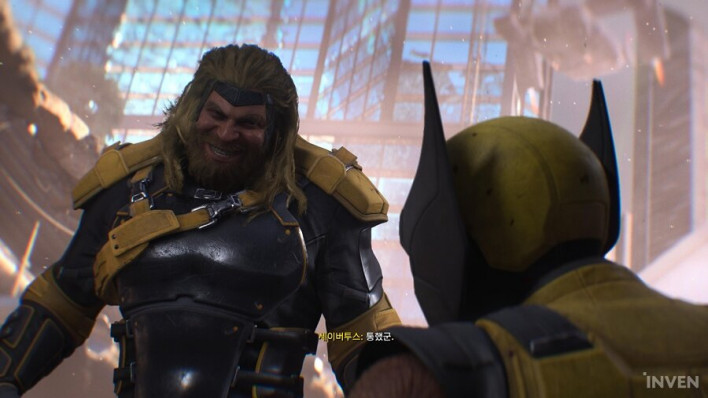
Sabretooth is closer to someone who enjoys fighting and killing for its own sake. In combat situations, he acts like a violent force that smashes through everything.
Mystique, on the other hand, likes being in Team X. As a mutant, she often has to hide her true self, but in Team X she doesn't need to hide. Instead, she can use her mutant abilities to help other mutants and contribute to the team.
And caught between them is Logan. Mystique and Sabretooth have different ways of acting to protect mutants, and Logan is constantly influenced between the two.
Having these distinct characters pull and push different sides of Logan allowed us to highlight his emotions even more strongly. Going into specifics would be a spoiler, but there's a scene where the three of them plan something together. Each of the three characters takes in the situation in completely different ways, and it clearly shows how Logan reacts to each of them.
'Lost memories' are an indispensable element of Wolverine as a character. Being able to uncover memories while directly playing as Logan allows for expressions different from films or comics. When utilizing Logan as an 'unreliable narrator' in an interactive medium, what kind of expressions were possible that aren't possible in other media?
" What was fun about handling Logan's lost memories is that the player and Logan go on the exact same journey together.
It isn't built on the premise of countless experiences and memories that only Logan knows while the player remains in the dark. The player discovers memories of the past right alongside Logan and experiences firsthand how he reacts when he recalls them.
Optional content deals with this aspect as well. You can find whiskey bottles scattered around, and there is optional content called 'Nightmare Trials'. Through these, you can explore memories across various points in Logan's life, including the 1800s.
While you don't directly play through those eras—instead exploring those memories while listening to Logan's narration—what makes it special is that players actively participate in uncovering the mystery rather than passively receiving the story by watching a movie or TV show.
Studying Wolverine and bringing him to life in a game over a long period must lead to discovering new charm you hadn't considered before. During development, were there moments where you felt, "This feels much more like Wolverine than we thought," or conversely, aspects where your prior perception of Wolverine changed?
" I'll speak from my personal perspective rather than for the entire team.
When we first started development on 'Marvel's Wolverine,' I thought there would be plenty of claw sequences, action, and violence. While those are certainly present, I was surprised during development by how many human moments we were able to capture beyond expectations.
If you only looked at screenshots, you might think it's a game where you just do claw action for dozens of hours. But in reality, there are quiet moments, and through them, you get to learn about Logan as a human being. It shows how he views and reacts to a world where mutants are under attack.
Developing the game over the past few years taught me a tremendous amount about Wolverine and his motivations. And unexpectedly, Logan can be quite humorous when he wants to be. He doesn't go around cracking grand jokes all the time, but when the situation fits, he can be pretty funny.
What was most critical in making players feel, 'I am controlling Wolverine right now'?
" Delivering the fantasy of becoming Wolverine when holding the controller was paramount. Ultimately, combat using claws always had to feel fantastic.
Of course, Wolverine as a character isn't complete merely by swinging claws and acting aggressive. But from a player's perspective, getting the feel of claw combat right was more important than anything.
At the same time, we had to remain faithful to the atmosphere surrounding Wolverine. People know that Logan lives in a brutal world alongside his claws. We also wanted to craft a more mature story, and violence is one piece of that narrative puzzle.
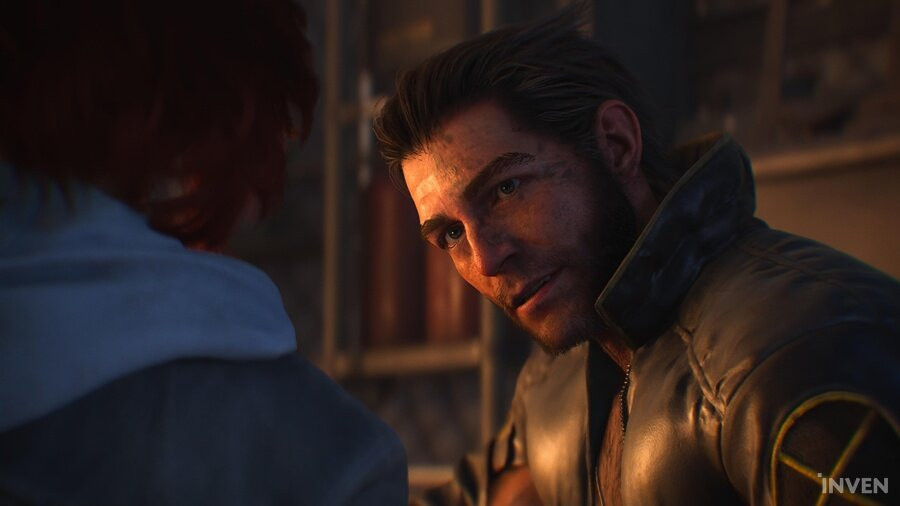
The team previously mentioned that the adamantium skeleton gives Logan tremendous physical weight. Yet when actually playing, the sense of speed in combat was just as impressive as that weight. How did you balance weight and responsiveness?
" That part was tweaked many times over several years. Very early versions of Logan were much nimbler than he is now. There was even a period where he moved almost like Spider-Man. But we couldn't just create Spider-Man with claws attached and convince players he was Logan carrying an adamantium skeleton weighing over 300 pounds.
Through extensive playtesting and feedback, we found a balance. Logan currently moves noticeably heavier than Spider-Man. For instance, if Spider-Man leaps onto a tree branch, he lands with extreme agility, but when Logan lands on a branch, the branch itself shakes.
We also made you feel that weight through audio in those moments. When jumping or landing, you feel the weight, and at the same time, you can hear it.
We also refined the controller's haptics and rumble multiple times. You can physically feel the sensation of swinging punches or the impact of jumping and landing. Adding a closer camera perspective to that completed the picture.
As a result, I believe we achieved a balance where controls respond quickly enough while delivering the distinct feel of a heavier character compared to Spider-Man.
If Marvel's Spider-Man had web-shooters and web-swinging, what did you see as the iconic element defining the gameplay experience of 'Marvel's Wolverine'?
" First and foremost, fighting one-on-one with a single enemy using claws had to feel truly great.
How the claws react to enemies and how they interact with the environment was also crucial. We checked whether blood splattered appropriately across the battlefield and whether surrounding objects broke properly. Audio, visuals, animations, and the tactile feedback from the controller all had to come together into one cohesive whole to realize the Wolverine fantasy.
No matter where you travel in the story, that core foundation always had to function flawlessly. We put immense effort into ensuring that every single moment you use the claws feels incredible.