On the 19th, at its annual developer conference, Google I/O 2026, Google officially unveiled 'Gemini 3.5 Flash,' the first core lineup in its next-generation artificial intelligence (AI) model series, 'Gemini 3.5.'
Google stated that despite being a lightweight model, the new release is characterized by its ability to go beyond simple information retrieval and text generation, maximizing advanced agent-based workflows and coding computational performance.
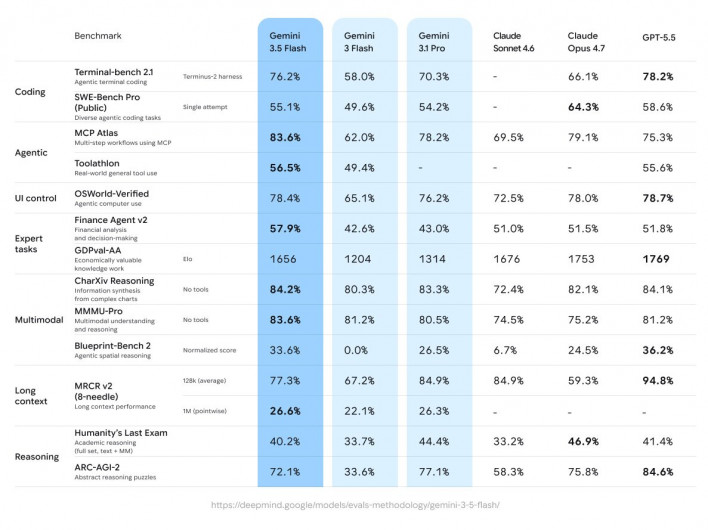
'Gemini 3.5 Flash' represents a significant technological leap, vastly outperforming Google's existing high-performance 'Gemini 3.1 Pro' lineup. In coding and multi-step agent performance benchmarks released by Google, 'Gemini 3.5 Flash' demonstrated intelligence that surpassed most of its predecessors. Notably, its data computational efficiency has been maximized, achieving data processing speeds up to four times faster than other state-of-the-art AI models on the market in terms of output tokens, effectively overwhelming existing market paradigms in speed and efficiency.
The most notable core competency highlighted in this announcement is the advancement of agent capabilities, which allow the model to make its own judgments and take action in complex environments. According to Google, 'Gemini 3.5 Flash' is designed to move beyond simple Q&A prompts, enabling it to independently perform multi-step tasks that require long-term reasoning and logical thinking without human intervention.
In conjunction with this, Google introduced 'Gemini Spark,' a personal AI agent that actively assists with users' daily digital tasks. 'Gemini Spark' operates 24/7 to maximize productivity by handling tedious and repetitive tasks such as analyzing email content, summarizing meeting minutes, and automating personal schedules. Google plans to offer the service first as a beta version to Ultra plan subscribers in the United States.
Furthermore, Google signaled the start of a full-scale expansion of its AI agent-centric ecosystem by unveiling a series of new platforms and development tools for developers and researchers. These include 'CoScientist,' a multi-agent system that can independently formulate hypotheses and verify experimental data during scientific research, and 'Anti-Gravity,' an agent-specific development tool that allows general developers to freely design complex multi-step tasks and build high-performance agents.
However, as a trade-off for the dramatic improvements in technical intelligence and processing speed, it has been confirmed that the actual usage costs for agents and API environments have risen slightly compared to previous versions, drawing attention to how its price competitiveness will fare in the market.
In his keynote address, Google CEO Sundar Pichai expressed confidence in the mass adoption of the agent-centric era, stating, "The new model we unveiled was designed from the ground up to help users seamlessly execute complex, agent-based workflows in business environments without friction."
Google is currently conducting internal testing for 'Gemini 3.5 Pro,' its top-tier model specialized for large-scale reasoning and specialized computation, and plans to finalize a formal release schedule once performance verification is complete.
Detailed technical specifications, various benchmark data metrics, and comprehensive guides for the new agent development tools can be found on the official Google Korea Newsroom and the official Google I/O 2026 website.