The film 'The Backrooms' is an intriguing case study in how far a creepypasta born from an internet community can expand. Even more surprising is that the film was directed by the very creator who popularized the 'Backrooms' mythos. The 'Backrooms' refers to a mysterious, unidentified space that people are said to reach after slipping through the cracks of reality.
Endless yellow wallpaper, the buzzing of fluorescent lights, and a labyrinthine structure with no exits or destinations. While it has now established itself as one of the internet's definitive urban legends, the person who propelled it to explosive popularity is Kane Parsons, a young creator known online as 'Kane Pixels.'
Since his teens, he has used the free 3D software Blender to create short films that garnered tens of millions of views, gradually building his own unique world over several years. The 'Backrooms' that emerged from this has spread beyond YouTube into games and various derivative works, now cementing its status as a cultural phenomenon.
The theater atmosphere proves this. From groups of students to young children accompanied by their parents, the audience is noticeably younger than expected. For a generation that grew up consuming internet memes and creepypastas, 'The Backrooms' is already a familiar name.
Surprisingly, the film begins with the standard grammar of horror cinema. It follows the perspective of a researcher isolated in the Backrooms to imprint the threat of the space before launching into the main narrative. At the center are Clark (Chiwetel Ejiofor), a furniture store manager, and his therapist, Mary (Renate Reinsve).
Clark is a man crushed by the weight of a failed life. His dreams of being an architect have vanished, leaving him with nothing but a customerless furniture store and an alcohol dependency. One day, he discovers a passage in the store's basement that leads to a strange space, and his life begins to drift in an entirely different direction.
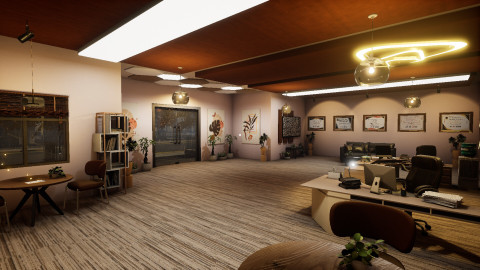
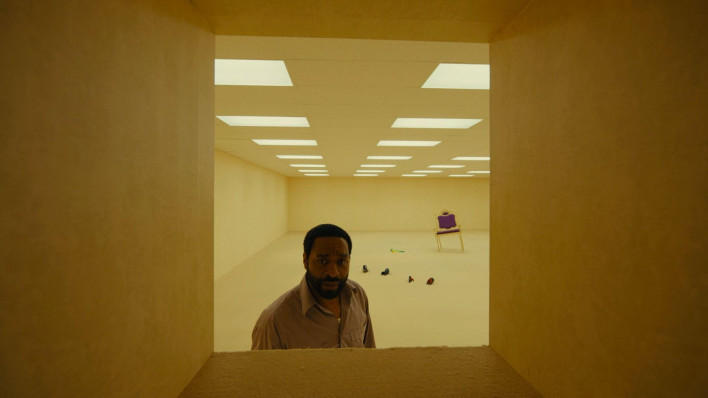
The depiction of the Backrooms themselves is the film's greatest strength. The endless yellow corridors and rooms, the unpleasantly persistent hum of fluorescent lights, and the structurally inexplicable layout instill a subtle yet constant sense of anxiety in the audience. It is not merely dark or gory; the source of the horror lies in the uncanny feeling that a familiar space has been implemented incorrectly.
What is particularly interesting is that the film attempts an approach different from traditional locked-room horror. While the terror in films like 'Saw' or 'Cube' stems from inescapable confinement, the Backrooms create fear through their excessive vastness. Clark can move freely between reality and the Backrooms, and the entrance never disappears. The problem is that the space is so immense that it feels as though one could never reach anywhere. It is not the confinement, but the infinity itself that becomes the horror.
However, the feature film format seems to have necessitated some compromises with the free-roaming imagination of internet creepypasta. After the midpoint, as a mysterious monster begins to appear in earnest, the story follows more conventional horror tropes. Characters who enter the Backrooms to help Clark find themselves in danger one by one, leading to a sequence of fleeing from an unknown entity.
In this process, the unique quality of 'The Backrooms' is somewhat diluted. The greatest appeal of the Backrooms as an internet legend lay in the inexplicable nature of the space itself, but as the film progresses into its second half, it takes on the form of a familiar survival horror movie.
Of course, the monster (entity) is an important element in the original work as well. However, the chase sequences with the monster in the film are not significantly different from what we have seen in many other movies—scenes of characters being grabbed by the ankle and dragged away, or isolating themselves against an unknown threat. These are all moments where the standard grammar of feature-length cinema is felt.
The narrative involving Mary reveals the film's philosophical side. The movie depicts the Backrooms not just as a habitat for monsters, but as a place where memories are physically manifested. The space is generated and expanded based on human memory, but because memory itself is imperfect, the space is also distorted.
The scenes where a house connected to Mary's trauma is repeatedly manifested within the Backrooms are particularly impressive. At first, it maintains its complete form, but it gradually shrinks and twists until the original shape is unrecognizable. These scenes, where familiarity and strangeness coexist, are the moments where the film shines most 'Backrooms-like.'
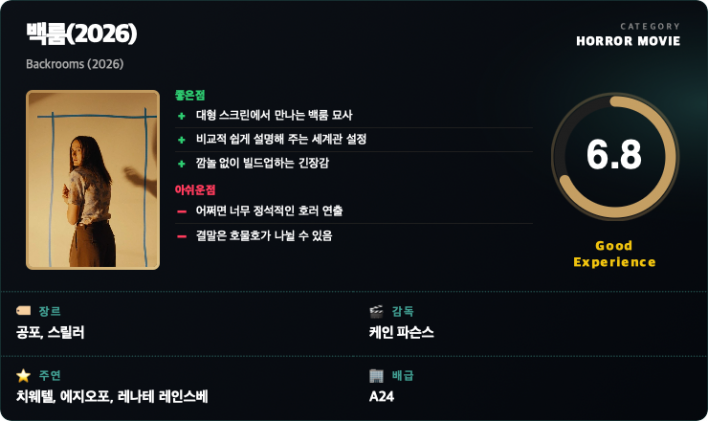
Ultimately, 'The Backrooms' is a well-made film. With distribution by A24, support from James Wan's production company Atomic Monster, and the capability of a young director adapting his own world, the technical execution is sufficiently impressive.
However, it is not a film that is accessible to every viewer. As it assumes a world-building accumulated over years on YouTube and the internet, viewers who have not encountered the original creepypasta or Kane Pixels' videos may find it difficult to understand the story's intent and conclusion. If you are expecting clear explanations and neat answers, you are likely to be disappointed.
From the start, the very existence of the Backrooms began as a creepypasta that rejects logic and causality. Therefore, the film also focuses on leaving behind a sense of anxiety and the unknown rather than resolving every mystery. For some, it will be a fascinating experience, but for others, it may feel like a frustrating, unfinished story.
Nevertheless, the fact that we can encounter an urban legend that defines the internet age on a massive theater screen makes 'The Backrooms' a meaningful work. At the very least, one thing is certain: this film knows better how to make the audience feel uncomfortable for a long time than how to simply startle them.

Sort by:
Comments :0