
The term "mechanical" when describing a process usually carries two connotations. One is that a task is performed accurately and without error according to a goal; the other is that it is done without a human touch, following a rigid framework simply to get the job done.
This is exactly the case with 'Halo: Campaign Evolved,' the remake of 'Halo: Combat Evolved.' While it uses Unreal Engine 5 to bring the campaign up to modern standards, that is where the effort ends. It leaves one wondering whether there is any real heart or attention to detail behind it.

Master Chief reborn in Unreal Engine 5


The one area where Halo: Campaign Evolved truly succeeds—and the reason I would confidently recommend playing it—is its visuals, which have been completely transformed thanks to Unreal Engine 5.
While Halo is undoubtedly a monumental IP in FPS history, it is a fact that its visuals had become dated for modern audiences accustomed to rapid technological advancements. This is hardly surprising, given that the previous remaster, Halo: Combat Evolved Anniversary, was released back in 2011.
In contrast, Halo: Campaign Evolved has reconstructed everything from cutscenes to in-game implementation using Unreal Engine 5, allowing both long-time fans and newcomers to experience Master Chief’s journey with high-quality graphics. The addition of lighting effects—which were non-existent in the original—and significantly improved textures not only please the eye but also greatly enhance immersion.

Same Battlefield, Modernized Combat Experience


Along with the visual leap, the modernized combat experience is another strength of Halo: Campaign Evolved. While the battlefields remain the same, the updated combat mechanics offer a fresh way to play.
Most notably, the health system has been changed from reliance on health packs to automatic regeneration. In the original, you had to find health packs to recover, but in Campaign Evolved, you can recover by taking cover, which significantly reduces the pressure.
Furthermore, the addition of a sprint mechanic allows for a true run-and-gun style. This makes it possible to quickly close the distance to the Covenant for close-range fire, or conversely, to sprint away from enemy grenades and onslaughts, allowing for much faster-paced combat than in the original.
The addition of new weapons also enriches the combat experience. As any Halo veteran knows, it is rare to stick with UNSC weapons for an entire mission. While UNSC weapons are straightforward, Covenant weapons often feature unique gimmicks that make them more powerful. Adding several new weapons not found in the original broadens the tactical choices, which was satisfying as it reduced the feeling of using the same gear repeatedly.
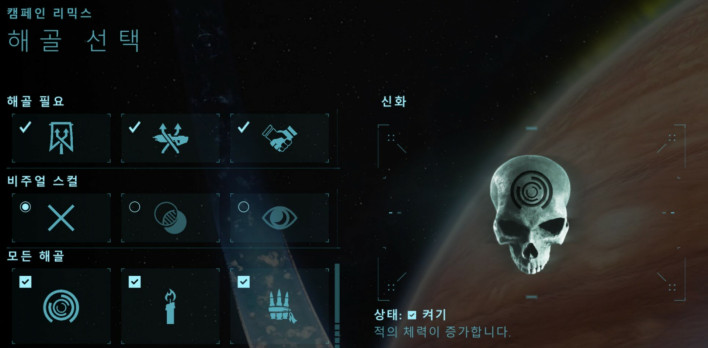
The 'Skull' system, which adds mission variety and increases replay value, has also returned in an enhanced form. Activating Skulls introduces various gimmicks, such as increasing Covenant health or causing Grunts to explode upon elimination, allowing players to experience the campaign in new ways, whether through hardcore combat or just for fun.
Ambiguous Prequel Missions and Disappointing Respect for the Classics

However, as mentioned in the introduction, there are shortcomings. The three prequel missions, introduced in lieu of multiplayer, feel lacking in narrative execution. While the intent was to depict the conflict and eventual mutual respect between the ODST squad and the Spartan, the characters' attitudes often feel forced.
For instance, even when Williams, the leader of the ODST squad, repeatedly insults Master Chief and Johnson, their responses feel lukewarm. Additionally, because the conflict has to be resolved within a small number of missions, the latter half feels rushed. It would have been better to either omit the prequel missions entirely or increase their count to allow for better character development for Williams.

While the modernization of the classic is well-executed, there are areas where more attention to lore would have been appreciated. A prime example is the lore regarding Master Chief’s suit. The Mark V suit, equipped with energy shields, was only deployed in combat starting in 2552. However, the prequel missions take place a year earlier, yet Master Chief’s suit still features energy shields during gameplay.
Casual players might not notice, but for fans of the Halo series, this is a disappointing oversight that raises questions. While one could speculate that it is an 'upgraded model' or try to analyze it based on existing lore, the lack of a clear explanation from the developers leaves one wondering if this was due to indifference or mere convenience.
I also felt that 'gimmick' plays from the original, such as map-breaking, should have been preserved as a nod to nostalgia rather than removed. Many remakes choose to keep famous bug-based exploits as 'Easter eggs' even when they could be fixed. Developers usually take this approach because they know these bugs have become part of the game's identity and hold sentimental value for many, but Halo chose the opposite path.
Trilogy Remake Hinted: If You’re New to Halo, Now Is the Time.

While it is not without its flaws, Halo: Campaign Evolved is a solid choice for those who want to experience the stature of 'Master Chief,' one of the most iconic characters in gaming history, or for those looking for a space opera armed with modern-day graphics.
With Sergeant Johnson’s line in the ending, "See you in the sequel," a remake of the trilogy seems likely. I sincerely hope that future remakes will add more heart and attention to detail rather than just being mechanical remakes.

- Greatly improved visuals thanks to Unreal Engine 5
- Modernized combat experience befitting a remake
- High replayability with the Skull system and co-op
- Narratively lacking prequel missions
- Disappointing lack of attention to original details
Review Platform: PC (Launch Version)

Sort by:
Comments :0