When playing 'Dark Souls'-style games, one often encounters a strange sense of dissonance. The bosses filling the screen are massive, flashy, and armed with overwhelming power, naturally prompting the thought, "How am I supposed to fight that?" In contrast, my character facing these monstrous entities feels pitifully small. They are fragile beings who can only look in one of eight directions, spending the entire time rolling, crawling, and scrubbing the floor. Even after finally defeating a boss, my character still looks weak.
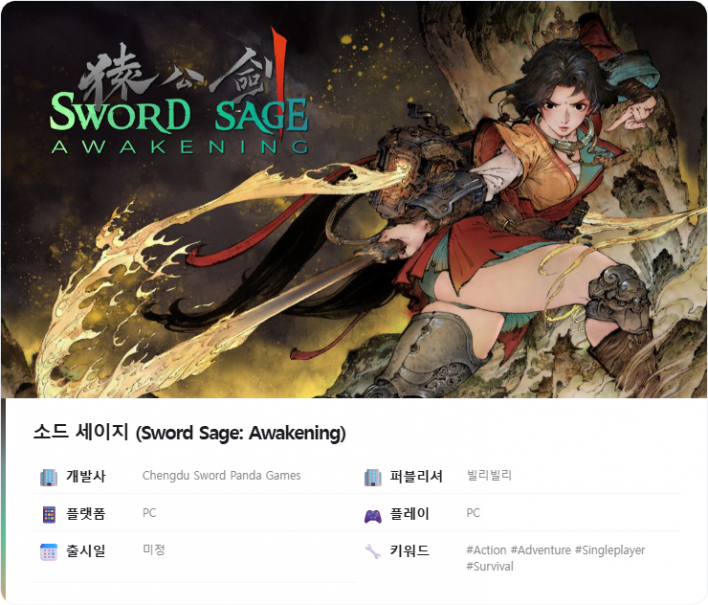
This is the result of maximizing the boss' power at the expense of creating a jarring disconnect with the player character. Why must only the bosses be large and flashy? Can't the protagonist, who faces these massive foes, also look like a formidable master? A new title has arrived that provides a clear answer to this fundamental question. It is 'Sword Sage: Awakening' (hereinafter 'Sword Sage'), an ambitious Chinese title that combines the heavy tension of a Soulslike with the flashy combat of 'Sifu'.
'Sword Sage', currently under development by Chengdu Zenmo Xiongwo Network, is an action RPG that captures the essence of Wuxia. The studio is led by a 25-person team of veteran developers who joined forces in January 2022 after working at major global game companies like Ubisoft Chengdu, Ubisoft Shanghai, and Virtuos. The game boldly excludes the 'roll' that has become a symbol of the Soulslike genre. Instead, it establishes a distinct identity by prioritizing a unique combat system focused on deflecting and countering enemy strikes.
I wondered if gamers accustomed to relying on evasion and rolling would be able to adapt to the one-beat timing of 'deflection'. With this curiosity, I played the demo build for over three hours at the Bilibili First Look event. To start with the conclusion: the immersion was so intense that the three hours flew by before I even realized it.
A master does not roll. They only deflect
There is no rolling in this game. Instead, deflection fills that role. When an enemy strikes, you deflect your body in that direction to dodge and immediately transition into a counterattack. This system, named 'Piqing-Ruhong' (避青入紅), uses actual terminology from traditional Chinese swordsmanship. 'Piqing' (避青) refers to avoiding the cold, sharp blade of an opponent, while 'Ruhong' (入红) describes the master's movement of dodging and counterattacking in a single motion to draw the opponent's blood.
Deflection isn't just about pressing a button. Sometimes, large Chinese characters appear indicating the enemy's attack direction (upper, middle, or lower), which is a signal that you must dodge in that specific direction. You must press the evasion button while simultaneously inputting the correct directional key: up for upper, left/right for middle, and down for lower. A correct input results in a successful dodge, while an incorrect command leads to failure. Conversely, attacks without directional indicators can be deflected in any direction. While the indicators are large and easy to read, it becomes quite challenging to match the directions in quick succession when multiple characters appear at once.
There is also a block. Since you only need to hold the button without worrying about timing, it is a safer option than deflection when reading the beat is difficult. The problem is that the sword's durability drops rapidly while blocking. You cannot just hold your ground indefinitely. Furthermore, the benefits of deflecting are so significant that even after failing once or twice, your hands naturally gravitate toward deflection.






To start with the conclusion, the "feel" of the deflection is excellent. The window is generous, so you don't have to time it perfectly to succeed. Every time you deflect, long afterimages follow the trajectory of the character and the sword; thanks to this effect, the sensation that "I am dodging correctly" is transmitted to your fingertips. It's a visual style that makes you look like you're playing well.
Repeated deflections rapidly deplete the enemy's stamina. When they are completely exhausted, a marker appears over the monster, and they collapse. If you get close and press the attack button, a critical hit is triggered, landing a one-sided blow like a grapple. This rhythm of deflecting, depleting, and countering was the most enjoyable part of the three hours. The 'feel' of 'Sifu', which the developers cited as a benchmark, naturally came to mind.
A unique tactic for managing sword life

The second feature of this game is the sword durability system. In this game, weapon durability decreases whether you are attacking or blocking. Once durability is fully depleted, your attacks deal almost no damage, and defense becomes impossible. Therefore, periodically switching weapons is fundamental to survival. Unlike existing Soulslike games where you primarily monitor your health gauge, here you must also track the lifespan of your blade. As there is one more resource to manage, the difficulty of combat management feels slightly elevated.
I experienced two types of weapons in the demo. The sword was agile and fast but had limited durability, while the two-handed sword was slow and heavy but had plenty of durability. Because the weapon characteristics are polar opposites, your combat strategy changes entirely depending on the blade in your hand. The rate of durability consumption varied depending on the opponent. While there is little need to switch weapons when clearing regular monsters, the situation is completely different in boss battles where consecutive attacks pour down like a waterfall. As attacks, blocks, and deflections cross over without rest, my hands became busy switching weapons.
The switching system itself is smooth. It transitions instantly with a single button press, with only a short delay of about 0.5 seconds. Weapons with depleted durability recover naturally over time when sheathed, so the rhythm of alternating between two weapons settles in naturally. Although the combat flow is briefly interrupted by weapon switching, it is not an unpleasant disruption. Rather, it is more like a clever device that intentionally raises the difficulty through constraints.
It would have been disappointing if it were just a simple hassle, but sword switching acts as an element that expands the breadth of tactics. This is because each weapon has different special skills. Like in 'Elden Ring', changing weapons changes the clear method itself. If you fight by switching in real-time, you can also perform a playstyle that alternates between the special skills of two weapons. From blades that poison enemies to blades that shoot sword energy like a projectile, and even blades equipped with automatic counter functions, each has a distinct feel, making it fun to choose weapons according to the situation. However, regarding the Five Elements attributes assigned to each weapon, it was difficult to clearly feel the effect that a specific attribute is effective against a specific enemy in practice. This part seems to need more refinement in the official version.
When a master meets a master

This is the highlight boss battle of the demo. The boss that left a strong impression was 'White Gibbon Sage', who graced the end of the demo. With a tall, human-like appearance and dressed in Taoist robes, he is an opponent who exudes the dignity of a master at a glance. In reality, he was a formidable foe who utilized sophisticated patterns. He launched offensives by mixing several patterns consistently, but there was no impression that the difficulty was unreasonably high for a final boss. Instead, the immersion provided by the battle was overwhelming. As I crossed swords with a human-like opponent, attacks and deflections went back and forth without interruption, and white sword light and red sword energy cut through the screen as the exchange continued. It was so flashy that it felt like watching a scene from a well-crafted Wuxia movie, and the visual pleasure alone was quite a treat to watch.
Here, the game's greatest strength becomes clear. While the image of fighting a giant monster with a single sword often creates awkwardness in action games, the climax of 'Sword Sage' comes from scenes where people exchange blows with swords. Since swordsmanship was originally developed from duels between humans, the exchange with a human-like boss meshes most convincingly. The moment the deflection system shines brightest is also during this duel.

Systems outside of combat are also well-equipped. Character growth takes an intuitive structure similar to 'Elden Ring', where you directly invest in stats, and the variety of talismans was particularly diverse. From those that assist with health to those that increase sword durability and those that extend the deflection window, the effects are colorfully subdivided, making it definitely fun to build according to user preference. There are also daggers to throw for harassment. While not a primary means of attack, they were useful during combat as they could apply a debuff upon impact.
However, as is usually the case with such action games, the key to deciding the outcome ultimately depends not on buffs or debuffs, but on how perfectly the user deflects and counters the enemy's offensive. Several types of buff potions were provided, but the perceived effect in actual combat was not very significant.
In the case of recovery potions, the structure requires an extra step. Unlike 'Elden Ring', where they are automatically recharged when resting at a site of grace, you must purchase herbs to craft potions, and the money to buy those herbs must be earned by hunting monsters. While this can be seen as an advantage of organically connecting the in-game economy and recovery resources, for users who want to focus solely on combat, there is room for the added layer of repetitive work to feel slightly cumbersome.
The atmosphere of a bright Wuxia movie, looking forward to the official release

The overall atmosphere of the work clearly differs from the common dark fantasy-based Soulslike. Instead of being dark and heavy, it is filled with the atmosphere of a bright and colorful Wuxia movie. The dialogue and background of the characters have the distinct color of traditional Chinese Wuxia. The protagonist is a young female swordswoman who has just entered the martial arts world and is growing up while learning martial arts from her master and seniors. With a lively yet solid physique and a bright expression, a vibrant energy permeates the entire work. However, in the case of voice dubbing, the tone is somewhat high and light, so it seems that opinions will be divided depending on the user.
Empty spaces still under development were noticeable in various parts of the game, such as boss battle direction. It is true that the first encounter felt somewhat plain due to the absence of cinematic direction that should have raised the tension to its peak when facing a powerful boss. However, as this is a part that the developers have specified is in the production process, it is expected to be neatly supplemented in the official version. In fact, the quality of the boss battle where the completed direction is applied proves this.
In terms of technical perfection, there was almost nothing to criticize. During the long demo time of over 3 hours, there were no frame drops or annoying bugs at all. The UI was intuitive without any clutter, and adaptation to the control system happened quickly. Despite being a demo build, the stability of the build is at a very solid level.
Even though it was a long play time of over 3 hours, I was able to be fully immersed without a moment of boredom. For gamers who like the tight tension unique to the Soulslike genre but are burdened by unreasonable difficulty, or for users who are attracted to flashy sword action, this is a title that must be watched. The perfection of the 'feel' of deflecting and countering enemy offensives like in 'Sifu' is particularly outstanding. The unique variable of sword durability, the generous evasion window, and the high-density sword-fighting exchanges with human-like bosses make me look forward to how much more refined it will be in the official release version.


Sort by:
Comments :0