On the 9th, the 62nd Civil Division of the Seoul Central District Court (Presiding Judge Lee Hyun-seok) dismissed all claims in a copyright infringement lawsuit filed by NC against Kakao Games and RedLab Games.
While the court acknowledged that substantially similar expressions exist between 'ROM' and 'Lineage W,' it ruled that copyright infringement had not occurred. The court reasoned that the quantitative and qualitative weight of the identified similarities within the game as a whole was not significant.
When the verdict was first announced, only the conclusion was reported, leaving the court's legal reasoning for the dismissal unknown.
According to the written judgment reviewed on the 31st, NC had argued that five components—the system for changing character appearances, the summon system, the equipment enhancement system, the item collection system, the PVP system, and various visual expressions—along with their organic combination, constituted both a copyrighted work and a protected achievement under the Unfair Competition Prevention Act.
The court examined each element individually, operating under the premise that parts corresponding to game rules fall under the realm of ideas and are not subject to copyright protection, even if they possess creativity.
The court recognized creativity in only four areas: the use of shield-shaped emblems to display the grade of transformation and summon cards; the visual effects for completing a collection using signature patterns; the signature patterns incorporating occult, alchemy, and magic circle elements; and the textures of old parchment and shop NPC imagery.
Most other elements were deemed to have already existed in prior games.
There was no dispute between the parties that the methods of dividing card grades into multiple tiers, fusing lower-grade cards to obtain higher-grade ones, and granting bonus stats for collecting specific cards had already been introduced in games released in 2019 and 2021.
The court determined that the enhancement structure—where success is guaranteed up to a certain level and equipment is destroyed upon failure at higher levels—and the classification of spellbooks date back to games released in the 1980s.
The screen layout, which divides the enhancement window into left and right sections, was also found to have been similarly adopted in various games since 2012.
The court also noted that the alignment system could be found in games from the 1970s and 1990s.
The argument that these components form a creative identity through their organic combination was also rejected. The court stated that the mere fact that game rules and other elements are combined to influence gameplay does not automatically imply creative individuality; such a combination must be distinct enough to differentiate it from other games to be recognized as creative.
The court explained that allowing users to selectively utilize systems based on their play style is a universal game rule, and that the structure linking enhancement grades to collections existed similarly in the codex system of a game released in 2006.
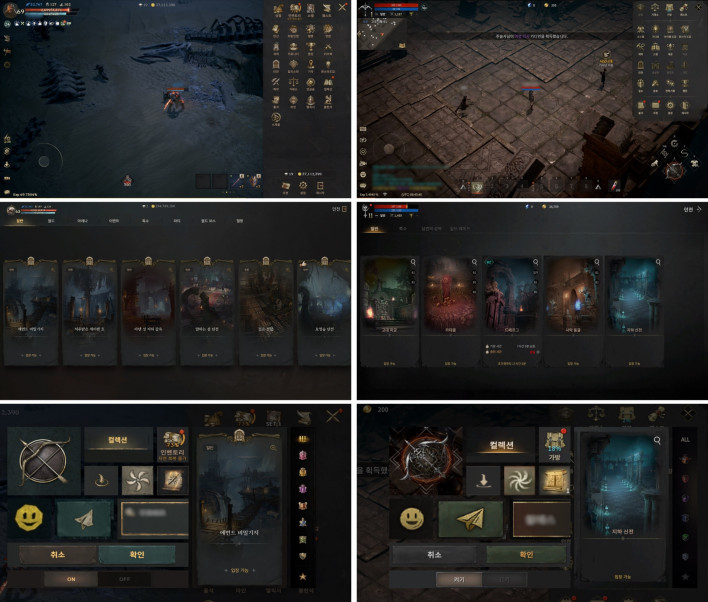
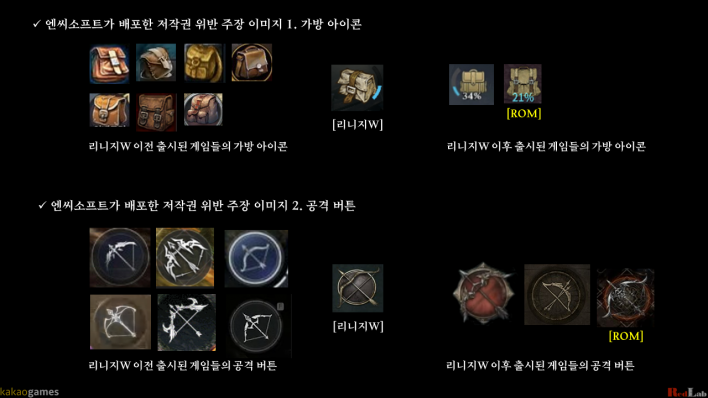
Substantial similarity was recognized in two of the areas where creativity was acknowledged. The court found that the costume and guardian systems in ROM use shield-shaped emblems of different colors and designs to indicate card grades, with differences limited only to minor details. Furthermore, it acknowledged that the shop NPC in ROM used expressions substantially similar to those in Lineage W, given the shared features of brown braided hair, a white frilled blouse, a T-shaped belt, and a basket containing spellbooks and potions.
However, the court judged that these elements—the grade display being only a small part of the system screen and the shop NPC being one of many—did not hold significant qualitative or quantitative weight within the entire game.
Conversely, it ruled that the parchment texture of the collection completion message and confirmation button could not be considered similar due to differences in the images, text, and shapes used.
The claim of misappropriation of achievements under the Unfair Competition Prevention Act was also dismissed. The court reasoned that recognizing the selection, modification, arrangement, and combination of elements already present in prior games as protected achievements would grant a monopoly over elements already in the public domain. It held that such combinations must reach a level where they possess significant reputation or customer-drawing power.
The court further noted that even if Lineage W and Lineage M possess more reputation or customer-drawing power than other games, it cannot be ruled out that this stems from other components, such as the clan system or the system for competing for castle lord positions, rather than the components at issue in this case.
Regarding unauthorized use, the court judged that there were significant differences between the two games. It pointed out that in Lineage W, using a card changes the character itself and cards cannot be traded, whereas in ROM, players use costume tablets limited by class, only the outfit changes, and the tablets can be traded like common items.
Citing data from the plaintiff, the court noted that more than half of Lineage W's revenue is linked to these systems, and it concluded that the differences in acquisition methods and tradability would significantly impact the time and resources invested by users.
Furthermore, based on differences in enhancement result effects and probability tables, the presence or absence of item attribute distinctions in collections, the difference between Lineage W's 3-tier alignment system and ROM's 5-tier system, and ROM-exclusive features like guardian mining and repetitive attacker detention, the court ruled it reasonable to conclude that the defendants borrowed and modified elements from prior games based on their own independent production intent.
The court also directly compared this case to the R2M case NC filed against Webzen. It stated that of the elements NC claimed were a creative combination in the R2M appeal, only the link between the enhancement system and the collection system exists in ROM, and thus the likelihood of users confusing the two games is relatively lower than in the R2M case.
The court denied NC's attempt to add core components of Lineage M as a separate work and achievement during the lawsuit, stating that the factual and legal composition differed from the original claim and thus lacked identity. It also rejected the argument that the creativity of a series should be judged based on the initial release, noting that the expression of Lineage M is distinct from that of Lineage W, which is a separate work.

Sort by:
Comments :0