'Mistbound,' a CCG developed by NC, published by Bilibili, and featuring world-building and IP oversight by ArenaNet, made an appearance at Bilibili World 2026. Some users might be surprised to see a NC-developed title at this event, as Bilibili World is primarily known as a subculture festival.
However, as Bilibili World has evolved into a comprehensive entertainment festival featuring major console titles and various indie games, it is not unusual for a game to be showcased through Bilibili, the publisher and organizer. The bigger concern was whether the game could wash away long-standing skepticism—even knowing that designer Baek Hak-jun, a former Hearthstone pro gamer known by the handle 'Kranich,' was involved in its development.
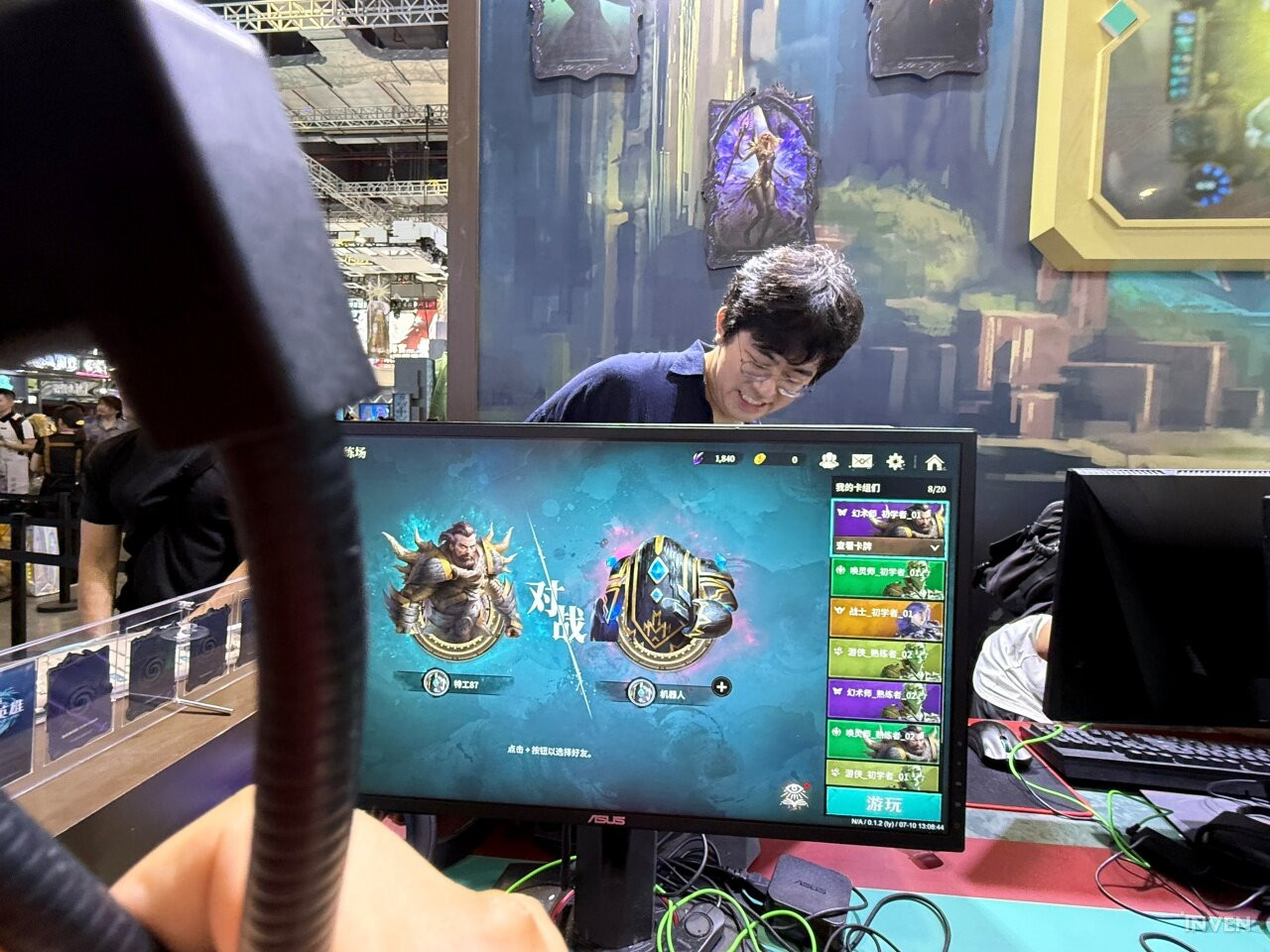
The Mistbound booth was located in the center of Hall 4.1H, where Bilibili-sponsored booths were gathered. Hall 4.1H is a section dedicated to package games and indie titles, including Persona 4 Revival, Total War: Warhammer 40K, and DAVE THE DIVER, alongside live-service games. Perhaps because of this, many users visited the Mistbound booth specifically to enjoy the CCG itself. With this in mind, the demo version skipped the usual tutorial and bot-match progression, jumping straight into bot matches and friendly duels.
While I have occasionally enjoyed TCGs like Hearthstone, Shadowverse, and Yu-Gi-Oh! Master Duel, I had never played a game that involved moving on a 5x3 grid like Mistbound. Just as I was about to get a feel for the game in a bot match, I caught the eye of designer Baek Hak-jun, who was observing user reactions. Once eye contact is made, the duel begins—it is the fate of every card gamer.
The first match was an absolute disaster. It wasn't just because my opponent was a former pro. In the card games I’ve played, the player character is fixed, and their class and available card types are static. Mistbound is different. Not only is the commander a unit on the field, but the commander's traits and the squad's special abilities are distinct. Having played mostly Hearthstone, I assumed the commander's traits were like Hero Powers, but I realized quite late that they are primarily used to trigger special effects of squad cards held in hand.


I started with the Warrior, which is said to be the most familiar to beginners. The Warrior squad generates a resource called 'Adrenaline' when the commander attacks, so the commander had to be aggressive. The 5x3 grid and the rule that cards on the field can move added another layer of complexity. As in other TCGs, you cannot place cards in the second row (the center) or the opponent's row. If the opponent moves a previously placed card into your territory, it reduces the number of cards you can play and your range of action. Therefore, it was crucial to block the opponent from crossing into your territory while strategically placing your own cards.
In the Warrior squad, the commander is responsible for seizing early momentum, but I played too cautiously, treating the commander like a King in chess—and that was my undoing. Designer Baek Hak-jun chose the Mesmer, a hybrid class from Guild Wars that utilizes illusions. In Mistbound, this is implemented by summoning special cards that last for one turn. The strategy was to endure that turn without losses, maintain my forces, and then counterattack once the illusions vanished. However, I grew timid as my field was dominated by illusions and my commander was attacked. By sacrificing other units to protect the commander, I lacked the late-game power to win. In the end, Baek's units occupied my base, and I was helplessly cornered, unable to play cards despite having the cost and cards available.

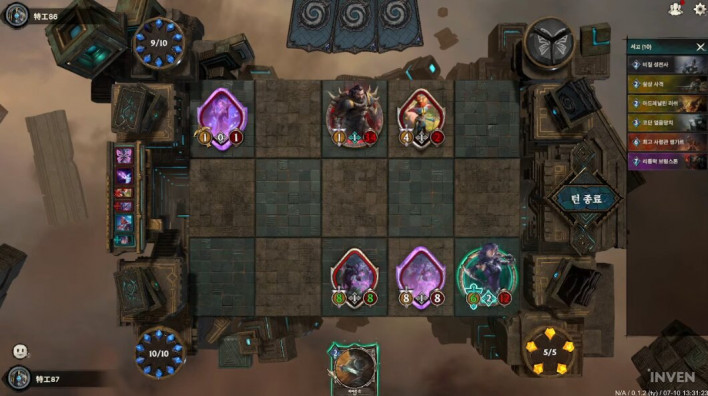
Knowing I couldn't beat a former pro, I decided to recover and learn the basics in a second game against a bot. Since I rarely use decks where the commander attacks directly, I chose the Necromancer squad. When a unit dies on the field, it drops 'Life Force,' and the commander's health recovers when a squad unit picks it up. For Necromancer units, special effects trigger whenever they or an ally pick up Life Force, allowing for strategic planning. It required the finesse of positioning units to be consumed and then placing allies to easily pick up the dropped Life Force.
The moment I realized this, I felt the true value of Mistbound. I understood why there were so many movement-related keywords in the Necromancer squad. It was designed to induce movement not just for combat, but to compete for Life Force. 'Powerful Olgos,' which deals 2 damage to a random enemy whenever an ally moves, is a prime example. It encourages allies to dodge and trade efficiently while moving actively to collect Life Force. Because of this, Powerful Olgos becomes a prime target, and protecting it feels similar to positioning pieces to defend a Rook or Bishop in chess.


I gradually applied pressure, occupied the opponent's territory, and left them with no room to resist. I finished the game with a spell card that destroys all Life Force on the field to deal double damage, followed by an all-out attack. While I had secured the field and landed a finisher, I wondered what options an opponent would have if they were pushed back. In the squad I played, if you lose control of the field, you don't just take direct damage—you can't even play units, leaving you with few options other than spells or special abilities, even if you have the cost.
Of course, in matches between players of similar skill, games might not spiral out of control so easily. However, for a first-time player, the Mistbound demo wasn't exactly easy. I sometimes forgot to move and ended my turn because of concepts unfamiliar to card games. This allowed the opponent to create space and apply pressure, which became a snowballing factor. I felt this firsthand in my first match against designer Baek Hak-jun, so I was hyper-aware of it in the bot match.
Still, these are extreme cases; usually, if you get hit without knowing what's happening, you just leave. Even fighting games, which were notorious for the 'you have to get hit to learn' mentality, now offer simplified commands and various modes to help players understand the game. Since CCGs are a genre primarily enjoyed by enthusiasts and don't stray too far from the basic grammar of the genre, you can adapt and find new fun after a few rounds.
The challenge for Mistbound moving forward will be how to naturally guide players through this flow and translate that interest into the world of Guild Wars. Despite the short demo, if they can successfully pique interest early on, they could quickly overcome this hurdle and gain momentum. As they announced plans for a CBT in the post-Bilibili World interview, I look forward to seeing them incorporate field feedback and present a more refined, compelling experience.

Sort by:
Comments :0