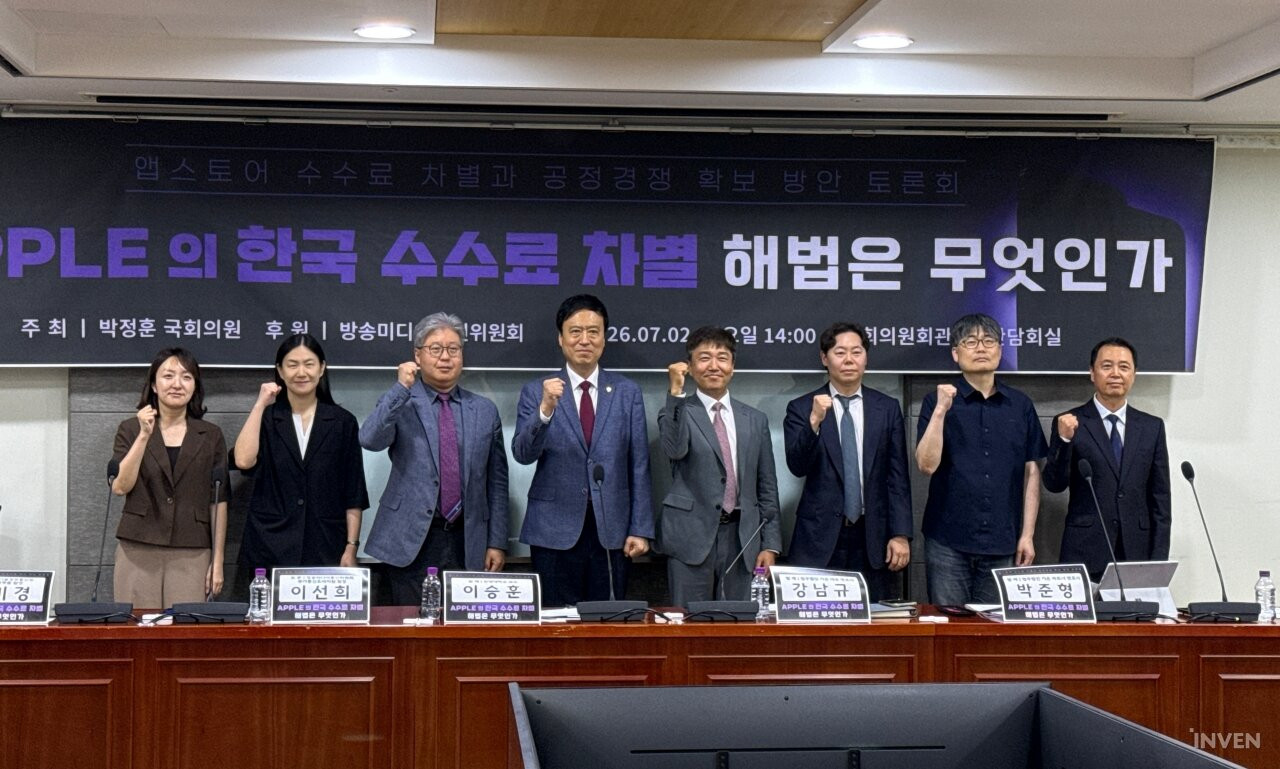
A seminar titled 'App Store Fee Discrimination and Measures to Ensure Fair Competition,' hosted by Representative Park Jeong-ha of the People Power Party (Songpa-gu A), was held on the 2nd at the National Assembly Members' Office Building. Sponsored by the Korea Communications Commission (KCC), the seminar was organized to address concerns that Apple continues to maintain in-app payment fees of up to 30% in Korea.
Professor Lee Seung-hoon of Anyang University served as moderator and lead presenter, followed by a second presentation from Managing Partner Kang Nam-gyu and Partner Attorney Park Jun-hyeong of the law firm Gaon. The panel discussion featured Lee Seon-hee, head of the KCC's Value-Added Telecommunications Investigation Support Team; Kwak Mi-kyung, head of the Digital Platform Team at the Ministry of Science and ICT; Attorney Kang Nam-gyu; Hwang Sung-ik, Chairman of the Korea Mobile Game Association; and Seo Beom-gang, Chairman of the Korea Webtoon Industry Association.
In his presentation, Professor Lee highlighted the gap between the initial expectations of the app market and its current reality. He noted, "At the time, in-app payments, which were fully opened to everyone from individual developers to large corporations, represented a new change in that a single payment could enable global expansion," but pointed out, "While the market and ecosystem continue to evolve, the regulatory framework is moving backward."
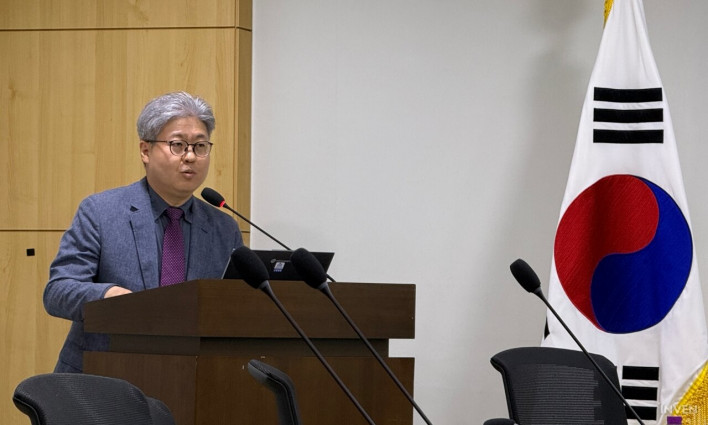
Professor Lee criticized the fact that the 30% fee set by Apple in 2008 has remained unchanged for nearly 20 years, stating, "Even highways lower or eliminate tolls once initial investment costs are recovered, but the app market has seen no change." He added, "It is now structured more like a toll tax than a service fee," and pointed out the issue of developers not receiving proper information during app review and refund processes.
He also addressed the controversy surrounding the effectiveness of Korea's world-first law banning forced in-app payments. "Europe is regulating more strictly than we are, which is actually leading to lower fees, but domestic users are facing reverse discrimination by not receiving those benefits," he said. "We need strong legislation that pre-designates dominant platform operators and prohibits discriminatory practices, similar to the Digital Markets Act (DMA), along with effective government-level implementation oversight and sanctions."
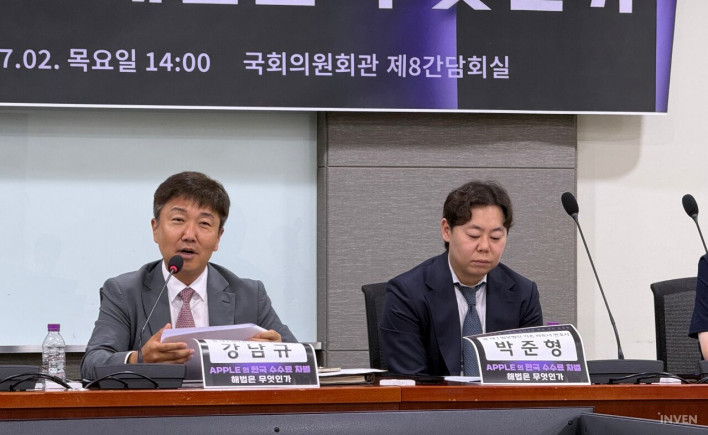
Attorneys Kang Nam-gyu and Park Jun-hyeong emphasized that the legitimacy of the 30% fee is crumbling based on overseas litigation cases.
In the U.S., Apple agreed to create a fund of approximately ₩150 billion and lower fees in the "Cameron v. Apple" lawsuit filed by small and medium-sized developers, and Google also established a $90 million (approx. ₩140 billion) fund in a similar case. Attorney Kang explained, "These lawsuits have spread the perception that the 30% fee is not absolute."
He noted that during the "Epic Games v. Google" trial, an economics expert testified in court that "in a normal competitive market without a monopoly, the appropriate fee would be around 9%," which led to Google lowering its fees (to 9–20%). He also cited a case in the U.K. where a court suggested 10% for in-app payments and 17.5% for app market distribution as appropriate fee standards in a lawsuit filed by developers against Apple.
Attorney Park Jun-hyeong emphasized, "The U.S. Department of Justice (DOJ) has also filed a lawsuit alleging that Apple maintains illegal monopoly power in the smartphone market in violation of Section 2 of the Sherman Act, and the Japan Fair Trade Commission has shifted toward pre-emptive regulatory legislation. It is clear that other countries have already judged this to be a flawed structure, not just us being stubborn."
Attorney Kang Nam-gyu pointed out limitations in Korea, such as the statute of limitations for damages running out after Apple ambiguously changed its fee calculation method (regarding VAT inclusion) in January 2023, and the lack of collaboration between the Fair Trade Commission, the KCC, and the prosecution. He suggested, "We need to introduce a class action system and establish the authority to recover and distribute unjust profits."
Furthermore, the two attorneys pointed out Apple's practice of calculating fees based on the amount including VAT only for domestic developers. While the price paid by consumers includes a 10% VAT on the supply price—a tax that developers must pay to the National Tax Service—Apple has applied the 30% fee to the total consumer price including this VAT, effectively collecting 33% based on the supply price.
The Korea Mobile Game Association reported Apple to the Fair Trade Commission in 2022 based on this issue, with claims that approximately 340 to ₩350 billion in unfair fees had been collected. Although Apple changed its method in January 2023 to calculate fees based on the supply price excluding VAT for domestic developers following the investigation, the two attorneys raised the issue that "no retroactive compensation has been made for the portions unfairly collected over the past several years."
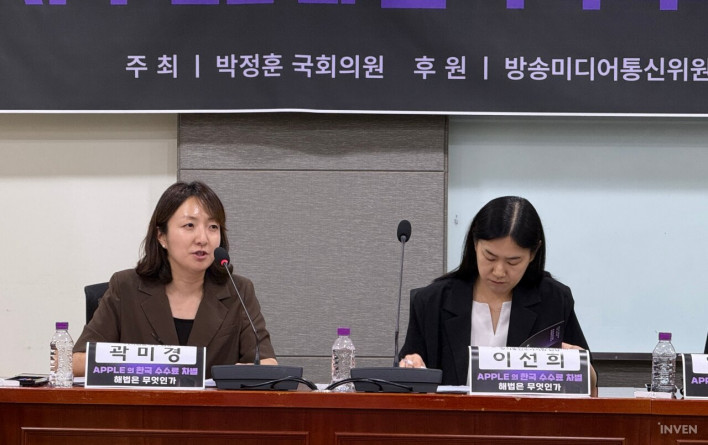
The subsequent panel discussion provided an opportunity to hear both the government's self-reflection and the industry's accumulated grievances.
Lee Seon-hee, head of the KCC team, apologized for the delay in processing despite the ongoing investigation and stated that the deliberation process would be concluded soon. However, she explained, "Under the current Telecommunications Business Act, the cap on fines is 1% of revenue, and while it was raised to 2% under the enforcement decree banning forced in-app payments, it is still far too low compared to the Fair Trade Commission or overseas cases," adding that legislation to raise the cap is being pursued.
Kwak Mi-kyung, head of the Ministry of Science and ICT team, introduced recent changes in Google and Apple's fee policies and expressed concern, saying, "However, Apple is only changing policies in countries with strict regulations, and such bypass policies could lead to discrimination against domestic developers."
Hwang Sung-ik, Chairman of the Korea Mobile Game Association, spoke with indignation on behalf of the industry. "The fight with Apple has already been going on for 10 years," he said. "Only Korean developers have been unfairly paying 33% fees for 10 years, which is estimated to be around ₩350 billion." He added, "Changing the future and taking responsibility for something should come after taking responsibility for the past. I hope Apple makes a forward-looking decision regarding the past unfair amounts."
Seo Beom-gang, Chairman of the Korea Webtoon Industry Association, stated, "We should not be obsessed only with the fee figures; corresponding benefits and choices must be guaranteed as well." He argued that it is necessary to examine whether benefits and opportunities commensurate with the value are being properly provided when the set fees are paid.
He cited the example of concerns over the costs of legal deposits for webtoons and web novels at the National Library of Korea. He noted that while the positions and value standards of copyright holders and the library (the collector) are bound to differ, what was effective in narrowing that gap was the value and meaning of the deposit's purpose, as well as the types and levels of benefits provided to the contributors.
Finally, he said, "Apple must first apologize for its attitude of only changing policies in countries with strong regulations while maintaining the status quo in Korea."

Sort by:
Comments :0