- Game Title: World of Tanks: HEAT
- Developer: Wargaming
- Platforms: PC (Steam/WGC), PS5, Xbox Series X|S, Steam Deck
- Keywords: #Tank #HeroShooter #CrossPlatform #F2P
- Genre: Hero-based Tank Action Shooter (PVP)
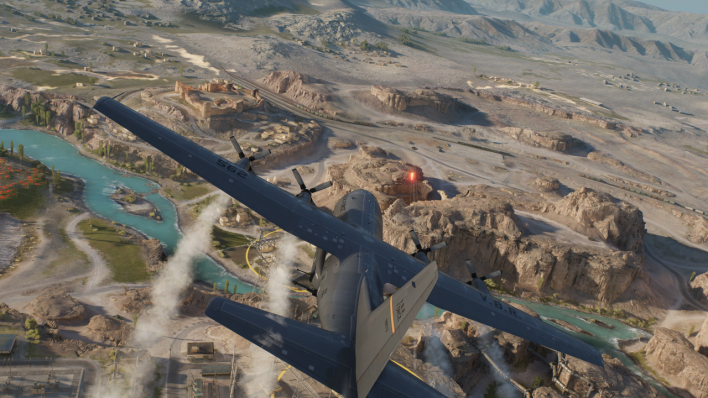
In a nutshell, 'World of Tanks: HEAT' is 'tank warfare turned into a hero shooter.' It retains the weight and feel of tank combat established by the original 'World of Tanks' while integrating a structure where players choose 'Agents'—each with unique abilities and ultimate skills—to head into battle. Set in an alternate reality after World War II, the game features tank and map designs unconstrained by historical accuracy, including battles set on orbital space stations or massive aircraft carriers.
Officially released on May 26, the game supports PC (Steam and Wargaming Game Center), PS5, and Xbox, as well as Steam Deck and GeForce Now. It also features cross-play and cross-progression, allowing progress to be shared across platforms. Here are the key features of 'World of Tanks: HEAT' revealed so far.
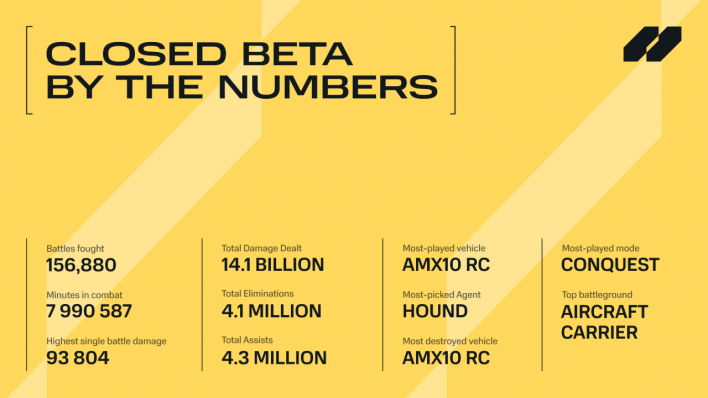
Ahead of its official launch, 'World of Tanks: HEAT' held a Closed Beta Test (CBT) from April 16 to 20. A total of 156880 battles took place, with a cumulative playtime of approximately 7.99 million minutes. These battles resulted in 14.1 billion total damage, 4.1 million vehicle eliminations, and 4.3 million assists.
The most used tank was the AMX10 RC. It was also the most destroyed tank, reflecting its high popularity and frequent encounters on the battlefield. The most selected hero among participants was the sniper-class 'Hound,' and the 10vs10 Conquest mode accounted for the highest share of gameplay.
Additionally, the highest Damage recorded in a single battle was 94804. To borrow the developers' words, "someone had a very happy day."
In fact, 'World of Tanks: Heat' underwent numerous tests long before its CBT. This began when it was first unveiled as a project for a successor to the 'World of Tanks' IP, under the name 'Cold War.' Having verified its gameplay mechanics step by step, 'Heat' made its public debut at Gamescom 2025 last summer.
According to Luke Nicholls, Community Director, who interviewed with INVEN at the time, the 'World of Tanks: HEAT' test community has been through a large and rapid series of private tests, even establishing a fast feedback loop by releasing new builds every two weeks.
Perhaps it was this foundation that allowed the recent CBT to record over 150k game sessions and 14.1 billion damage over five days.
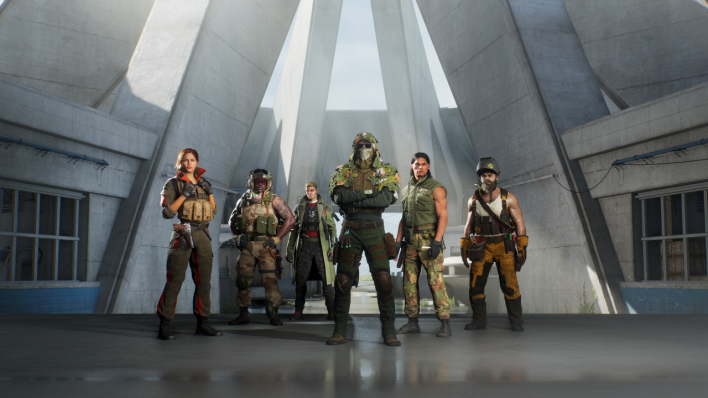
The core system of 'World of Tanks: HEAT' is the Agent. Each agent belongs to one of three roles (Defense, Attack, Sniper) and possesses unique traits, a ultimate skill, and a personal arsenal of up to two tanks.
Even with the same agent, combat style changes depending on the tank selected. While an agent's traits and ultimate skill remain constant, the abilities attached to the tank vary. For example, the Defense agent 'Chopper' uses an Active Protection System and Vulcan auto-turret when piloting the M1E1, but utilizes a Jamming Field and Barrier when in the FV4030X. However, the ultimate skill remains the same regardless of the tank.
The Defense role includes two agents: Chopper and Ember. Chopper's trait, 'Stubbornness,' automatically triggers damage reduction when health is low and stacks additional defense when capturing or defending a point. It is a passive ability that activates automatically when conditions are met. The ultimate skill can be used to call in mobile artillery to push back enemy positions or support allied advances.
Ember possesses a trait that allows safe passage through hazardous terrain like minefields or napalm, and her ultimate skill is a seismic attack that drops a large bomb to detonate underground. It is useful in defensive situations due to its knockback effect.
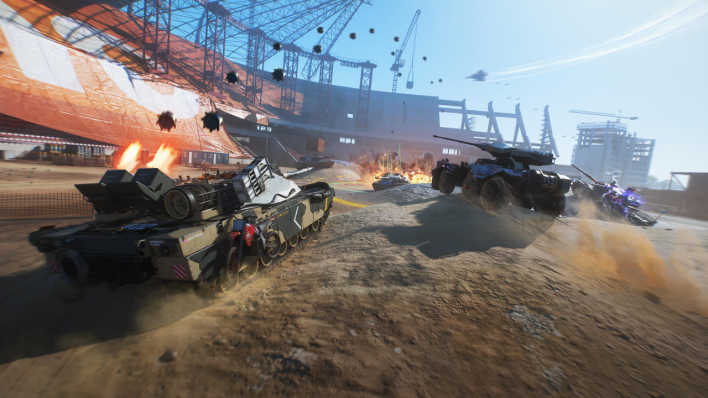
The Attack role includes four agents: Kent, Raketa, Reaper, and Twister. Each agent has a significantly different playstyle.
Kent has a trait that increases reload speed with repeated hits. His ultimate skill fires missiles at enemies in front; a short lock-on fires Hydra rockets, while a long lock-on switches to guided Hellfire missiles, allowing for situational versatility.
Raketa has a 'Scavenger' trait where parts that restore health drop around enemies when they are destroyed. Among her available tanks, the OBJ. 287 is specialized for close-quarters combat, using a harpoon to close distance instantly or deploying combat cages to trap enemies. Her ultimate skill, 'Rampage,' increases fire rate and prevents health from dropping below 1 for a set duration. She is ideal for charging into the heart of enemy lines to cause chaos.
Reaper has a trait that prevents instant death from a single hit, and his ultimate skill calls in an F-4 Phantom to drop napalm. Twister specializes in high-speed mobile combat with a trait that increases reload speed while boosting and a ultimate skill that deploys an EMP drone.
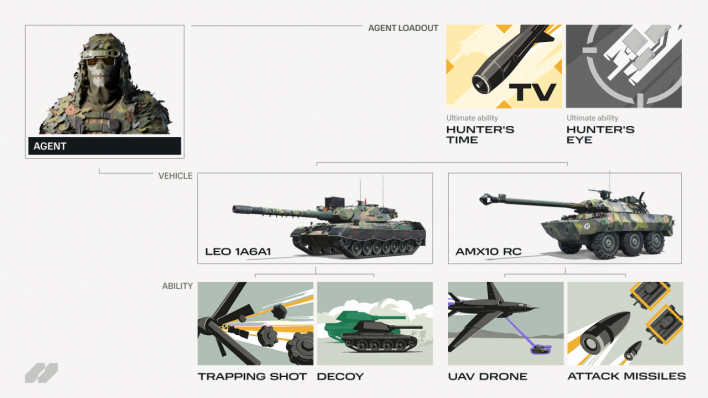
The Sniper role includes two agents: Hound and Fuzzer.
Hound's trait highlights enemy weak points when aiming. His ultimate skill fires guided missiles from the air to target marked enemy tanks with low health; successfully destroying a tank this way partially recharges the ultimate skill. Among his tanks, the AMX10 RC is notable for its combination of UAV drone reconnaissance and air-to-ground missiles to strike spotted enemies.
Fuzzer has a trait that removes all status effects, and his ultimate skill calls in an aircraft to perform a laser-guided strike. His tank, the M3E1, is specialized for mid-range support using TOW anti-tank missiles and a laser designator.
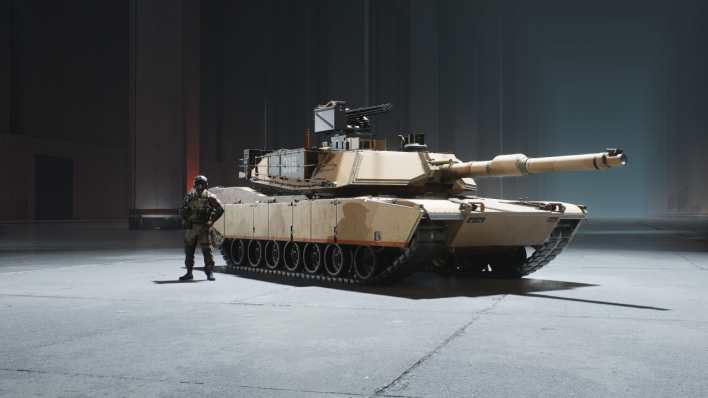
Repeatedly playing as an agent accumulates EXP, and leveling up grants skill points. These points can be used to unlock skills, and up to four unlocked skills can be equipped for battle.
Skills are divided into four categories: Trait Enhancement, Ability Enhancement, Attribute Enhancement (accuracy, engine power, turret rotation speed, etc.), and Ultimate Skill Enhancement. Only one skill can be equipped from each category.
A unique aspect is that equipped skills do not activate immediately at the start of battle. Players must accumulate 'Skill Activation Points' through combat activities like eliminating enemies, capturing points, or blocking damage. A skill activates only when its specific cost is met: 300 points for Tier 1 skills and 600 points for Tier 2. In short, the build completes as you play actively.
Note that Skill Activation Points and ultimate skill energy are separate resources. Both are charged through combat, but they fill different gauges, so be careful not to confuse them.
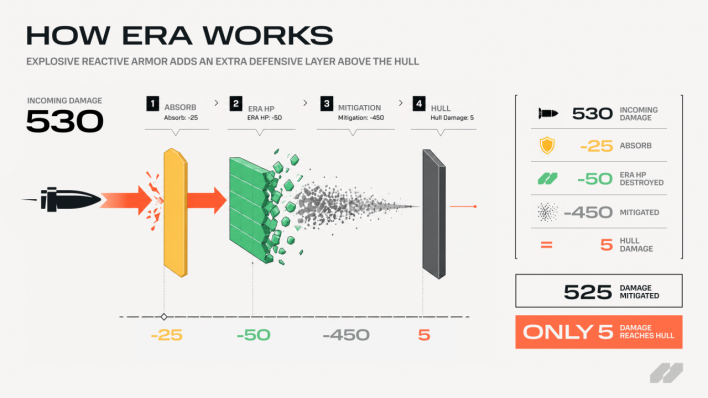
Tank performance can be fine-tuned via modules. Module slots are divided into categories such as Firepower, Defense, Ability, Utility, Recon, and Mobility, with different slot configurations for each tank. Many modules involve trade-offs: increasing firepower might lower defense, or boosting ability efficiency might reduce mobility. New modules are unlocked as the tank levels up.
Each tank is given two equipment slots. Slot 1 is dedicated to recovery items like repair kits, while Slot 2 usage depends on the tank's role. Equipment comes in two types: those that trigger automatically when conditions are met and those activated manually by the player.
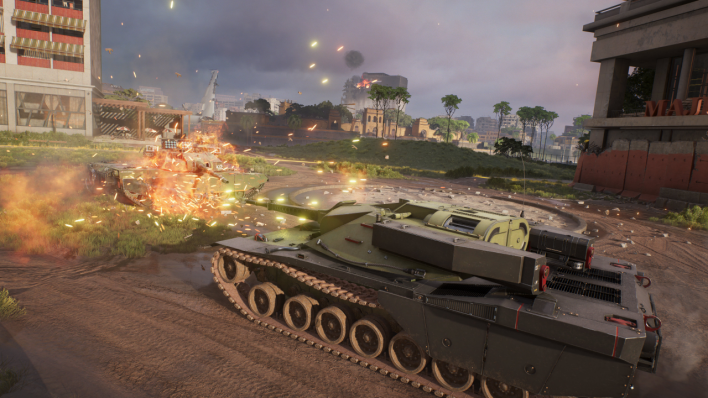
While 'HEAT' wears the skin of a hero shooter, the skeleton of its combat remains that of the 'World of Tanks' series. In particular, the vision system and armor structure demonstrate that this game is more than just a simple shooter.
The vision system is designed on the principle that 'information must be acquired.' Just because an enemy tank is visible on screen does not mean all information is displayed immediately. When an enemy enters your field of view, they are 'Rendered,' showing only the tank's model without UI info. Aiming directly, pinging, or dealing damage transitions them to 'Spotted' status, displaying the agent's name and health. Going one step further to 'Identified' status shares health, outlines, and distance from allies with the entire team.
Tanks that rely on stealth, like snipers, have high stealth stats, meaning they remain 'Spotted' for a shorter duration. Breaking line of sight after firing and repositioning is key to survival. Conversely, tanks in a recon role have the primary mission of sharing enemy locations with allies using recon tools or UAVs. Since the act of spotting and identifying enemies is rewarded with points, players can contribute to the team just by providing information, even without dealing direct damage.
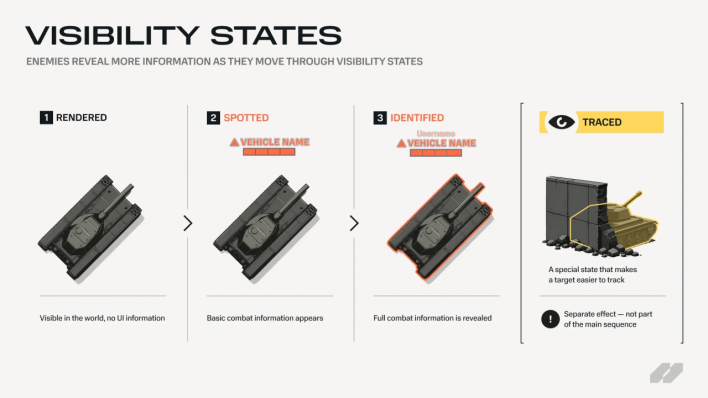
'Traced' status is a separate vision effect that highlights enemies in yellow, allowing them to be tracked even behind cover. The key point is that this is visible only to the player who applied the 'Trace' and nearby allies, not the entire team.
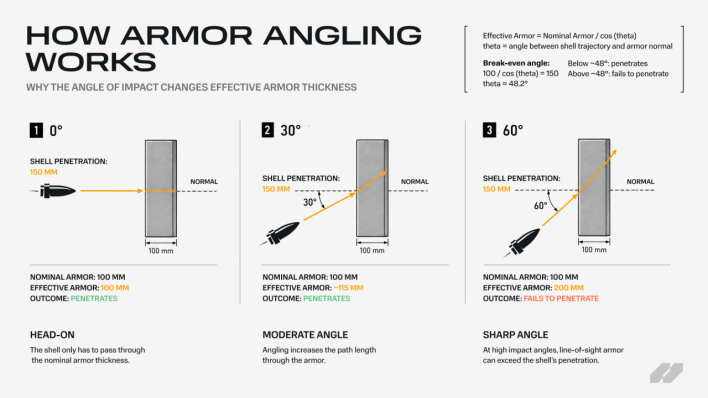
When aiming at an enemy, the reticle color indicates penetration probability: green for possible, yellow for partial or reduced damage, and red for impossible. There are various shell types like AP (Armor-Piercing) and HE (High-Explosive), each with an optimal range. Beyond this range, penetration and damage decrease; at three times the optimal range, they drop to 50%, and at extreme ranges, they fall to 30% of the base value.
The structure where damage is influenced by where you hit, at what angle, and from what distance is identical to the original 'World of Tanks.' The fact that this specific tank-warfare calculation underlies the fast-paced hero shooter gameplay is what distinguishes 'HEAT' from other shooters.
Quick Play offers four PVP modes. All modes include respawns, encouraging aggressive play and experimentation.
Point Capture (5vs5) is a mode where players capture and hold points that appear sequentially across the map. Because the points keep moving, quick judgment and adaptation are required. The first team to reach 2000 points wins.
Domination (5vs5) is a mode fought over a single point. Filling the capture gauge to 100% wins the round; if an enemy remains on the point, progress stops at 99% and overtime begins. Played as a best-of-three, it is introduced as the mode where strategic thinking and team cooperation are most critical.
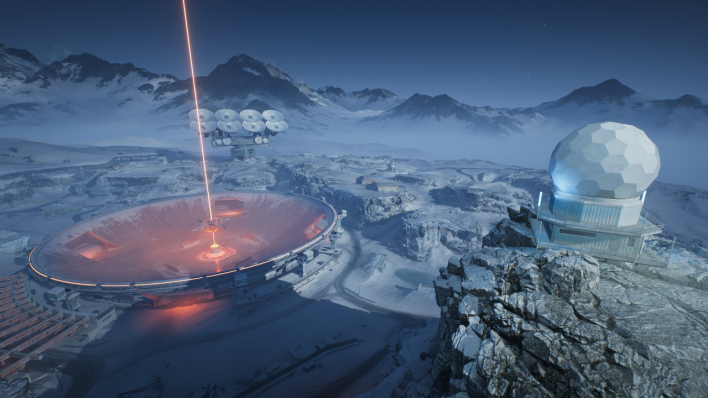
Assassination (5vs5) is a mode where points are awarded only by collecting tokens dropped after destroying enemy tanks. It is important not only to pick up enemy tokens but also to recover tokens dropped by allies to prevent the enemy from scoring. Power-up items appear throughout the map, and the first to reach 25 points wins.
Conquest (10vs10) is a mode where multiple bases distributed across a large map are captured simultaneously. Points increase in proportion to the number of bases held, and dynamic events like airstrikes or elimination challenges occur during battle to turn the tide. The first to reach 2000 points wins. This was the most played mode during the CBT.
In addition to these four PVP modes, an AI battle mode is provided. Players can play the same maps and modes against AI, serving as a practice environment for new players to get accustomed to tank controls and game rules.

Sort by:
Comments :0