
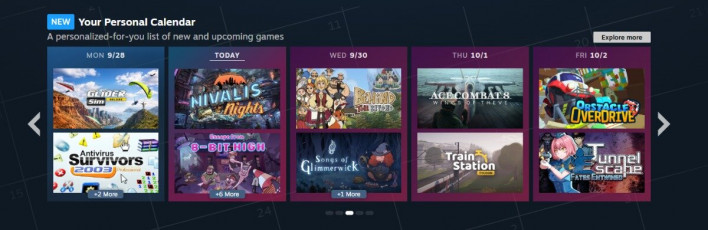
Steam's 'Personal Calendar' has shed its experimental tag to become an official feature. The tool filters upcoming releases over the next eight weeks by date based on the games a user frequently plays, and can now be accessed directly from the Steam store homepage.

Valve announced via an official Steam update early in the morning on October 24 (KST) that the Personal Calendar has graduated from Steam Labs and become a permanent feature of the Steam Store. This comes roughly one year after it was first revealed as a Steam Labs experiment in October last year.
The recommendation method starts with play history. Based on recently played games, it finds users with similar tastes and highlights upcoming titles that those users have wishlisted or are playing. Games played for longer periods carry greater weight, while titles played for only a few minutes have little impact, and the recommendation list updates daily. Valve emphasized that personalization relies purely on algorithms, with no paid placements or manual curation.
A significant number of adjustments were made during the beta period. As developers can now specify anticipated full release dates for Early Access titles, 1.0 releases can also appear on the calendar. Wishlist, Early Access, and DLC filters alongside display options have been enhanced, and optimization for PC, mobile, and SteamOS device screens has also been implemented. According to Valve, users click on more than 2,000 different games per day on average from the calendar.
This is welcome news for small and mid-sized developers. Marketing analysts previously noted that while the threshold to reach Steam's 'Popular Upcoming' tab had risen to requiring roughly 100,000 wishlists, the Personal Calendar provides exposure starting two months prior to release, generating between 300 and 3,000 wishlists per day for a single game. This gives indie games—which often struggled to compete against major releases—an official channel to reach players with matching tastes. Games without a confirmed release date cannot appear on the calendar.
As of mid-this year, games disclosing AI usage account for about one-third of new Steam releases, exceeding 500 titles per month. In effect, the Personal Calendar's structure can act as a filter. Appearing on the calendar requires a certain level of wishlists, making it difficult for games with almost no wishlists to cross the threshold, and since tastes are determined by playtime, games dropped after just a few minutes of play are barely reflected in recommendations.
Of course, the Personal Calendar is not a feature designed to prevent the proliferation of AI games. It only changes the list visible on individual screens rather than reducing the total number of games listed on the store, and Valve did not present this feature as a countermeasure against AI games. The Personal Calendar is available on the store homepage or its dedicated page after logging into Steam.