
The practice of overseas game companies appointing third-party entities as domestic representatives despite having local subsidiaries will be put to a halt. The Culture, Sports and Tourism Committee of the National Assembly has prepared a committee alternative for an amendment to the Game Industry Promotion Act, which explicitly specifies in law the priority order for entities to be designated as domestic representatives and allows for restrictions on information and communications network usage if obligations are not fulfilled.
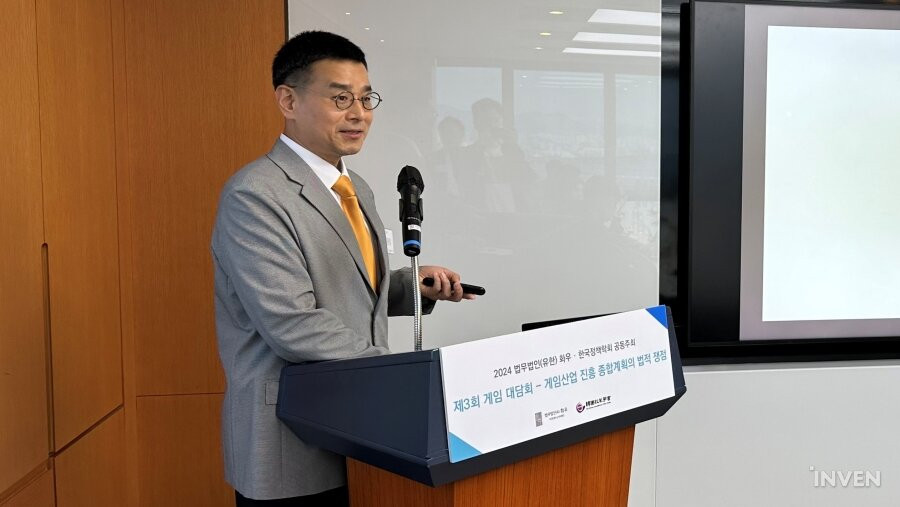
According to materials released on the 23rd by the Game Center at Yoon & Yang LLC, the Culture, Sports and Tourism Committee conducted a joint review of bills proposed by Representative Cho Seung-rae and Representative Kim Jae-won, consolidating them into a committee alternative. The two bills passed review by the Culture and Arts Legislation Review Subcommittee on September 3, and the alternative is being pushed for submission to the plenary session of the 439th regular session of the National Assembly.
The amendment adds a new clause to compliance requirements for game-related businesses, stating that they must "address domestic user damage protection and complaint handling." This establishes user protection as a statutory obligation for business operators. User damage protection and complaint handling have also been newly included in the proxy duties of domestic representatives.
The biggest change lies in the qualification criteria for domestic representatives. Current law defines eligibility merely as "a person having an address or place of business in South Korea."
The amendment places domestic entities established by the business operator as first priority, and domestic entities that exercise a dominant influence over executive composition and business operations as second priority. Only when neither entity exists can a third-party entity capable of faithfully performing the duties be designated.
Under this structure, overseas game companies with branches or affiliates in South Korea will have those respective domestic entities directly take on responsibility as domestic representatives.
Post-designation management obligations will also be established. Overseas business operators must train their domestic representatives and inspect their work status pursuant to Presidential Decree. As long as the game is distributed or provided in South Korea, the designation must be maintained without interruption and cannot be arbitrarily altered.
Enforcement measures have also been strengthened. If a business fails to designate a domestic representative or fails to comply with corrective orders issued for probability-type item disclosure violations, the Minister of Culture, Sports and Tourism or the Chairman of the Game Rating and Administration Committee can order the refusal, suspension, or restriction of information and communications network usage.
Regarding this, Yoon & Yang evaluated it as "a powerful enforcement tool that effectively makes blocking access to domestic services possible."
The Ministry of Culture, Sports and Tourism and the Game Rating and Administration Committee will be newly granted authority to request document submissions. They can request materials from business operators when aware of suspected legal violations, when reports or complaints are filed, or when verification is required to determine whether an entity is subject to domestic representative designation. Fines will be imposed for failing to designate a domestic representative, designating an unqualified entity, violating oversight and management duties, or failing to submit or submitting false documents.
The domestic representative system was implemented in October 2025. Overseas business operators exceeding certain thresholds, such as sales revenue or domestic installation counts, are subject to designation. According to the Ministry of Culture, Sports and Tourism on July 10, 80 out of 81 companies obligated to make designations completed them, while 24 companies without the obligation also designated representatives voluntarily.
Although the designation rate was high, Yoon & Yang explained the background of the amendment in its materials, noting that vague qualification criteria for designated entities and insufficient post-designation management and supervision mechanisms often resulted in "merely formal representative designations." Issues were also continuously raised that users had virtually no domestic point of contact when experiencing damage such as undisclosed probability information, refund rejections, or account suspensions.
The amended law will take effect six months after promulgation. The priority provisions will apply to cases where domestic representatives are newly designated following implementation. Even business operators that have already designated a representative must redesignate their subsidiary or other priority entity within six months of the enforcement date if such an entity exists.