Seven years ago, Remedy Entertainment made a strong impression on mystery enthusiasts and supernatural shooter fans with 'Control.' Its unique world reminiscent of the 'SCP Foundation' and the intriguing entity known as the Federal Bureau of Control (FBC) gained depth over the years, eventually connecting with the developer's other franchises like 'Alan Wake' to craft a massive shared narrative.
And now, the second entry in 'Control' makes its appearance. The setting is exactly seven years after the original game—matching the actual time it took for the sequel to be released. This time, the protagonist is not the new Director, Jesse Faden, but rather Dylan Faden, who fell into a coma following the conclusion of the first game.
As evidenced by the protagonist setup, 'Control Resonant' is a full-fledged sequel, yet it exhibits contrasting characteristics to its predecessor in many ways. While the first game looked inside the FBC's headquarters, this entry explores the outside world. Furthermore, unlike the Director's exclusive Service Weapon that took the form of a gun, Dylan's weapon, the Aberrant, takes the shape of a melee weapon.
What is clear is that this game, completed by Remedy over roughly seven years, possesses a certain 'something' unseen in any other title—regardless of whether that something appeals to personal taste.

7 Years Later, Stepping Outside the Oldest House

Much like its original predecessor 'Control,' 'Control Resonant' also stems from a single past event. At the heart of it is the slide projector found by the sibling pair Jesse and Dylan in a dump during their childhood. It is the object that triggered the 2002 'Ordinary AWE (Altered World Event)' in Ordinary, Maine. The projector found by the siblings that day altered the fates of countless people, while setting the two on diverging paths.
As players of the original game know well, after that day, 10-year-old Dylan was imprisoned in the Oldest House and forced to undergo training and experimentation to become a candidate for the next Director. It was 17 years later that his older sister, Jesse, entered the Oldest House to rescue him—the setting of the original 'Control.'
Playing the original game provides a clearer picture of how Dylan fell into a seven-year coma. To put it briefly: Dylan was taken over by a malevolent entity called the 'Hiss' and killed many people. His sister, newly appointed as the Director of the FBC, defeated the Hiss, and Dylan remained in a coma ever since. Knowing just this much should be enough to play the sequel without issue.
'Control Resonant' begins right at the moment Dylan awakens from his seven-year coma. As a new threat emerges, the lockdown on the Oldest House is lifted, and this threat uses immense power to isolate all of Manhattan. Meanwhile, Director Jesse is away under the pretext of dealing with an even greater threat.
Whether you played the first game or not, playing 'Control Resonant' places you at the exact same vantage point as Dylan. Imprisoned at age ten, Dylan has now turned 34. And like him, players have never seen the Manhattan that lies outside the Oldest House.

With the game's setting expanding to Manhattan, the area to explore has grown noticeably larger compared to the linear gameplay of the original. Perhaps because it isn't quite an 'open world,' the development team preferred the term 'open-ended world.'
The new entity threatening Manhattan and the Bureau remains shrouded in mystery, much like other entities in the game. They are terrifying forces that cause mysterious resonance in reality and objects, shattering them into a state known as 'Patterning.' Boss-level entities consumed by this Patterning are referred to in-game as 'Resonants.'
Another characteristic of the Resonants is their intense hostility toward the 'Hiss,' which still threatens the world. Because of this, FBC agents maintaining control in Manhattan are investigating whether their presence could serve as another clue to resolving the Hiss crisis.
Stepping back into the world after 24 years, Dylan joins forces with the FBC to find his missing sister and to save a Manhattan grotesquely transformed by Patterning.
From Villain to Hero: Dylan Faden and the 'Aberrant'

Hearing the heartbreaking story of Dylan's childhood—or lack thereof, since he was continuously locked up by the FBC—anyone would sympathize with his plight. However, that does not justify the atrocities he committed in the previous game. With a villain possessed by the Hiss now stepping up as the protagonist, the way FBC agents treat Dylan forms a notable highlight of the game.
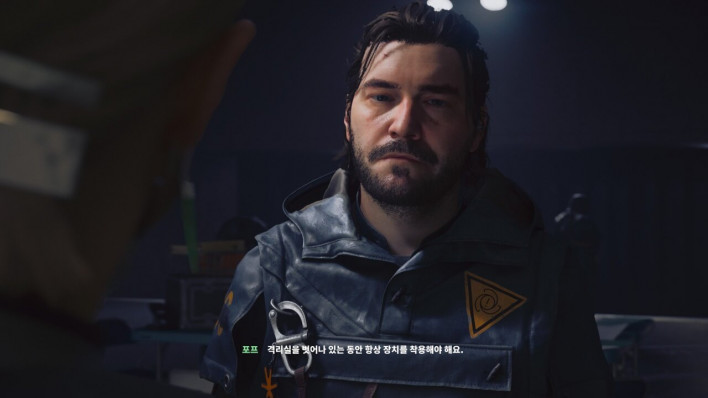
To the Bureau staff, Dylan is hardly someone they can look upon with warmth. When he unleashed the power of the Hiss, over 500 people died in a single day inside the Oldest House. Because there is no telling when he might use his power against the FBC again, Dylan carries out his mission throughout the game with a device called a 'portable containment unit' attached to the back of his head.

The new character Zoe De Vera serves as a companion who adds depth to Dylan's unique story while chiming in regularly to keep gameplay lively. She plays a crucial role for Dylan, who has had almost no human connection for 24 years. Personally, her music taste is incredible.
Dylan uses the 'Aberrant' as his weapon. His older sister Jesse gifted (?) it to him in his chest before her disappearance. Though it looks like an iron rod made of an otherworldly substance, it lives up to its name by freely changing shapes.
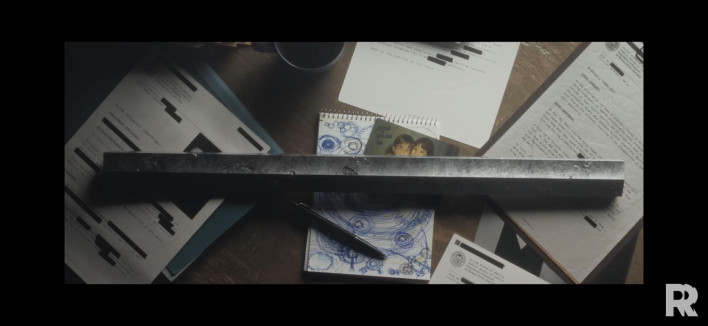
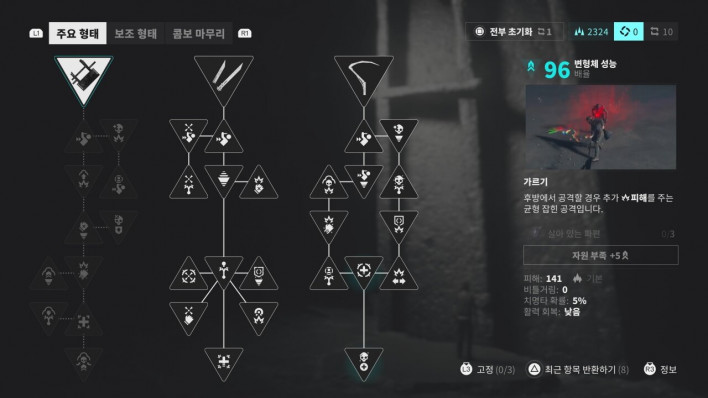
The core of combat in 'Control Resonant' revolves around this Aberrant and the combat abilities Dylan gains by defeating Resonant bosses.
The Aberrant allows players to configure a set of three transformations: Primary Form, Secondary Form, and Combo Finisher. There are three Primary Forms and three Secondary Forms. With a staggering six Combo Finishers, the number of combinations available to build a set is substantial.
Furthermore, each time a Resonant boss is defeated, Dylan can choose one of two abilities to acquire. Considering that Dylan can equip up to six abilities in quick slots, combined with the possibilities of Aberrant combinations, you are unlikely to run into a friend playing with the exact same weapon and skill setup.
Additionally, Dylan does not level up or grow stronger simply by defeating monsters. Dylan's stats and skill effectiveness depend on how much the Aberrant and his abilities have been upgraded. Thus, rather than focusing on a single weapon form, the system encourages using available resources to unlock other weapon trees as well, boosting overall Aberrant performance.
Thoroughly exploring the map is essential to obtaining upgrade resources, and purchasing materials from vendors situated in each region can often be the best approach. In this way, 'Control Resonant' encourages exploration as a direct path to character progression.
Because of the vast variety of weapons and abilities, it was impossible to explore every build in a single playthrough, but utilizing status effects proved crucial in every battle.

Dylan's attacks inflict basic damage while building up a 'Stagger' gauge on enemies. Once an enemy's Stagger gauge fills, they can be instantly executed regardless of their remaining HP. Performing an execution grants a short buff that enhances basic attacks. This 'cycle of execution and attack' is immensely important—to the point where early deaths were common simply from not knowing this mechanism.
Additionally, players can craft builds focused on applying various status effects, such as stacking fire attacks on mold enemies to trigger explosions. Refining your preferred combat style through gameplay is one of the key pleasures of 'Control Resonant.'
Describable Only as 'Art'



While the diverse combat choices were engaging, map design is the true standout strength of 'Control Resonant.' Stopping anywhere in the game to take a screenshot results in a work of art. (Though why is there no Photo Mode?)

Manhattan, defined by the developers as an 'open-ended world,' is divided into roughly eight major sectors including the Sinkhole, each offering a distinct landscape. From sectors overrun by Mold escaping the Oldest House to evacuation spaces taken over by the Hiss, and the Sinkhole undergoing Patterning, every region boasts a unique atmosphere.

In particular, heavily Patterned areas like the western region, the Sinkhole, and the final 'Unidentified Sector' mark the absolute pinnacle of Remedy's accumulated artistic prowess. Up becomes down, walls become floors, and down becomes up once more. Visuals reminiscent of fleeting scenes from the film 'Inception' stand fully realized as interactive map design.


In the original 'Control,' the developers showcased their creativity to the fullest in the sequence known as the Ashtray Maze. The thrill of navigating an ever-shifting maze while listening to music lent by Ahti the janitor returns in 'Control Resonant' on a vastly expanded scale.
Of course, it must be noted that navigation has become correspondingly more difficult. The original 'Control' was perplexing enough at launch that many players gave up due to navigation issues, and the developers previously mentioned devoting significant effort to this entry's map system based on those bitter memories.

Perhaps because of this, the map system feels fairly well refined. Interactive elements in the surroundings are easy to spot on the minimap, and since the overall map scale isn't excessively large, identifying unexplored areas using the map was quite manageable.

The issue, however, isn't the map itself, but having no idea how to physically reach the space shown on screen. While early areas like the Central Sector or Mold Sector have relatively flat map designs that minimize this hassle, later sectors undergo full Patterning, causing players to forget where they even came from. Depending on an individual's sense of direction, this aspect may prove polarizing.
Another minor inconvenience is the requirement to trek back to a nearby fast travel point upon finishing an exploration run. To fast-travel to another area, players must walk all the way to a 'Door' fast travel point, meaning you cannot simply open the map and select a destination. As a result, whether reaching the far end of the Sinkhole or defeating a Resonant in the Astral Plane, you are forced to make the trip back to a Door.
The puzzle structure designed around 'Power Cores' also adds to the fatigue. Puzzles that require carrying electricity from a powered Power Core to an unpowered one appear continuously from start to finish, and failing to move quickly often resets the charge. Ultimately, this serves as another mechanic forcing players to navigate the shortest route based on spatial awareness, which will likely frustrate those lacking a knack for navigation.
A Broader, Deeper 'Control' Franchise
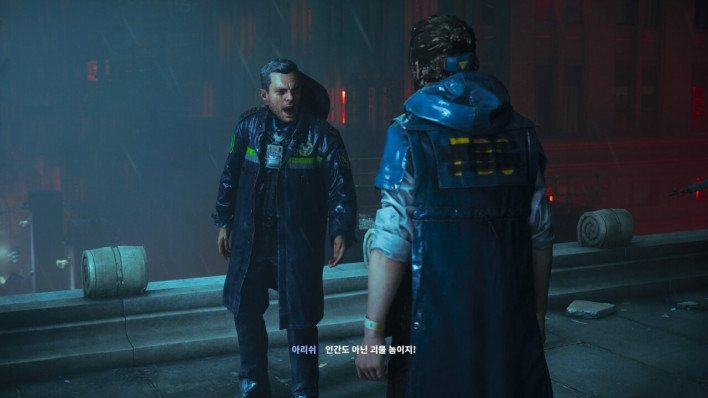
'Control Resonant' is a title where Remedy's adventurous attempts shine in many respects. Placing Dylan Faden—the other half of the Ordinary event—as the protagonist, the game takes a deeper look into his past, which was viewed through his sister's perspective in the previous game. Combined with an expanded scope extending to Manhattan and a new threat, the 'Control' universe that originated inside the Oldest House expands to the next level.
The revamped melee-focused combat feels brisk thanks to fast pacing and varied choices, giving players a strong sense of agency. Executing enemies to empower attacks and combining weapons with abilities to forge a personalized combat style strongly support this experience.
However, the 'Spore-Flame' synergy combo I tested felt so powerful that it raised questions about whether other options are necessary. Since I couldn't test every build in a single playthrough, whether these diverse options truly hold equal weight warrants further exploration.
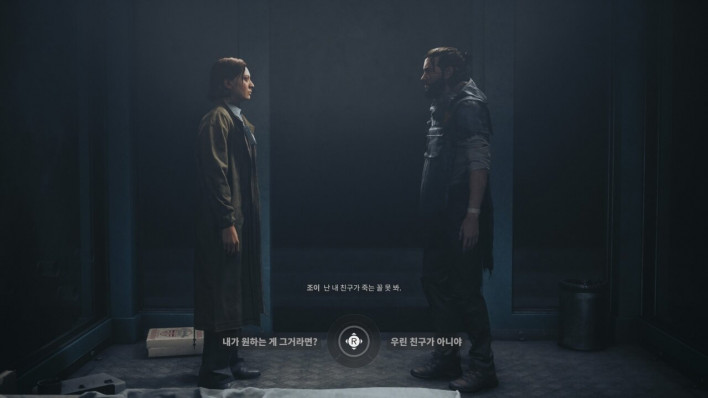
While combat difficulty leans on the harder side, the 'Assist Mode' in the options menu is exceptionally detailed, allowing anyone to complete the game stress-free. Using Assist Mode carries no penalties, and players can fine-tune damage multipliers dealt and received to match their desired playstyle. Of course, players who find it too easy can also increase the difficulty further.
Still, what will come to mind first when recalling this game in the future is likely the grotesquely warped landscape of Manhattan. The map and boss designs possess a charm unmatched by any recent game, and Remedy's imagination—delivering the thrill of the Ashtray Maze on a grander scale—remains intact.
While backtracking out of previously cleared spaces could indeed be tedious at times, simply exploring the map provides a meaningful experience for fans of mystery and the occult.
It is impossible to know when or how Remedy will further expand the 'Control' universe. If they can continue delivering surprises as they have here, waiting for what comes next will always be a pleasure.