Video games are usually enjoyed through sight and sound. Recently, haptic elements like vibrations in controllers or mice have been added as well.
At this year's Gamescom, German startup ZESTUM added a new sense to gaming: smell. As the screen transitioned to a field of grass, the smell of grass filled the air; moving to a flower field brought floral aromas; and a farm scene was followed by the scent of livestock. This was all made possible by the olfactory gaming device, "The Scentbar."
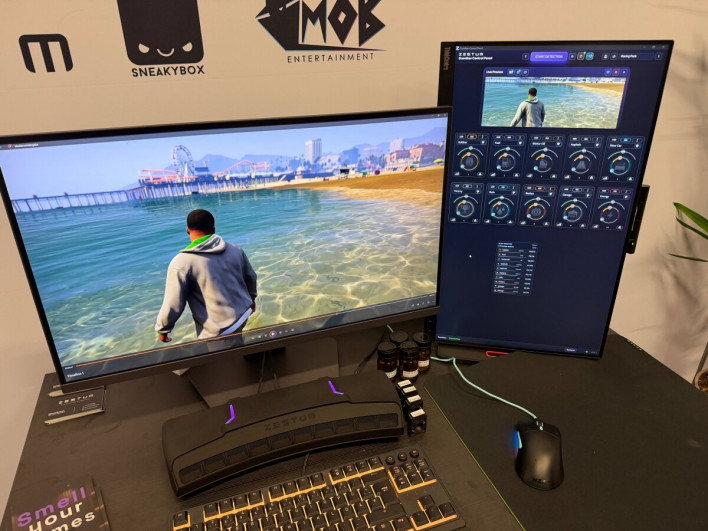
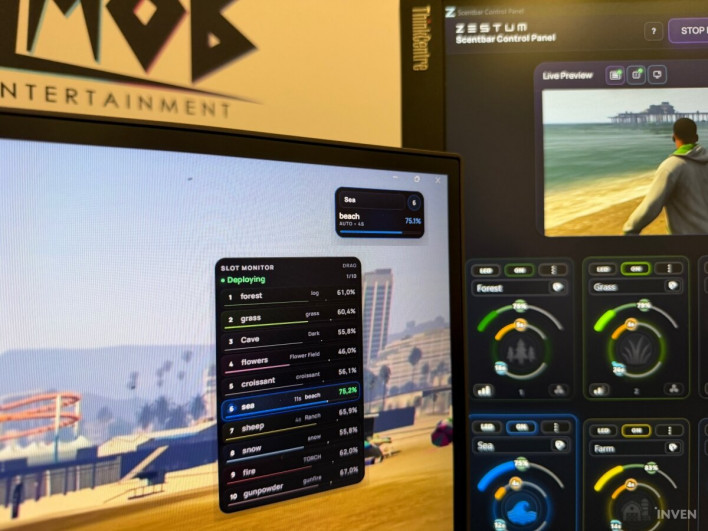
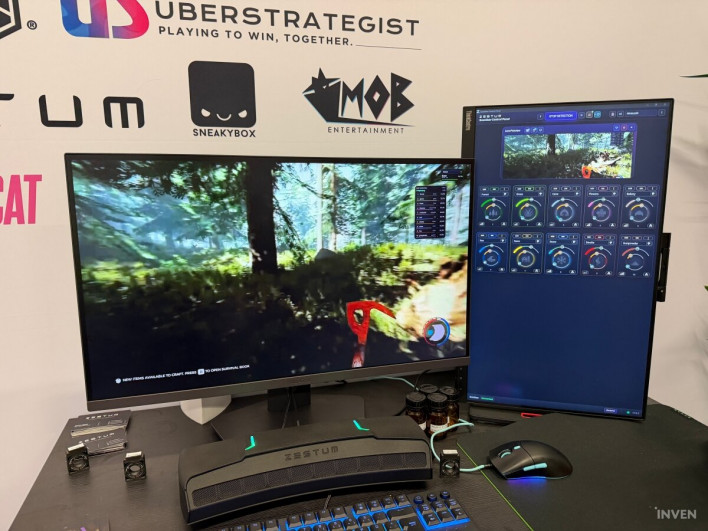
The principle behind it is screen recognition. When users run the dedicated software and select the monitor to detect, the program analyzes the screen in real time, classifies the scene, and emits the corresponding scent as soon as it exceeds a designated probability threshold. In the demonstration witnessed by the reporter, as soon as the probability for a "forest" scene reached 86%, the fans immediately started spinning. The same method applies not only to game screens, but also to videos, TV shows, movies, and board game scenes.
ZESTUM co-founder Samuel Wiebe highlighted the strength of this method in that it requires no collaboration with game developers. "We use image detection. We don't need an SDK," he explained. Indeed, during the demonstration, he brought up a racing game screen and typed "car" and "motor" directly into the label input box, creating a new trigger on the spot.
Because users set the recognition targets and trigger conditions themselves, the settings can be carried over even when changing games, levels, or maps.
The hardware consists of 10 scent slots and 10 fans. Assigning one fan per scent, it emits individual scents in real time, adjusting the scent intensity by controlling the fan's rotation speed, operating duration, and frequency. The scents come in the form of "scent pellets" contained in replaceable pods, requiring users to simply swap out the pod when the pellets run out. It connects to PCs via USB-C using a separate power supply to account for fan power consumption, while consoles connect via a sync box that receives HDMI signals.
The higher-end "Pro" model adds rear ambient lighting and allows multiple units to be connected and synchronized.
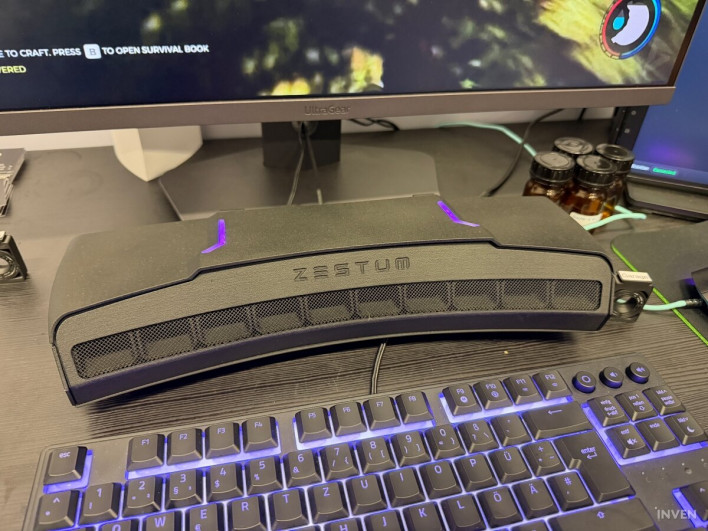
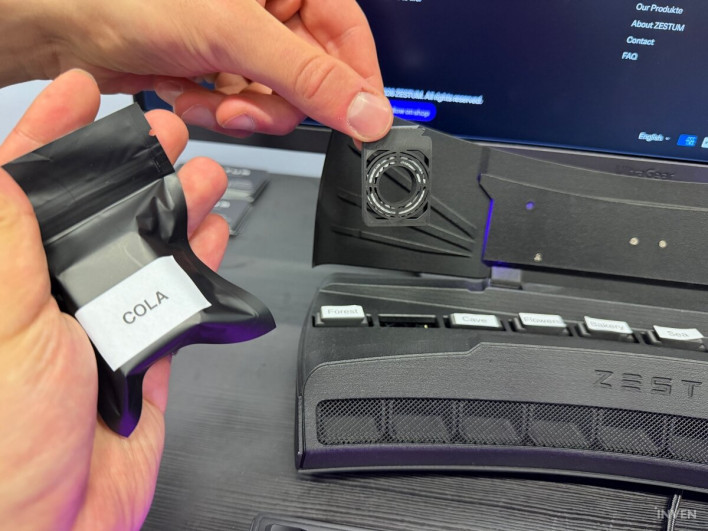
The scents themselves are created in partnership with external specialists. Wiebe revealed that development was entrusted to perfumery companies in Switzerland and Cologne, undergoing certification processes. Co-founder Salomo Bertram noted that this was the area where they put in the most effort. "Smoke in reality is harmful to the human body. So, while accurately capturing the mental association people have, it must also be long-lasting and safe," he explained. He added that the Swiss company they are collaborating with has focused solely on scents for 30 years.
At launch, the scent line-up consists of three genre packs: Action, Racing, and Nature. With 10 scents per pack totaling 30 varieties, Action includes gunpowder, leather, and smoke; Racing includes tires and energy drinks; and Nature includes forest, grass, flowers, soil, and moss. Users who wish to use all 30 scents at once can connect multiple main units side by side. The company considers dynamically blending scent combinations like RGB colors as its next research phase.
An impressive aspect is how giving users freedom of choice over scents was established as a product philosophy. "Just because it's a zombie game doesn't mean everyone always wants to smell blood or death," Wiebe said. "Our goal is to let users choose what they want to smell." If the scent of burning tires in a racing game isn't to your liking, you can simply swap it out for a different scent.
The pricing structure sets the main unit at €299 (approx. 470,000 won), which includes the initial scent package. Additional scent packages cost around €40 (approx. 60,000 won) and are expected to last two to three months. Wiebe compared the monthly cost of 10 to 15 euros (approx. 23,000 won) to "about the same as subscribing to Netflix in Germany."
Since users purchase the hardware once and replenish scents according to their taste, it resembles a setup where users expand their configuration based on their gaming preferences.
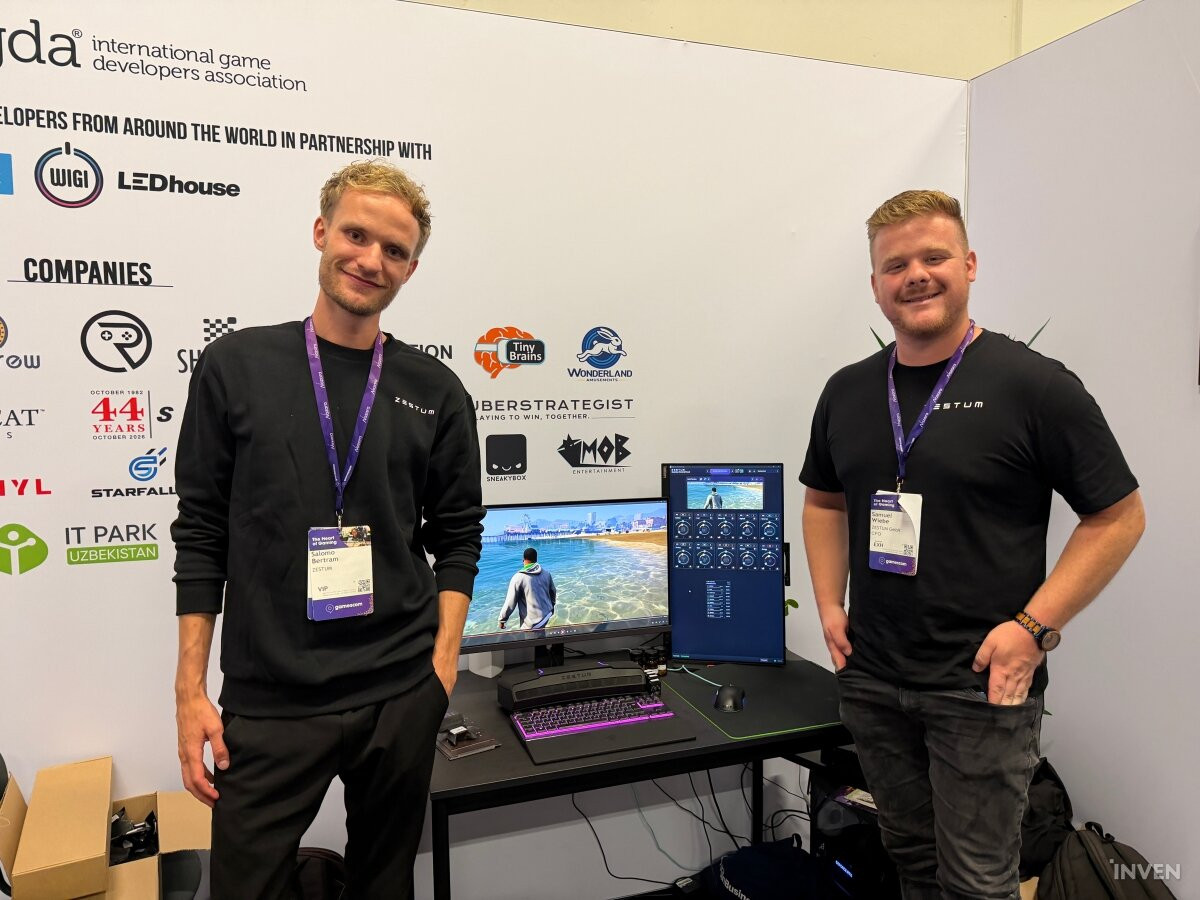
ZESTUM originated from an entrepreneurship program at TH Köln in 2023. Bertram, who was focused on immersion while building home theaters, met Wiebe, a mechanical engineering major, and completed the first prototype during the program. They continued development in Aachen with assistance from local startup support institutions.
Wiebe initially handled hardware and early firmware before moving to business development, while a newly joined game developer took charge of the software. There are four co-founders, including Bertram and Wiebe, and the team currently consists of a core group of four alongside three to five student staff. The company stated that its Kickstarter campaign launched in March this year and exceeded its funding goal.
Long-term usage test results were also shared. Bertram reported that 10 testers have been using the product for six months now after the initial two-month phase, saying, "Now they tell us that if The Scentbar isn't connected, it feels like something is missing—as if sound or color were gone."
He summarized the company's direction with the phrase "a speaker for the nose." Their vision is that, just as sight and sound have, scent can establish itself as a fundamental element of the experience.
The next steps are two-fold. One is platform expansion. Currently exclusive to PC, the goal is to support consoles and VR next year. For VR in particular, the company is envisioning a separate wearable product rather than a desktop unit. Bertram said, "Whether the form factor is wearable or a surround system, our goal is to make it so that once users connect it, it just works."
The other is content collaboration. Wiebe stated, "Working with studios or publishers is our biggest goal," citing titles like 'Farming Simulator' as potential pairings. Bertram added, "Major publishers have already expressed interest," explaining that "since this is an unprecedented product, we are carefully evaluating which games it will suit best first."
Regarding a launch in South Korea, the response was that global sales are the baseline. Starting in Germany, shipments have been sent to the US, with no plans to limit regions. Bertram said, "As reservations and orders pile up, we can rapidly scale up production," adding, "Since our original concept was to let everyone smell their games, there's no reason to remain restricted to specific regions." Shipping availability is expected to open up as stock is secured.
Attempts to add scent to gaming are not new. However, early products were limited by a narrow selection of scents and difficulty in adjusting intensity, making precise scene-scent matching difficult. The design of The Scentbar specifically targets those pain points by highlighting screen recognition, independent fans for each scent, and user-customizable triggers and threshold settings.
Ultimately, the key question is whether smell can become a constant in gaming setups alongside sight and sound. How precisely it handles scent timing and lingering aromas in fast-paced games, and whether it provides an experience compelling enough to keep refilling scent packs, will determine the answer.
The fact that testers who have used the product for over six months reported feeling that "something is missing without it" serves as an initial indicator of its potential. ZESTUM deployed around 50 units at Gamescom, demonstrating the device with games including 'Fortnite'.