By 2025, the 'Dynasty Warriors' series made a truly grand comeback.
Granted, a lot changed in the process. While the game's core thrill of viewing a battleground where thousands clash from a micro perspective and sweeping through them remained, the dozens of officers and as many weapons that embellished that core were all gone. With only a single protagonist and a dozen weapon types left, 'Dynasty Warriors: Origins' cemented the franchise's revival by delivering an overwhelming sense of exhilaration that surpassed all previous entries.
However, before all of this, there was 'Dynasty Warriors 3'. Following its predecessor, which felt more like a test run, it featured revamped systems and massive volume. It marked the start of the Dynasty Warriors golden age during the PS2 era, leading into Dynasty Warriors 4 and 5.
For me personally, it brings back deep memories—'Dynasty Warriors 3' was the very first console game I ever bought. Without knowing that Xtreme Legends was a standalone expansion, I bought it and ended up playing only Lu Bu, unable to touch Wei, Shu, or Wu, before finally buying the main game and playing it to the point of exhaustion. Though I ended up playing the subsequent Dynasty Warriors 4 and 5 even more.
And now, 25 years later, 'Dynasty Warriors 3' has returned with the word 'Remaster' attached. It was a fantastic game, but this is 2026. It's time to stand on a new scale.
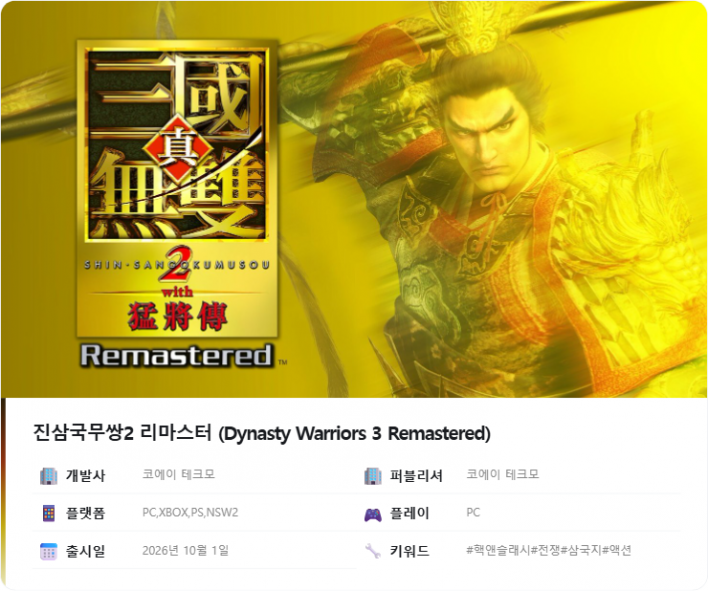
A 25-Year Gap: What Has Changed? Counters, Evasion, and Weapon Fusion
First, it must be pointed out that this is a 'remaster,' not a 'remake.' Since every title is set during the Three Kingdoms era, subsequent games essentially double as remakes anyway, making the word 'remake' redundant—yet this title is firmly a 'remaster' that brings 'Dynasty Warriors 3' back to life as it was.
To get straight to the point, this means the combat system is inherently unrefined by modern standards.
Back then, every officer in the Dynasty Warriors series performed moves using identical inputs. The system of 'Normal Attack' followed by 'Charge Attack' (input as '□ x N + △') had six variations depending on the number of normal attacks, each serving the same tactical purpose regardless of the officer.
From 'Charge 1' used without normal attacks to 'Charge 6' triggered after five normal hits, each followed a set formula: Guard Break, Launcher, Stun, Wide-area Attack, Launch-and-Pursue, and Character-Unique Action. This was identical across all officers. As a result, an officer's tier was determined by how few openings their animations had, along with their attack range and damage values.

This meant that despite having over 40 officers and as many weapon types, gameplay ended up feeling largely similar—a limitation that 'Dynasty Warriors 3 Remaster' fails to overcome. While the go-to moves shift based on elemental triggers during mid-game progression, in most cases, clearing grunts relies on wide-reaching Charge 4 and 6, while handling enemy officers involves mixing Charge 3 for stuns and Charge 5 for airborne follow-ups.
The issue is that it is now 2026. By 2001 standards, this provided a stellar feel for action, but while it may look flashy, the repetitive play patterns make it grow stale quickly for an action game.
As a result, Omega Force added a few variations here: 'Evasion' and 'Perfect Power Guard', an enhanced version of the original 'Power Guard'.
Both are system improvements aligned with recent action game trends. Both 'Power Guard' (pressing attack while guarding) and the new 'Evasion' action trigger a strong counterattack that stuns the enemy when timed with incoming attacks, making them essential techniques on higher difficulties where enemies gain massive stat boosts. Since the latest title, 'Dynasty Warriors: Origins', also heavily featured rock-paper-scissors-style combat requiring precise responses to enemy moves, this represents a meaningful addition.

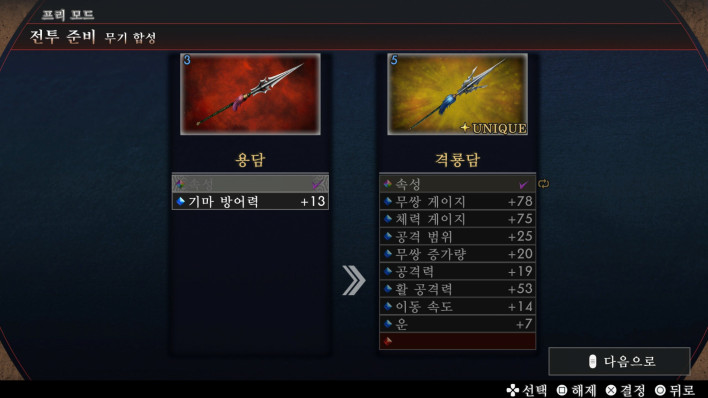
Additionally, 'Weapon Fusion'—a mechanic that didn't appear until Dynasty Warriors 8—has been added. The series' weapon system drops weapons with randomized option values, but players can now extract desired options and add them to their current weapon. Options can be overwritten with higher values, swapped out entirely for new ones, or even have their elements replaced.
This significantly expands weapon customization choices. Dynasty Warriors 3's elemental system is divided into Fire, Lightning, Wind, and Slash, with Slash being exceptionally powerful. Previously, weapon elements could not be changed, so even if you earned a Unique Weapon by fulfilling specific conditions, a lower-tier weapon with Slash was often more practical if the Unique weapon had a poor element. Now, players can directly apply Slash to those Unique Weapons.
In short, 'Dynasty Warriors 3 Remaster' maintains the core action feel of the original while adding subtle twists through new systems. While graphical and voice acting enhancements are expected of any remaster, improving core mechanics is technically optional—meaning no one would have complained had they omitted them.
Yet making these subtle mechanical adjustments was a clever move. As detailed below, without variations like Evasion and Perfect Power Guard, 'Dynasty Warriors 3 Remaster' would have felt far too much like an antique.
Why Dynasty Warriors 3 of All Games? It kicked off the golden age, but...
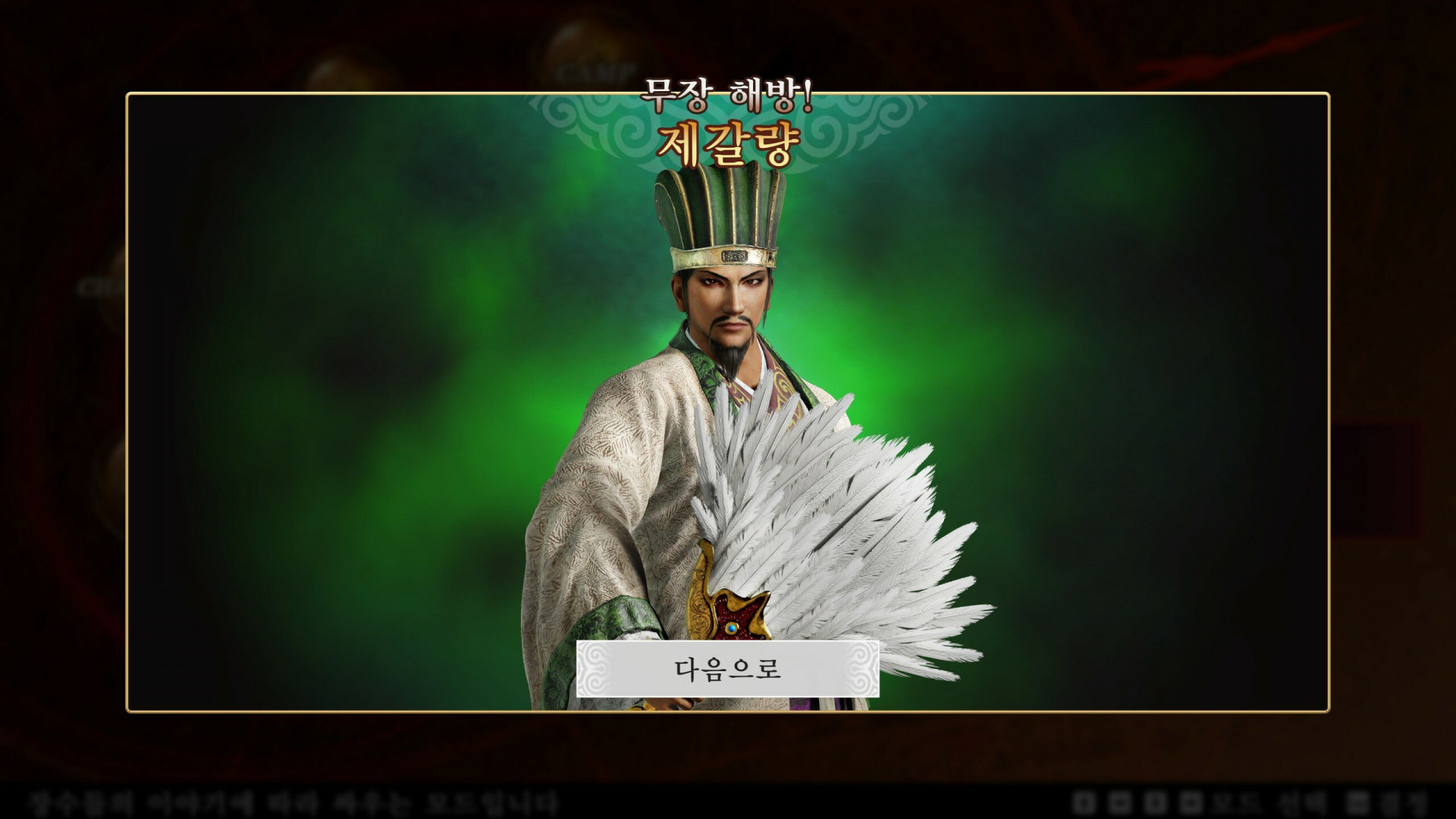
Before moving on, it should be stated that 2001's 'Dynasty Warriors 3' was undoubtedly a masterpiece. It inaugurated the series' golden era, offering a sheer volume of content for its time with numerous battlefields, dynamic battle conditions, and dozens of officers.
However, the more I played, the more I questioned: 'Why Dynasty Warriors 3?' In my experience, while DW3 was great fun, Dynasty Warriors 4 and 5 were practically direct upgrades. While it's hard to rank them when accounting for their respective eras, DW4 and DW5 fit modern action game trends far better even at release, and domestic series communities were bustling at the time. Considering the three titles were released about two years apart, new ideas and improvements arrived at a rapid pace.
As a result, 'Dynasty Warriors 3 Remaster' finds itself in an awkward position.

For players introduced to the series through 'Dynasty Warriors: Origins'—which doubled down on sweeping away hordes of foes—the battlefields in Dynasty Warriors 3 feel far too tame. Enemy density falls short, attack ranges feel overly narrow, and encounters with enemy officers feel overly simplistic.
Conversely, veteran fans who have followed the series since the early days will inevitably look back at Dynasty Warriors 4 and 5, which offered far richer systems and volume. Even Dynasty Warriors 4, the immediate successor, changed 'Charge 3' into 'Charge Rush' for much punchier, multi-dimensional combat, whereas 'Dynasty Warriors 3' remains faithful to the basic framework without offering anything beyond it.
Of course, evaluated strictly as a 'remaster,' 'Dynasty Warriors 3 Remaster' is an excellent title.
It faithfully preserves the original's combat and action while overhauling the engine for solid visuals, and integrating Xtreme Legends content ensures a substantial playtime that holds up by modern standards. With weapon fusion, subtle combat improvements, and additional battlefields, it achieves an expansion that stays within reasonable boundaries. As the end product of a remastering effort, it is near-perfect.
The problem is that the game selected for this remaster is far too old, and far superior siblings exist. Throughout my playthrough, I couldn't shake off the regret of wishing Dynasty Warriors 4 or 5 had received a remaster of this quality instead. After all, playing Lu Bu in DW4, where he spins his Sky Piercer like a helicopter blade, was infinitely more exhilarating than DW3's single forehead flick.
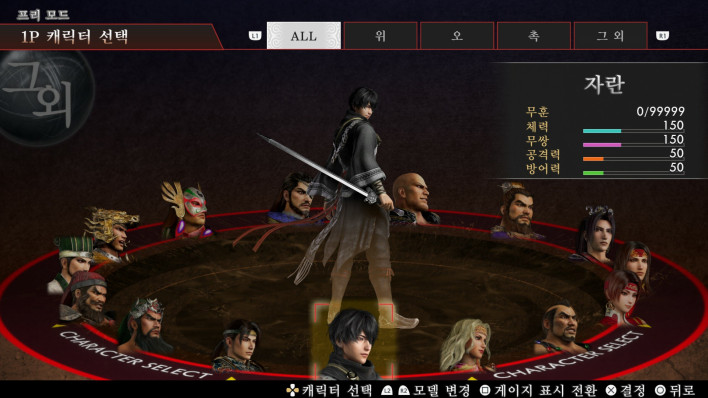
A Textbook Example of a 'Remaster' Yet the Original Has Simply Aged Too Much
To sum up the review, 'Dynasty Warriors 3 Remaster' is an impeccably crafted remaster that serves as a textbook model. It unifies once-separated content, adds new elements, and delivers superb visual modernization as a core remaster mandate. However, because the underlying original is so old, no amount of faithful restoration can fully elevate it into an extraordinary game by today's standards.
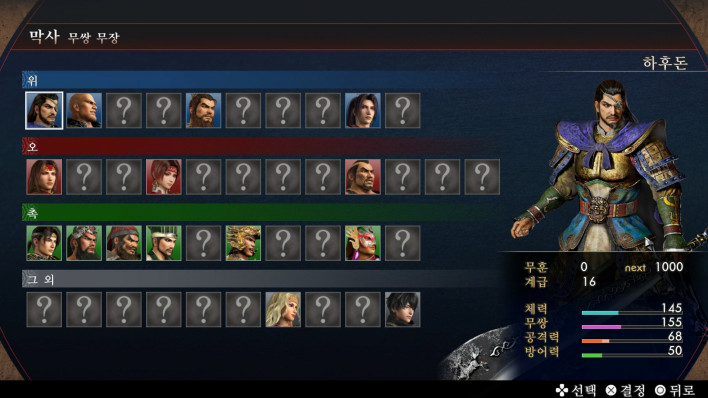
When 'Dynasty Warriors: Origins' launched last year, I was filled with concern before playing. As a massive Dynasty Warriors fan who devoured every entry—enduring even the disasters of DW6's Renbu system and DW9's open world—watching Origins abandon the classic formula of many officers and countless weapons in favor of a single protagonist was concerning.
Yet after playing Origins, I realized something. What I truly wanted from Dynasty Warriors wasn't a vast roster of officers or weapons, but the pure exhilaration of sweeping through waves of enemies at once. Ultimately, Origins was an immensely satisfying game, delivering a fantastic series reboot that leaves players eager for a sequel despite lacking the actual Three Kingdoms in a Three Kingdoms story.

And in 2026, 'Dynasty Warriors 3 Remaster' steps back to bring classic Dynasty Warriors back to the table. The massive officer roster is back, the weapons are back, and each officer's Musou Mode is back—yet a brain pampered by Origins' sheer exhilaration fails to ignite.
It is a good remaster, and the original was indeed a fine game. However, it feels insufficient to satisfy modern tastes enough to command a spot among 2026's top releases. It feels like reuniting with a first love who is doing well in life—yet no longer looks as enchanting as they once did.
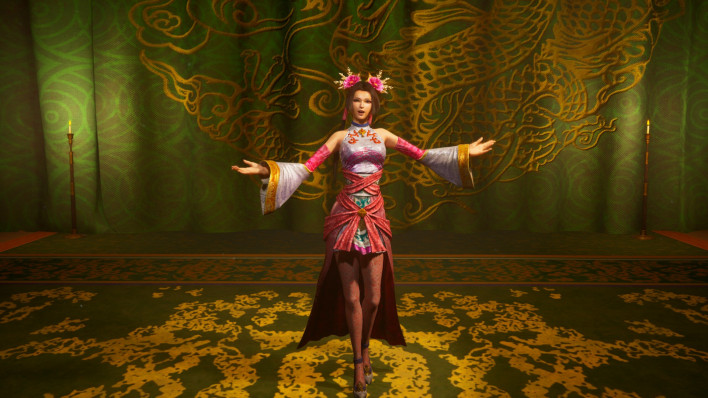
- Faithful original recreation and visual enhancements
- Combat mechanics updates, including Evasion and Counters
- Substantial additions of new battlefields, officers, and systems
- Original game feels far too aged by 2026 standards
- Inevitable repetitive gameplay
Review Platform: PC (Launch Build)