Riot Games held a Q&A session between the 'League of Legends' development team and global media.
Riot Games hosted a developer briefing to share updates on 'League of Legends' for the first half of 2026 and discuss the success of 'Swarm'. The presentation was followed by a Q&A session with domestic and international press.
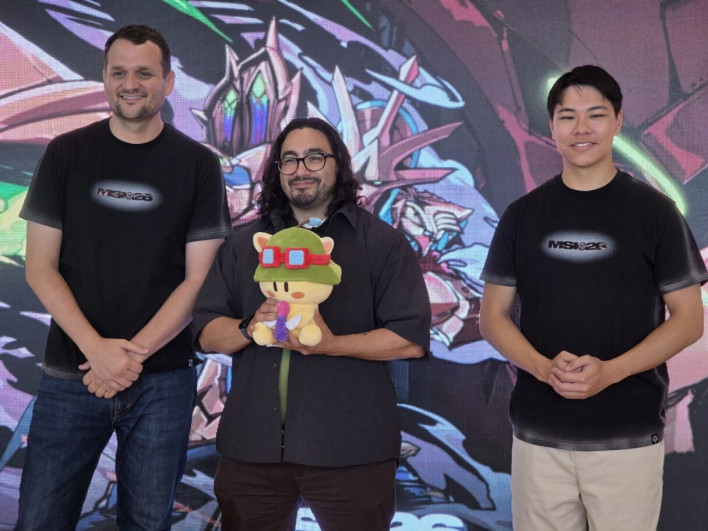
The speakers in attendance were Paul Bellezza, Executive Producer of League of Legends; Matthew Leung-Harrison, Lead Gameplay Designer; and Eduardo Cortejoso, Mode Product Lead. A wide range of questions were addressed, covering the progress of the new client, console expansion plans, the status of the MMORPG project, the health of the bot lane meta, the background behind the removal of Atakhan, and the philosophy behind pro-scene balancing. Below is a summary of the key Q&A.
Q. TFT announced its transition to Unreal Engine and a standalone client. What is the current progress on the new 'League of Legends' client and visual improvements?
" Paul Bellezza, Executive Producer: It is proceeding smoothly. With TFT utilizing its own client and engine, we have gained more freedom to improve the 'League of Legends' experience as well. We are seeing good progress and will share more details at the end of this year.
Q. When will players actually be able to see the new client? Also, with WASD controls expanding to ranked play this year and gaming controller support added, are you considering expansion to or integration with console platforms?
" Paul Bellezza, Executive Producer: I cannot share any specific timeline right now. If there are updates, we will share them at the end of the year. The response to WASD controls has been quite positive, and we have confirmed that it does not pose significant issues for the overall player experience. There are no plans to expand to other platforms at this time. However, we do see many players attempting to use controllers, and you are free to do so. We will learn what we can from that process. There are no official plans for console expansion either.
Q. Looking at overseas media, there is frequent news about Riot hiring developers with MMORPG experience. Is a MMORPG in development, and if so, at what stage is it?
" Paul Bellezza, Executive Producer: Marc Merrill confirmed several years ago that an MMO is in development, and it has been in progress for years. Hiring is also ongoing. However, that project is under R&D and is separate from the PC version of 'League of Legends.' So, I am at the same stage of anticipation as all of you. We will have to wait and see how it turns out.
Q. A topic that is always discussed in the 'League of Legends' meta is the bot lane. There is an assessment that the meta this season, both in pro play and regular games, is heavily focused on the bot lane. How do you view the actual influence of the bot lane?
" Matthew Leung-Harrison, Lead Gameplay Designer: One of our intentions with the position quests was to empower the bot lane. We reduced the relative power of the mid and jungle roles and shifted the weight to the bot lane. At the same time, we placed restrictions on roaming-style supporters, as excessive roaming creates an unpleasant experience for both supporters.
As a result, we have seen the meta shift toward the bot lane, which was somewhat intentional. At the same time, we wanted the bot lane to be open to various types of champions. Mage champions are currently being used frequently in the bot lane, and this is also partially intentional. We have ensured that ranged damage dealers can still find their place.
While mage champions currently show a fairly high win rate, especially when paired with roaming supporters, we do not believe they are overly dominating the game. We think the current state—where mages appear alongside strong early-game or scaling ranged damage dealers—is a healthy bot lane meta.
Q. There were not many changes moving from Season 1 to Season 2. Are you satisfied with the scale of these changes? Also, with the addition of Swarm and Classic, there are now more entry points to 'League of Legends.' How important do you think these entry points are for attracting a new generation of players?
" Matthew Leung-Harrison, Lead Gameplay Designer: The decision to apply relatively few changes in Season 2 was intentional. Players pointed out that the pace of change in 2025 was too fast. We believe this was the result of both failing to accurately target the direction of change and the sheer scale of the modifications.
Therefore, we took a more conservative approach in 2026. We focused on returning to the fundamentals and only applied changes we were certain were beneficial. We decided to avoid burdening the game with experimental attempts.
" Paul Bellezza, Executive Producer: The important thing is to adapt to the needs of both current and potential new players. Riot Games' philosophy is to be the most player-centric game company in the world, and to do that, we must understand the needs of different players.
At the same time, we must acknowledge that everyone learns and enjoys games differently. The games I enjoyed 30 years ago are completely different from what new players encounter today. I am from the RTS generation, so I had to move the mouse to move the camera, but if I tell that to the current generation, they don't understand. They ask, 'Why don't you just use a touch screen.
WASD controls are a prime example. We want to recognize those differences and increase accessibility while keeping the essence and competitive experience of 'League of Legends' intact.
Q. You keep mentioning 'returning to the fundamentals of the game.' Could you explain specifically what you mean by that? Also, you mentioned that player feedback has increased the fun; how do the total active user numbers compare to previous years?
" Matthew Leung-Harrison, Lead Gameplay Designer: The core of 'League of Legends' is that it is both an action game and a strategy game. However, in 2025, there were so many objectives that strategic choices actually disappeared. With too much to do, the game ended up telling the player what to do. There was no room for creativity in side-lane management, teamfights, or skirmishes. In English, we describe this as putting players on a set track. Returning to the fundamentals means the game has become one where players can freely attempt various strategies.
Another fundamental is position identity. Last year, it didn't make much difference whether you played Vayne in the top lane or the bot lane. That is why we introduced position quests. Mid lane is in the center of the map, so roaming is frequent, making boots important; top lane focuses on split-pushing, so we made teleport more accessible. Ranged damage dealers are a position that needs to buy many items, so we designed them to secure gold. We wanted to strengthen the identity of each position without overly restricting the plays possible in those lanes.
Regarding metrics, both ranked and Swarm are showing strong performance and growth across various regions.
Q. There is the issue of having to consider both solo ranked and professional play when balancing. Last year, there were comments about wanting to see specific champions in pro play, leading to criticism that balancing was focused on tournaments. What are your thoughts on this? Also, your experience playing Korean solo ranked last year became a hot topic; do you plan to play again this year?
" Matthew Leung-Harrison, Lead Gameplay Designer: One of the reasons we introduced Fearless Draft last year was to reduce the burden of having to balance based on pro play. Thanks to that, champions can be valid in both regular games and pro play, and we have fewer trade-offs where we have to keep win rates low for the sake of regular players.
Currently, we focus more on regular players for the majority of the time. The exception is the patch right before major tournaments. Patches 26.12 and 26.13, leading up to MSI, were prepared with the tournament in mind, but the five patches before that did not heavily consider pro play. We pay attention to ensuring the meta reaches the desired point just before a tournament, and otherwise, we place more weight on ensuring regular players have new and fun experiences.
I do plan to play some solo ranked today. I won't be able to play much since I'm only in Korea for a few days, but I played relatively stably in Diamond 2 last time, so I hope for the same this time.
Q. How do you define a successful augment? Also, if you had to pick one of the current in-game augments you are most satisfied with, what would it be?
" Eduardo Cortejoso, Mode Product Lead: A healthy augment is one that amplifies a champion's core fantasy. A prime example is the Tank Engine. It maximizes the fantasy of Dr. Mundo running around the map as big as the screen.
However, not all augments are designed for that purpose. Silver-grade augments have a strong auxiliary nature, meant to be combined with other augments. Ultimately, what we aim for is to enable the realization of new champion fantasies through the augment system.
The combination of attaching burn-related augments to Brand is also a good example. It was a bit too strong in the early version, but it is an area we want to flesh out more.
There are also groups of augments that don't fit this mold, like the Poro Blaster, which is instantly fun without needing deep thought. Most roguelike games offer many more choices, but in Swarm, you only get four. Therefore, it is important to compose the nature of the choices as diversely as possible. You should be able to choose an instinctively fun augment like the Poro Blaster, or go in the direction of maximizing Dr. Mundo's fantasy.
Q. Atakhan was removed. What kind of feedback did you receive, and what internal discussions led to the decision to remove it?
" Matthew Leung-Harrison, Lead Gameplay Designer: The early version of Atakhan had two modes. The resurrection mode was not liked by players, so we removed it quickly.
The original intention was to create action in game situations that were flowing too passively. We thought that if they didn't die, team members would be more active in engaging. It made sense in theory, but when applied, players didn't like the idea.
As 2025 progressed, the same feedback returned regardless of the region. Even though players in each region don't communicate with each other, Korean, English-speaking, and even pro players repeatedly said there were too many objectives and the game was too complex. Seeing that feedback, we critically examined whether this was an element that should be in the game. It was difficult to remove in 2025, but we decided to remove it entering 2026.
At the same time, I view the fact that we experimented with Atakhan positively. If you don't try, you can't learn anything. In that process, we learned a lot about development cycles and what players like and dislike.
Q. Two months ago, 'Chovy' mentioned that with the disappearance of large preseason-style patches, it has become difficult for pro teams to predict patches. I would like to hear your response to this.
" Matthew Leung-Harrison, Lead Gameplay Designer: When we apply changes to the game, we inform pro players in advance at a reasonable level. However, if a change is clearly good for the game, we do not delay it just because pro players might not be comfortable adapting to it.
A pro player in 2026 is different from one in 2016. With the introduction of Fearless Draft, a wider champion pool is required. Since such major changes affect roster decisions, we inform them much further in advance.
Regarding the pace of change, we are proceeding at a level agreed upon with pro players. However, I think we should have informed them about the minion-related changes a bit earlier. There was no reason it had to be applied at that exact moment. We will take this as a lesson and communicate better in the future.
Q. Regarding Swarm, you said you would make every game feel fresh; are there internal criteria for judging that freshness?
" Eduardo Cortejoso, Mode Product Lead: I should start by talking about the experience in Arena. What we watch for is the point where patterns begin to solidify in player decision-making. If it reaches a state where players feel they must take a specific augment and champion combination, and if they don't get it, they want to give up on the game, that is a bad sign.
What Swarm aims to reward is adaptability. The diversity of each game should not come from force, but be a result of what the player chooses.
To this end, we use two methods. One is fine-tuning the draft experience. If the pick rate of a specific augment combination is too high, we look at the data and adjust it. The other is to continuously inject new systems and content. That is why we have already released two sets this year.
Looking at TFT, when a new set comes out, players spend the first month or two exploring builds and directions. But as time passes, the answer naturally solidifies. We want to avoid that situation in Swarm. We add new content or remove/change existing elements to make players read the game anew.
At the beginning of the year, we released set augments that provide additional bonuses that stack over time, and this time, we changed direction to introduce skill augments. We will continue to use different approaches and systems to induce players to pursue diversity.
Q. I understand that 'League of Legends' has never released collaboration skins with external IPs. It seems to align with your current move to expand the user pool by bringing in external IP fanbases; why haven't you made such attempts?
" Paul Bellezza, Executive Producer: It is a topic we are constantly discussing internally. It's not that we haven't collaborated in the past. We have collaborated with Louis Vuitton.
When collaborating with external parties, what we consider most important is whether we can create something meaningful for players together, rather than just a collaboration to put something into the game.
We are experimenting with various attempts related to this within Riot, and some of them seem successful. We are discussing it, but there are no concrete plans yet.
Q. Swarm recorded record-breaking performance in the first half of the year. You have introduced various event modes for a long time, but they didn't all receive the same level of response. Has there been a change in the development philosophy for new modes since the success of Swarm?
" Eduardo Cortejoso, Mode Product Lead: To answer briefly, yes. The success of Swarm is clear, but it was not planned. Unplanned success is always a welcome kind of problem.
We have clearly learned from success stories like Arena and Swarm. Players want fast follow-up responses. They have clearly told us that they want Riot to invest in the experience as much as they invest in the game, and we have heard them.
So, when Swarm was released, we judged it right to meet those expectations at the point where players were. We released a Lunar New Year update in two months; there was no precedent for such a fast update in past event modes.
Through this experience, we have re-evaluated our overall approach to modes. We are rethinking how to maintain modes with good performance, how to return them to players, and whether to aim for the same level of performance in future new modes or set different goals. The way we think about new modes has changed.
Q. The removal of minion aggro techniques was controversial even before the patch was applied. Among veteran players, this change was perceived as effectively removing various laning techniques, including aggro holding. I am curious if player feedback after the patch matches the direction you expected at the time, and if any unintended side effects are being observed.
" Matthew Leung-Harrison, Lead Gameplay Designer: This change generally met our expectations. However, if there is one thing to improve, it is to give players more sufficient notice before changes.
This type of detailed optimization is difficult to understand and is counter-intuitive gameplay. We intend to avoid putting these types of elements into the game in the future. For reference, this mechanic caused minions to draw aggro in strange ways when attacking champions, and as a result, it could force a very bad lane state on certain champions. We judged that it excessively damaged gameplay.
It is true that some skill expression disappeared with this change. However, we do not believe it is good for the game to have too much power placed on that skill expression. Rather, it lowers the accessibility of the game.
Jungle timers are an example. Repeatedly typing jungle timers in chat is also a form of skill expression. But compared to providing the same timer to everyone, we have to think about whether that is the kind of skill we want for being good at 'League of Legends.' We judged that the minion change also did not meet that standard.