A recent indie game has found itself at the center of a controversy surrounding Steam's refund policy, which allows users to return games within two weeks of purchase, provided they have played for less than two hours, without needing to provide a specific reason.
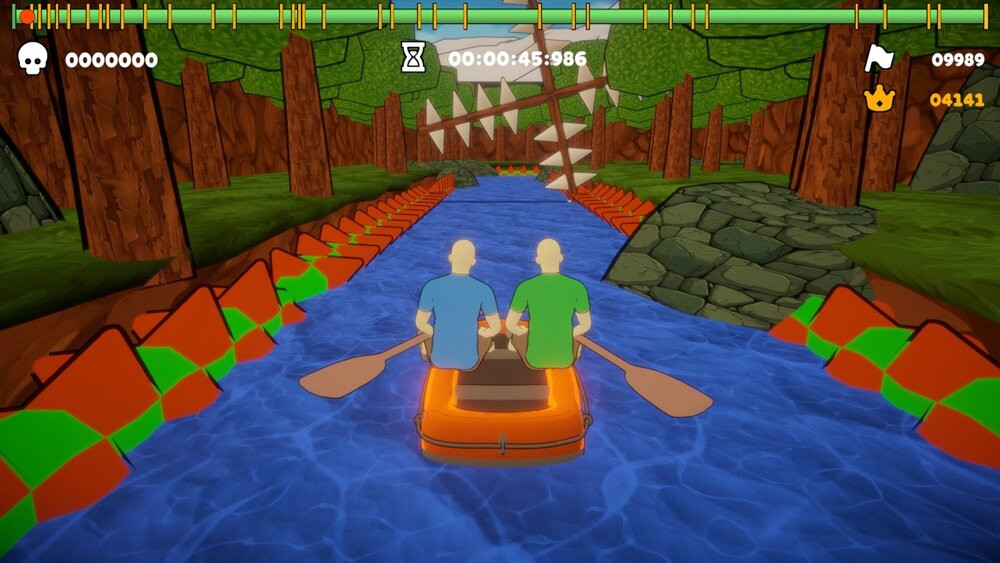
The game in question is 'Paddle Paddle Paddle,' a title well-known in the community as a 'friendship-destroying game.' Officially released on July 25, 2025, this 2-player co-op game requires two players to coordinate as they man the left and right oars of a boat, navigating through complex waterways. With its simple yet addictive gameplay and an intuitive system that makes it easy to enjoy with a friend, the game has earned high praise for its quality, currently maintaining a 89% recommendation rate and a 'Very Positive' rating on Steam.
Despite these positive user reviews, sales performance has fallen short of expectations. While it is true that for indie games, quality does not always correlate with sales volume, the issue for 'Paddle Paddle Paddle' is not sales, but refunds.
On the 6th, developer Mateo expressed his frustration with Steam's refund policy on X. "We've had over 55k refund requests so far," he stated. "This is absurd. I hope Steam takes some action regarding its refund policy." According to the figures he shared, the refund rate for 'Paddle Paddle Paddle' has reached a staggering 21%.
Steam's refund policy is undoubtedly a positive feature from a user's perspective. It is a reasonable choice to request a refund if you bought a game but lost interest, or if you played for about an hour and decided it didn't meet your expectations. The problem arises with indie games that have short playtimes or titles like 'Paddle Paddle Paddle' that are designed for casual, quick enjoyment. A Steam review shared by Mateo vividly illustrates this situation.
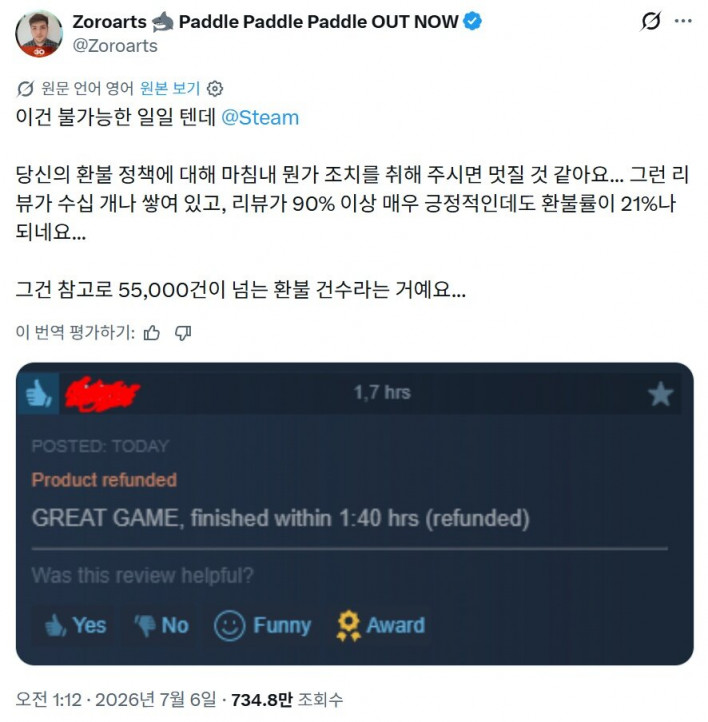
The reviewer described the game as "excellent" and recommended it to others. However, they had only played for one hour and 40 minutes, and they requested a refund after reaching the ending. While a positive review is beneficial, the fact that the user finished the entire game and then requested a refund is understandably disheartening for the developer.
Of course, some argue that the developer is also to blame for creating such a short game in the first place. Addressing this, Mateo explained, "The game was designed with a target playtime of about four hours. In fact, there are quite a few reviews from players who spent over five, or even more than 20 hours playing it," emphasizing that it was never intended to be a two-hour game. However, he did express some regret, noting, "Speedrunners or highly skilled players have managed to reach the ending in under two hours."
Meanwhile, after his post spread further than expected, he carefully clarified his position. "I am not against Steam's refund policy itself," he explained. "I just felt it was wrong for people to play a game for an hour and a half, enjoy it fully, and then request a refund simply because they can—and then brag about it in a Steam review."
As this situation has gained attention, a variety of opinions regarding Steam's refund policy have emerged. Some point out that requesting a refund after enjoying a game is malicious behavior, while others take a more detached view, suggesting that developers should compensate by increasing playtime, such as by adding stages later on. Caught between Steam's consumer protection policies and the realities faced by indie developers, the debate over refund criteria is likely to continue for some time.