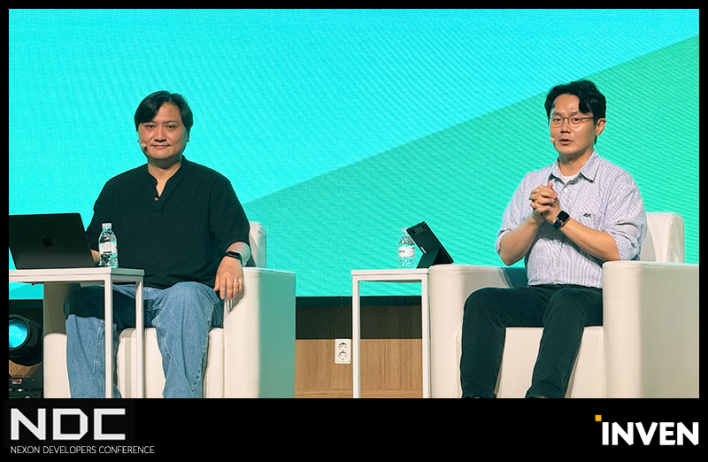
Topic: The AX Journey of Nexon and KRAFTON: What We Tried and What We Let Go Speakers: Kang Deok-won (Director, Nexon Korea), Lim Gyeong-young (Vice President, KRAFTON) Field: Artificial Intelligence Recommended for: Those interested in spreading AI literacy, innovating development productivity, and establishing enterprise-wide compliance
Tags: #NDC26 #AX #AI_Literacy
[🚨 Session Topic] In this session, Nexon and KRAFTON share their field experiences regarding their AI Transformation (AX) journeys—what they attempted, what they abandoned, and the criteria they use to prepare for the next steps. The discussion covers insights gained from the actual implementation process, ranging from spreading AI literacy and innovating development productivity to building enterprise-wide compliance, managing organizational change, and optimizing costs.
While many companies have jumped into AI Transformation (AX) alongside the rise of generative AI, the actual journey is not just about technology adoption, but a series of experiments, trial and error, and difficult decision-making. On the final day of NDC 2026, the two leaders driving AX at Nexon and KRAFTON gathered to share their successes and failures without reservation.
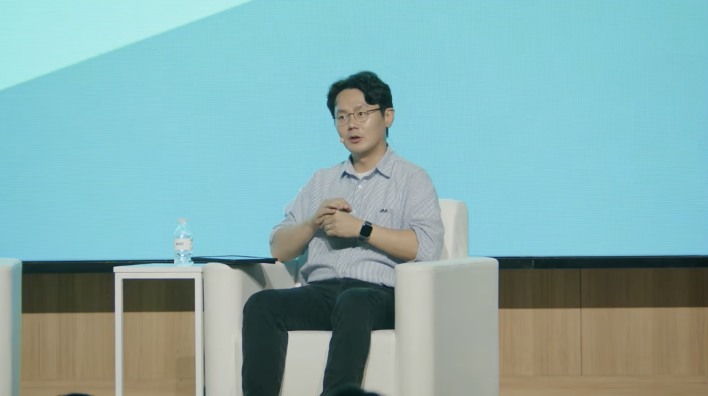
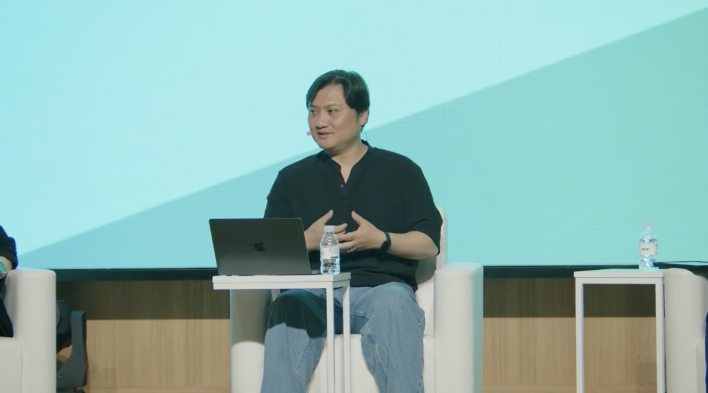
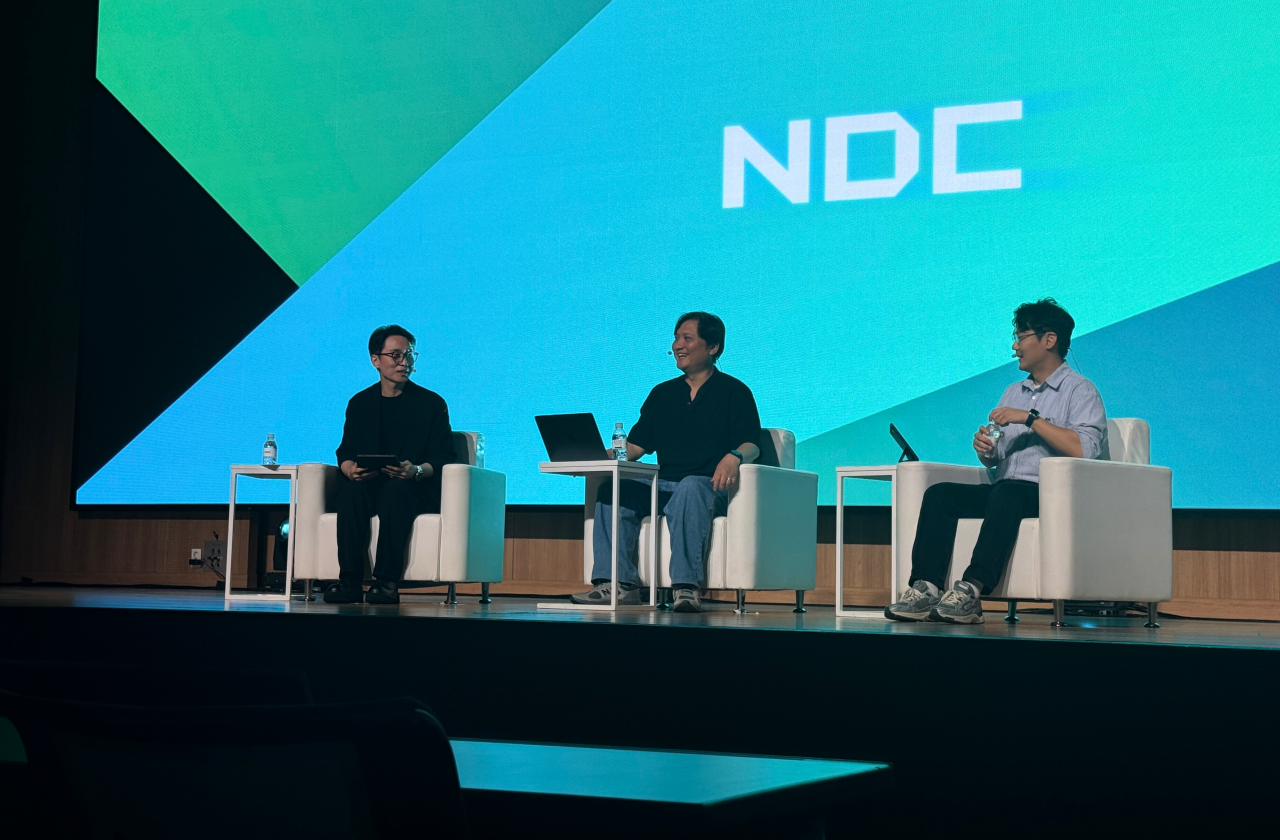
Kang Deok-won, Director of the AI Division at Nexon Korea, and Lim Gyeong-young, Head of AI Transformation at KRAFTON, discussed their experiences, moderated by Professor Kim Sang-kyun of Kyung Hee University. Despite being competitors, the two repeatedly expressed empathy as "colleagues facing the same challenges."
Different Starting Points: Nexon's 'Efficiency' vs. KRAFTON's 'AI-First Declaration'
The two companies began their AX journeys with different focuses. Director Kang explained that Nexon's initial goal was operational efficiency. "At first, we focused on automating labor-intensive tasks like service monitoring and reporting, which helped reduce operational burdens and improve our live service response capabilities," he said. Nexon's focus has now shifted to development productivity. The company is prioritizing development productivity as its top task, pushing for innovations in development methods, such as creating dedicated AI models and redesigning development pipelines.
Vice President Lim stated that KRAFTON focused most on "changing the way we solve problems to an AI-first approach." This means using AI first when working or brainstorming, and testing ideas with the expectation of what AI might produce. "Rather than trying to solve everything with AI at once, we are experimenting in stages, measuring the effects of applying AI to smaller units of work," he said.
Because Nexon is large and manages a diverse range of games and projects, it was difficult to push for AX using a single standard method from the start. Director Kang noted, "It might sound irresponsible, but we placed more weight on 'let's just try it.'" He explained that they focused on bottom-up foundations through AI literacy training and spreading success stories across organizations. He cited the discovery of 'champions' within each organization to lead AX as their greatest achievement, noting that these individuals play a key role in scaling success stories across the company.
KRAFTON followed a similar path but started with a strong declaration of intent from top management. "KRAFTON declared an 'AI-First' stance last November, and that expression of intent from management had a huge impact," VP Lim emphasized. Thanks to this strong commitment and the active provision of various AI tools, 97% of employees responded in a company-wide survey this February that they were "using AI." He added, "I believe management's expression of intent is still working effectively today."
The tangible changes were also clear. Director Kang cited the shift in how operational tools are built at Nexon as the most significant recent change. In the past, when development or operations teams needed data or tools, they had to submit requests to the data and development departments and wait a long time for results, often leaving them 'a step behind' when responding to critical live issues. As data literacy improved, each team began extracting its own data and building the necessary monitoring tools and operational consoles directly. As a result, the speed of securing decision-making information and responding to live issues has improved significantly.
VP Lim stated that they prioritized building foundational infrastructure first. "We constructed a common pipeline called 'KRAFTON Playground' and a 'Data Foundation' to ensure data literacy, allowing us to share the results created through automation," he explained.
The effects spread widely. A notable example is an HR team employee who had never coded before using Codex and Claude Code to build tools that automate recruitment interview scheduling, meeting room reservations, and email requests.
What Was Abandoned: Nexon's 'Suspension of Enterprise-wide Open-Claw Adoption'
While there are successful AX cases, a key part of the session was discussing 'things that had to be let go.' A representative example for Nexon was the enterprise-wide adoption of 'Open-Claw,' a powerful open-source-based agent tool. Management, including the CEO, tested it and decided it would greatly help productivity, leading to a pilot test by the 'champions.' They even developed a custom version, 'NX-Claw,' to address persistent security issues.
However, they hit a wall. Director Kang revealed, "Because it was open-source, updates were too frequent. Most were security-related, so we couldn't ignore them, but keeping up with them created an overwhelming operational burden." Automatic updates often caused system crashes, and given the company's size, the infrastructure costs were significant.
Nexon quickly concluded that "enterprise-wide adoption at this moment is premature." From this experience, Director Kang said, "We reaffirmed a simple but important truth: what is technically possible is not always sustainable." He explained that security is the top priority for stopping a project, and they re-evaluate if the expected effects are insufficient after considering user experience and costs.
VP Lim of KRAFTON candidly shared two 'misjudgments.' The first was the somewhat hasty adoption of large, enterprise-grade tools. While versatile, they struggled to capture the company's unique characteristics or the essence of their business in detail. The second was creating various tools that ultimately went unused.
He added, "We had plenty of experience, but if a tool doesn't gain users, it's ultimately a failed experience." However, KRAFTON does not use specific metrics to measure failure. They view the AX transition as a continuous process of trial and error, aiming to accumulate experience as an asset rather than measuring failure.
Hurdles to Diffusion and the Role of Central Organizations
Spreading success stories from one organization to another was a challenge for both companies. Director Kang admitted, "Even when good cases emerged, it was difficult to spread them to other organizations, and overcoming the speed gap between teams was very hard."
Nexon operates a Slack AI community with over 3k employees sharing daily experiments, but that wasn't enough. Recently, they began applying a top-down strategy as well. The central AI Division monitors progress closely, selects appropriate cases for teams lagging behind, and acts as a 'bridge' by connecting them with teams that have already implemented those solutions.
KRAFTON also faced difficulties in sharing success. VP Lim said, "If you share a success story but people build a wall saying 'that has nothing to do with me,' it becomes meaningless." To solve this, KRAFTON hired a dedicated role called 'FDE (Forward Deployed Engineer).'
FDEs are AX-dedicated personnel dispatched to various departments to solve technical, infrastructure, and methodological problems based on AI-native methodologies and to design and establish work automation. Having an 'AI-savvy person' in the office for casual questions proved effective. They also created an 'AX Portal' to publish results like an app store, with plans to expand it into a marketplace in the future.
The Hot Potato: Costs... "Expenses are visible, but effects are hard to measure"
Cost was one of the hottest topics throughout the session. Director Kang stated that "AI costs are the biggest hot potato," revealing that costs increased much faster than expected while actively supporting various tools for bottom-up diffusion.
However, he pointed to a bigger challenge than cost: "measuring how much these expenses translate into valuable work." For example, if token costs are high but a game development project is shortened by a month, those tokens are a worthwhile expense.
Nexon is researching cost-prediction models by analyzing token usage, usage patterns, and project progress, but noted, "It's not easy to reach a conclusion because results vary significantly depending on the day of the week and holidays."
KRAFTON configured a dashboard to view token costs, enterprise seat costs, and individual subscription costs in one place. Once token usage was made public, employees asked conflicting questions: "Are you telling us to cut costs?" vs. "Are you telling us to use more."
VP Lim said, "The answer differs for every company, organization, and situation. It might be right to encourage more usage in organizations that haven't secured AI literacy yet, while guiding those that are somewhat standardized to use it more efficiently." KRAFTON also provides a self-made benchmark table comparing the cost-effectiveness of models to help members choose. To reduce costs, they are lowering unit prices through direct contracts with partners and operating their own foundation models.
Industry Specifics: What makes AX in game companies different
The two had interestingly different views on the specifics of the game industry. Director Kang noted, "Games are ultimately an industry that creates "fun," and there is no right answer for fun." Therefore, areas where AX is easy to apply (automation) and difficult to apply (fun, creativity) are much more clearly divided than in other industries.
He said, "We are currently focusing on areas where effectiveness is easy to verify, but in uncertain areas where creativity and judgment are important, we must first define 'what humans must do.' AX in the game industry will be a process of redefining the role and value of humans beyond mere efficiency."
On the other hand, VP Lim viewed the game industry as easier to adopt AI. While commerce or finance cannot avoid regulatory issues regarding governance, games are relatively free. "Games are an industry where creativity must be the center," he said. "If we can make the work of crafting assets one by one easier with AI, we can spend that time on better creation, allowing creativity to flourish even more." He added that he finds great joy in leading AI transformation in the game industry.
The two companies' approaches also differed in how they handle vast context data. Nexon is focusing on converting user data, planning documents, and source code accumulated over its long history into 'data that AI can use well.' Director Kang explained that "standardizing all game data into one is impossible," so they are focusing on building an ontology that organizes relationships between data on a flexible data structure.
KRAFTON created a 'Data Foundation' catalog by distinguishing between game production assets and non-production assets, and built governance that separates production and publishing stages to account for different AI regulations in regions like Europe, Korea, Japan, and China.
AI-Native Workflows and Future Competitiveness
Both agreed that true change comes from 'workflows.' Director Kang stated that "there are still many unclear parts about how AI-native flows will unfold," so they are focusing on organizing existing workflows into a form that AI can utilize. It is a process of breaking down and standardizing work so that agents can perform each unit.
He emphasized, "If you view AX only as an efficiency tool, you won't get more than just churning out the same content two or three times. What's more important is redefining what humans should focus on. AX should not be a means to process work faster, but a process of finding the essence of work."
VP Lim said they started with the definitions of 'work' and 'workflow.' KRAFTON is pushing for 'enterprise impact' projects that turn unit-level work automation into a single process to accumulate experience. They are focusing on making work at the operational level a single, connected flow before moving to inter-departmental connections.
He explained, "Previously, it was a method of receiving a request, processing it, and replying. Now, we are working on automating that entire chunk with AI."
Evaluating AX Progress
The two also differed on the criteria for evaluating how far AX has reached. Director Kang stated that Nexon currently evaluates based on "how concrete and agent-based the work has become." This is because it is relatively easy to measure whether work has been broken down into units that AI can perform and whether it has actually been automated.
However, he noted, "These are just preliminary steps." He believes that if this concretization and agent-based work are repeated sufficiently, it will lead to a transition to AI-native workflows and time/cost savings in the long term.
Director Kang also made it clear that AX progress cannot be judged by time and cost savings alone. "Qualitative factors, such as whether we have achieved results that change company policy or culture, or created value that was previously impossible, will become important. In the future, we intend to create criteria with operational leaders that can evaluate not just efficiency, but the level of innovation."
VP Lim's stance was more cautious. "I think setting evaluation criteria is very dangerous," he began. This is because it is easy to make wrong judgments like "if you adopted AI, shouldn't you have time left over?" and the standard of 'normal evaluation' is inherently ambiguous.
He explained, "Our indicator is actually that we try not to have such evaluation criteria." While quantitative results like the number of apps registered in an app store can be measured, KRAFTON judges that "more effective AX is happening when someone asks someone else about something they don't know, and explains that unknown thing to someone else." They view the process of sharing trial and error as a signal of progress.
A Word to Juniors and Newcomers: "Expectation over Fear"
At the end of the session, both left messages for those entering the game industry. Director Kang said, "AI is developing so fast that even we feel half-expectation and half-fear. But the game industry has always grown with change, and every time technology changed, new opportunities opened up." He urged them to "place more weight on expectation than fear of AI, and move forward one step at a time with a mind to explore possibilities."
VP Lim predicted that juniors entering the industry now will become "true AI natives." This is because they are a generation that learns to work with AI from the start without stereotypes. "I am so excited and curious about what kind of games and businesses they will create in the new creative environment of the game industry," he said. "We welcome them."
When asked what they would like to learn from each other as competitors and colleagues, VP Lim replied, "I think we are all colleagues in AX, given that Nexon and KRAFTON are facing the exact same concerns."
Director Kang responded, "As we face similar concerns, I want to refer to and share the parts that have been solved," adding that he gained a hint from KRAFTON's approach of dividing organizations into those encouraged to use tokens actively and those encouraged to use them efficiently.