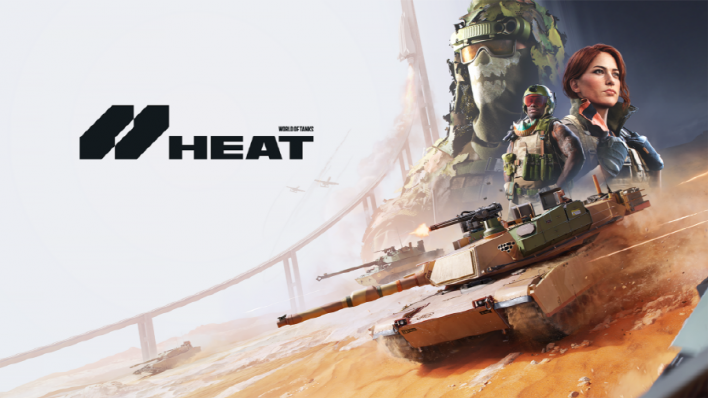
Wargaming's new game 'World of Tanks: HEAT' was officially released on the 26th. Combining the gravitas of tank warfare built by the original 'World of Tanks' with an 'Agent' system featuring unique abilities and ultimate skills, this game concluded its first large-scale closed beta test last April, recording a total of 156,880 battles and approximately 8 million minutes of cumulative combat time. To commemorate the game's launch, Inven conducted an interview with Artyom Yantsevich, Product Director of 'World of Tanks: Heat'. In addition to his career at Wargaming, he has accumulated about 15 years of industry experience, having held creative roles on major titles such as 'The Witcher III: Blood and Wine' and 'Cyberpunk 2077' at CD Projekt Red. He is currently overseeing the vision, strategy, and execution of 'HIT' at Wargaming. From the balance philosophy regarding the HSTV-L, the tank that was both the most loved and the most criticized during the CBT, to the process in which the early development idea of "giving tanks superpowers" evolved into the Agent System, and even the development team's definition of it as "a tactical tank shooter, not a hero shooter." We asked about the direction of 'World of Tanks: Heat', which has finally achieved an official release after a long time. Artyom Yantsevich, Product Director ©Wargaming 'World of Tanks: Heat' takes a unique position by combining hero shooter elements while sharing the same IP as the existing 'World of Tanks'. I am curious whether this direction was established from the beginning of development, or if the direction was changed during the development process.
The idea of adding "superpowers" to tanks, such as air support or bombardment, existed from the early stages of development. However, we refined and modified this concept based on feedback collected during testing.
Instead of expressing them as the tank's direct "abilities," we shifted toward expressing these abilities through an agent system while maintaining core functions. This allowed us to make the functions easier to understand and visually emphasize them, while increasing clarity and fun while preserving the basic gameplay intent.
The hero shooter genre already has many competitors in the market. If the development team were to choose the key point that differentiates 'HIT' from existing hero shooters, what would it be? World of Tanks: Heat is different from hero shooter games. Please view it as a tactical tank shooter game focused on tanks and agents.
Between existing 'World of Tanks' users and hero shooter users new to tank games, which target audience are you placing more weight on? Or is there a separate strategy to satisfy both demographics simultaneously?
According to feedback collected through multiple playtests, the game's core concept has been well-received by the younger user base. We are continuously refining and simplifying the game's key mechanics to ensure that both new and intermediate users can easily access and enjoy the game without being overwhelmed by complexity from the start.
At the same time, we are maintaining and expanding the deep gameplay system to allow hardcore and veteran users to continue exploring advanced strategies, synergies, and vehicle customization options.
Our goal is to deliver a vehicle combat experience that is easily accessible to a wide range of users while providing meaningful depth for those who wish to fully master the game. It was previously announced that the results of the last CBT recorded approximately 8 million minutes of combat time and about 14.1 billion damage. I am curious to know which metrics among the data collected through the CBT the development team focused on the most, or if there were any aspects that differed from expectations. During the CBT, the main priorities were technical stability, cross-play functionality, and gameplay balance. In particular, emphasis was placed on ensuring that the cross-play and cross-progression systems function seamlessly across platforms, and balance issues identified through alpha tester feedback were also resolved.
Most alpha test participants reacted positively to the changes, and many players expressed their desire to continue playing the game.
During the CBT, the AMX10 RC was recorded as the most used and simultaneously the most destroyed tank. I am curious to know what adjustments you are considering regarding the skewed pick rates of specific tanks/agents.
It is scheduled to be fixed at the time of official release. We plan to analyze data based on game progress and readjust tank balance.
AMX10 RC, the sniper class tank that recorded the most usage during the CBT ©Wargaming
Additionally, could you share any memorable feedback or interesting episodes you received during the last CBT? While we have received a lot of positive feedback overall, the feedback I keep mentioning concerns one of the tanks, the HSTV-L. The HSTV-L is a small, fast assault tank operated like an assassin. During the CBT, this tank received the most praise in the game, but at the same time, it also received the most complaints. Many players named it their favorite tank overall, while others said it was so powerful that it surpassed all other tanks.
In this situation, the easiest response would be, "This tank is too powerful, it needs fixing." However, we will not do that. The praise has told us an important fact: the HSTV-L's design concept is being implemented exactly as we expected, which is very encouraging. The part we need to adjust is the numerical aspects surrounding that design concept. The identity of the tanks will be maintained.
The AI Battle (Sandbox) mode has been functioning as a learning space for beginners; do you plan to maintain the AI Battle mode even after the official release? I am curious if there are any plans to introduce additional tutorials or training modes.
During the CBT period, AI battle mode and shooting training mode were available, and both modes are scheduled to be included in the official release. We will also provide beginner tutorials to help new players better understand the core gameplay. At the same time, we are planning additional onboarding opportunities and new training modes for the future.
"The design concept of the HSTV-L is what we expected." "The only thing to adjust is the numerical aspects." ©Wargaming
It was impressive that the core mechanics of the original game, such as armor thickness, angle, and ricochets, remained intact. At the same time, this system might feel complex to casual users. By what criteria are you drawing the line between simulation depth and accessibility?
" We always evaluate new ideas based on core design principles. One of our main creative directions is 'Mighty Machine Mastery.' This game is fundamentally a tank combat game built around the interaction between armor and shells, and we are building the game on top of the existing foundation of this genre. In this system, every element capable of inflicting damage is designed to play a meaningful role, and players will gradually learn the depth of mechanics—such as various shell types, armor configurations, and impact angles—through actual gameplay.
To support this learning curve and enhance adaptability, we have introduced tools such as armor indicators that allow players to visually identify weaknesses during gameplay. This enables new players to easily understand where to aim beyond the frontal armor, while allowing experienced players to gain sufficient depth to explore advanced mechanics and master the system.
How many agents are expected to be ready at launch? Please share any plans regarding the agent addition cycle after launch. The official release will feature 8 agents, and we plan to introduce additional agents whenever a new season begins. The game is characterized by a structure where agent and tank combinations are fixed. I am curious why you excluded a free combination system. Is it for balance reasons, or is it a design philosophy related to character identity? We received a lot of positive feedback regarding the concept of human-machine synergy during the early stages of development. This is the core of our design philosophy and one of the game's key principles. This approach also helps maintain balance consistency by reducing potential imbalances between gameplay systems. The fact that tank characteristics differ by agent even within the same role group was the fun of replayability. What is the first factor considered when designing a new agent? Is it the agent's character, the tank's combat role, or the gameplay concept of the skills and ultimates? When designing a new agent, we first consider the overall gameplay concept and the role the agent will play within the human-machine synergy system. This includes how skills and ultimates contribute to tactical situations and how they interact with various tank roles. Next, we develop the agent's personality and visual identity in parallel with the tank design, ensuring that the two elements harmonize to support the same gameplay and storytelling intentions. Ultimately, the final design is determined by combining gameplay features, emotes, and the synergy between the agent and the tank. While there are aggressive agents like Raketa specialized in close-quarters assaults, snipers were fragile and faced significant limitations in objective battles. Specific for each mode Situations where agents are at an advantage or disadvantage are inevitable. I am curious about your philosophy regarding this balance. Thanks to the feedback from players who participated in the CBT, we are currently aware of the balance issues and are proceeding with adjustments based on player opinions. After the official launch, we will be able to secure more extensive data to identify and resolve balance-related problems more effectively. During the CBT, players could experience four modes: Base Capture, Domination, Assassination, and Conquest. Are there plans for additional modes after the official launch? If there is anything specific you can reveal, please introduce it. For the official launch, in addition to the existing four PvP modes, a Versus AI mode and a Shooting Range mode are scheduled to be added. Additionally, a beginner's tutorial will be provided to help new players better understand the core gameplay. At the same time, we are currently planning and experimenting with larger-scale modes. Personally, I found Conquest (10vs10) the most fun. It was an experience where the scale of combat was distinctly different compared to 5vs5 mode; is there a mode that the development team is promoting as the signature mode of 'HIT'? Currently, Conquest We view the mode as a core mode of the game. We plan to introduce matchmaking where you can select your desired mode through a future update. ©Wargaming Even after the official launch, we are currently using the 'Quick Play' matchmaking method, which randomly assigns players to one of four modes. Will it be possible to select a mode for matchmaking in the future? As the game evolves, we will review opportunities to introduce additional options through future updates. Through tank parts, firepower, survivability, I have confirmed the progression system that enhances mobility and other capabilities. I am curious to know how the design incorporates the impact of performance differences caused by parts on battle balance. Various tank models and agent traits enhance the tactical characteristics of tanks and modify abilities, allowing players to adjust their play style through customization. The matchmaking system ensures balanced and fair matches by considering both player skill and tank performance. I understand that 'World of Tanks: Heat' uses a new engine developed in-house by Wargaming. What are the biggest technical features of this engine, or how does it differ from existing engines? The most important point is that this engine was developed around two main pillars. One is Wargaming's signature tank physics engine and combat feel, and the other is the modular agent and ability system necessary to implement a new dimension of gameplay in 'World of Tanks: Heat'. A general-purpose third-party engine would not have been able to provide these two features natively, and providing them simultaneously would have been even more impossible. From a technical standpoint, hardware compatibility was not a secondary consideration but a top priority from the very beginning. The engine has undergone optimization and is designed to run smoothly on a wide range of hardware, from older PCs to Steam Decks, while maintaining visual quality befitting a modern game. Furthermore, because the engine was developed in-house from start to finish, we can iteratively improve rendering, vehicle physics, abilities, and agent systems according to our desired schedule. The necessary for new agents or new modes If a feature is not yet in the engine, it can be simply added through further development. The proprietary engine that was essential for the two core elements forming the foundation of the game ©Wargaming First, we provide an option to disable cross-platform matchmaking if players prefer a more controlled environment without differences in input methods. At the same time, we are continuously striving to ensure a fair and high-quality gaming experience across all platforms, including mouse/keyboard and controller input. Our design focus is not simply on reaction speed, but on how well players understand and utilize tank mechanics and tactical decision-making. Through this, we ensure that success depends more on gameplay knowledge and strategy than on the input method itself. Please say a few words to the World of Tanks IP fans who have been waiting for this launch, and to the gamers currently playing World of Tanks: Heat. We thank all the fans for their continued support and passion for waiting for the official launch. The team is doing its utmost to perfect the game, and we look forward to you all experiencing it.