Nexon achieved its highest-ever quarterly performance in Q1 2026, with revenue of ¥152.2 billion (approx. KRW 1.42 trillion) and an operating profit of ¥58.2 billion (approx. KRW 542.6 billion). Revenue and operating profit increased by 34% and 40%, respectively, year-over-year. This performance was driven by the global success of the new IP 'ARC Raiders' and the solid growth of the 'MapleStory' franchise.
'ARC Raiders' surpassed 16 million cumulative units sold within six months of release. Over half of its active players have logged more than 100 hours, with total playtime exceeding 1.5 billion hours. Nexon plans to sustain this growth with the 'Frozen Trail' update in October, which will include a massive new map and story content.
The 'MapleStory' franchise saw a 42% year-over-year revenue increase, bolstered by the performance of 'MapleStory Grow' and 'MapleStory Worlds.' While Nexon expects a moderate performance in the second quarter due to base-effect headwinds for 'Dungeon & Fighter' and 'Mabinogi Mobile,' it anticipates a rebound in the second half of the year through various catalysts, including the overseas launch of 'Mabinogi Mobile,' the Korean publishing of 'Overwatch,' and 'Dungeon & Fighter: IDLE RPG.'
Nexon has also solidified its plans for structural improvements to enhance capital efficiency and shareholder return policies. The company is implementing a cost-management policy to keep labor costs and headcount at previous-year levels and has confirmed a ¥30 billion share buyback and an annual dividend of ¥60 per share. Additionally, Nexon signed a 10-year renewal for the 'Dungeon & Fighter' PC service with Tencent and will transfer the development of the Chinese mobile service to Tencent to strengthen local expertise.
Earnings Call Q&A
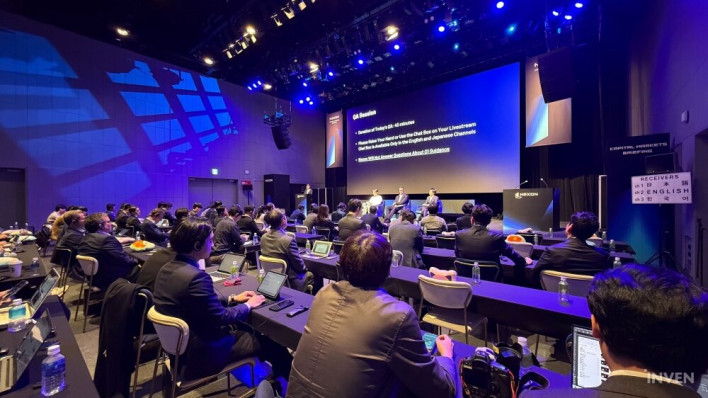
Regarding 'ARC Raiders' monetization: The 'Frozen Trail' update in October is a mix of free content and a premium pass. Can we expect a profitability rebound after this update.
CEO Lee Jung-hun = The October update is the largest since the launch of 'ARC Raiders.' User expectations are high, and we are internally very optimistic. Observing community reactions and play patterns since launch, we confirmed that users want deeper core systems and richer experiences rather than just a simple accumulation of content. This is the primary goal of the update. We will introduce a massive new map, new goals for endgame users, and story content exploring the origins of the ARC, so we expect significant changes in the second half.
In terms of monetization, we expect the large-scale free update to bring back lapsed users and drive purchases through new user acquisition. At the same time, we are offering a paid premium reward pass that expands customization options, such as character outfits. As we have announced a shift in our live service strategy to a major update cycle of six months or more, we ask for your continued interest.
The Chinese 'Dungeon & Fighter' franchise has seen lower revenue compared to four or five years ago. Is there a structural issue where the franchise itself is aging, making it difficult to maintain revenue as the user base grows older and trends shift?
CEO Lee Jung-hun = That question is a fundamental concern for every developer of long-term live games. Online games are like living organisms; user inflow and outflow occur every moment. For long-running projects like 'Dungeon & Fighter' or 'MapleStory' that have been serviced for over 15 years, daily inflow might seem minimal, but when converted to an annual basis, the volume of incoming users is vast.
The user base is circulating, and the idea that metrics decline simply because users age is inaccurate. The current issue is that the update direction for this action RPG has become stagnant, making it predictable for users. Instead of similar patterns of dungeons or level-cap expansions, we need freshness in design. This is a matter of content quality and direction, not the aging of the user cohort.
As a countermeasure, Nexon, Neople, and Tencent have been exploring ideas to provide freshness for several years, and the results will be reflected in the game starting in the second half of this year. We are carefully preparing a concrete plan to apply the portfolio expansion strategy that succeeded with the 'MapleStory' franchise to 'Dungeon & Fighter.'
Regarding the Chinese 'Dungeon & Fighter Mobile,' last quarter's guidance expected flat performance, but that was not the case. What is the analysis, and why was the effect of the level-cap increase minimal? Also, does transferring development to Tencent mean a reduction in the Korean development team and a change in the cost structure.
CEO Lee Jung-hun = I will answer from the perspective of the entire 'Dungeon & Fighter' franchise. In Q2, KPIs such as traffic and user engagement showed meaningful achievement, but revenue metrics were lower than expected. Traffic remains stable for both mobile and PC. For the PC version, the goal is to maximize engagement through the June anniversary event and the October National Day update, and to maintain retention until next year's major update.
Mobile saw traffic growth with the March update, but it lacked sustainability. Users are not motivated by the stagnant progression system and want fresh content they haven't experienced on PC.
Transferring development to Tencent does not mean a reduction in the Korean development team. The Tencent team will accelerate the development of content tailored to local user tastes, while the Korean team will maintain creative control based on their deep understanding of the IP. This year, both teams will work together to launch updates that create new metas and play motivations.
We are also working in parallel to increase content production speed by introducing AI-based workflows. While it is difficult to increase the update speed of a 20-year-old 2D dot-based game, we are making progress in increasing content supply by automating repetitive tasks.
The goal for the Chinese service is growth, not just recovery, and the 10-year renewal announced today will be a stable foundation for this growth.
Does the transfer of development to Tencent change the revenue-sharing ratio? Are the revenue targets in the guidance figures before or after the change in the revenue-sharing ratio.
CFO Shiro Uemura = The revenue figures are the same. The revenue-sharing ratio is not included.
Last quarter's guidance expected a ¥9 billion increase, but that level of growth is not appearing. There must be bonuses related to 'Dungeon & Fighter' performance or 'ARC Raiders'; are there other factors lowering labor costs.
CFO Shiro Uemura = 'ARC Raiders' performance is in line with expectations, not exceeding them. There are instances where deferred revenue makes the reported figures look larger. There are two factors lowering labor costs: one is that we are controlling hiring, and the other is the reversal of bonus provisions for underperforming titles. We expect labor costs to remain at a similar level to the previous year on an annual basis.
You mentioned that Q2 would be the lowest quarter of the fiscal year and cited catalysts for a turnaround. Should we understand that performance will improve toward the second half of the year? Please share the full-year outlook.
CFO Shiro Uemura = It is our policy to provide guidance only for the next quarter, so it is difficult to give annual guidance. Qualitatively, among our three major franchises, 'Dungeon & Fighter' will do its best for the June anniversary and National Day preparations, and 'MapleStory' will maintain its positive momentum. 'FC' will use the June World Cup as a driver to increase engagement. 'ARC Raiders' is expected to gain momentum through its major October update. There are numerous catalysts in the second half, including the Taiwan/Japan launch of 'Mabinogi Mobile,' the Korean publishing of 'Overwatch,' 'Dungeon & Fighter: IDLE RPG,' and 'Azur Promilia.
If there are many positive factors starting in Q3, should we understand the Q2 slump as temporary.
CFO Shiro Uemura = The Chinese business is in a difficult situation, and it is true that reconstruction will take some time. The method of rebuilding the Chinese business is a very important task. Excluding that, there are various catalysts we can rely on, so I believe it depends on overcoming the challenges in China and maintaining the growth trajectory.
What is the sensitivity to exchange rate fluctuations and the annual impact.
CFO Shiro Uemura = We do not predict exchange rates, but we are assuming a rate of ¥159.33 to the dollar for Q2. A ¥1 fluctuation in the exchange rate has an impact of ¥750 million on revenue and ¥140 million on operating profit.

Sort by:
Comments :0