In August 2026, a closed hands-off demonstration of 'Guild Wars 3' was held at the NC booth at Gamescom.
First revealed last May, 'Guild Wars 3' is a brand-new entry in the series arriving 14 years after its predecessor. However, it is not simply a sequel depicting the era after 'Guild Wars 2.' Instead, time flows backward. 'Guild Wars 3' is set in ancient Orr, over 1,000 years before the first game, back when the human gods had not yet left the world.
At the event, developer ArenaNet showcased actual gameplay of 'Guild Wars 3,' which is currently in early alpha. During the roughly 18-minute presentation, the development team focused heavily on introducing the new traversal system and combat mechanics. Rather than simply adding more modes of transportation, they emphasized a structure that carries the 'Momentum' generated during movement directly into combat, dynamically altering fighting methods based on terrain, enemy traits, and party composition.
The demonstration was conducted as a 'hands-off' presentation, where the developers explained the game while walking through gameplay footage rather than offering hands-on play. ArenaNet Studio Head Colin Johanson personally presented the game. A brief Q&A session followed the hands-off demo.
Note that photography and video recording inside the demonstration area were strictly prohibited for security reasons, and no separate screenshots or B-roll were provided.
Orr 1,000 Years Ago, Before Everything Began
'Guild Wars 3' is set in Orr, over 1,000 years prior to 'Guild Wars: Reforged.' This is an era before the human gods departed Tyria, shortly after Dhuum, the original god of death, was cast down from his throne and replaced by Grenth. It takes place even before the First Guild War occurred.
ArenaNet chose this era for two key reasons.
First, for existing players, it offers a direct look at a historical era that had only been known through fragmented lore over the past 20 years. Although Orr holds a crucial place in the history of the 'Guild Wars' franchise, what players were previously familiar with was largely Orr after its downfall. In 'Guild Wars 2,' players explored ruins raised from the seabed by the Elder Dragon Zhaitan.
In contrast, 'Guild Wars 3' showcases Orr prior to its destruction—an era when magic overflowed across the land and the human gods resided in Arah. The developers highlighted the opportunity to directly explore an era that was previously documented only in small fragments.
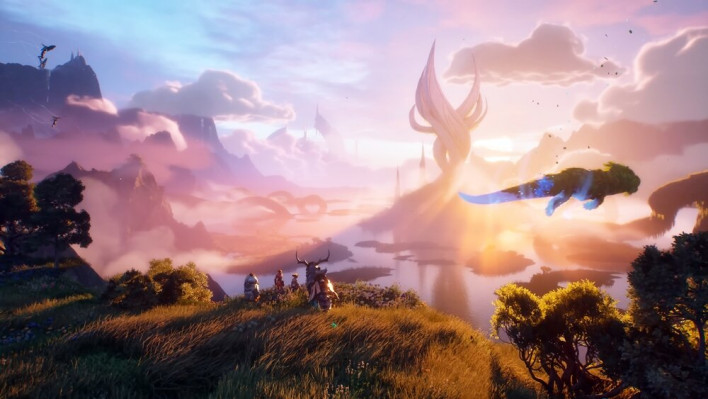
At the same time, new players will not need to study the long history of the franchise. Because most of the events from the first and second games have not yet taken place, both veteran players and newcomers can start the story on relatively equal footing.
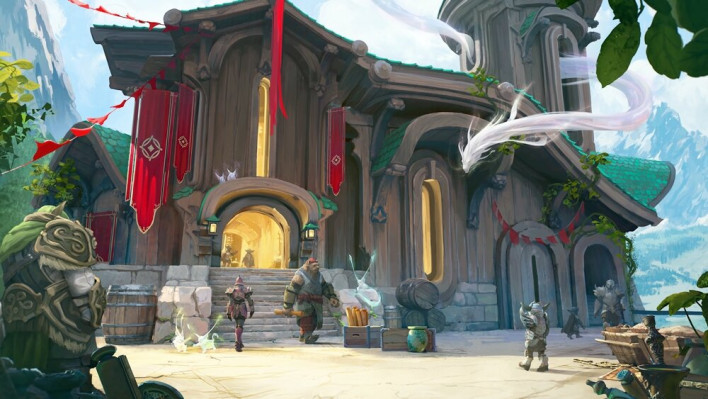
Players take on the role of a 'Vaelwarden,' a member of the 'Order of the Vael,' the oldest guild in Orr.
In this era, Orr's immense magic permeates nature itself, creating a unique magical ecosystem known as the 'Vael.' The role of a Vaelwarden is to protect the wilderness of Orr and the countless magical spirits living within it. Their creed is simple: "Protect those who cannot protect themselves."
The Vael spirits encountered in the game are not mere background elements. Vaelwardens form bonds with and protect them, and some spirits directly assist in gameplay. During the demo, a player summoned a small Vael spirit to illuminate the surroundings while exploring dark ruins.
A ruined temple dedicated to Dhuum also appeared during the presentation. In this era, Dhuum has just been cast out from the pantheon, with Grenth rising as the new god of death. Followers of Grenth destroyed Dhuum's temples across Orr, leaving the abandoned ruins as hazardous locations.
This historical backdrop also shapes the game's visual tone. Technologies seen in 'Guild Wars 2'—such as tanks, firearms, and massive floating cities—do not yet exist. Because even magic has not yet spread widely among Tyria's mortals, the overall world feels like a lower-tech high fantasy compared to previous entries.
Running, Flying, Wall-Running... An MMORPG with Transformed Traversal
The first aspect ArenaNet emphasized in 'Guild Wars 3' was movement—specifically, the joy derived from controlling the character itself rather than just fast travel mechanics.
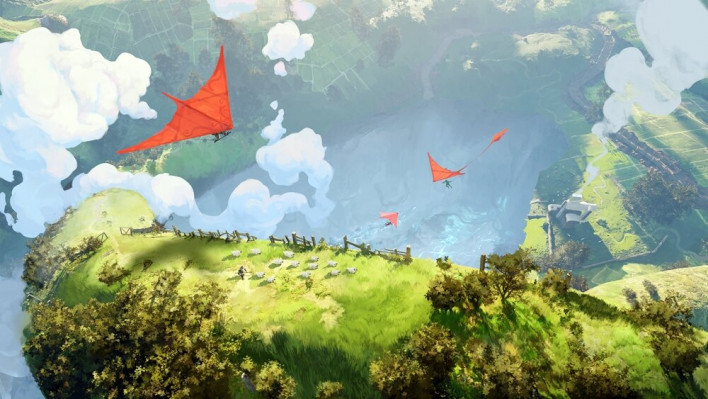
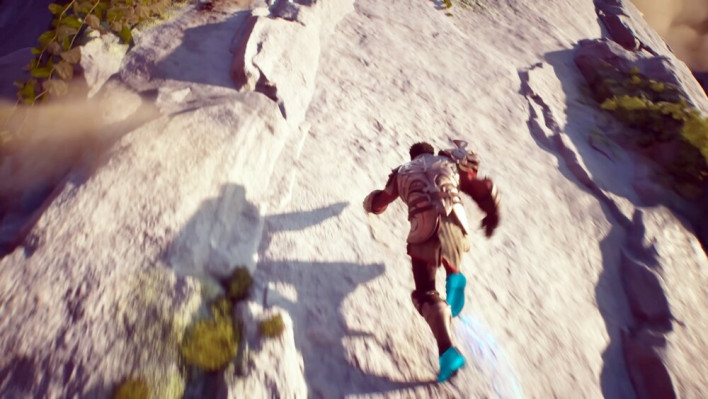
To achieve this, 'Guild Wars 3' offers significantly freer movement than traditional MMORPGs. Players can scale high terrain, run along walls, leap from heights to deploy a glider, and utilize various other traversal methods.
Connecting all of these actions together is a new system called 'Momentum.'
In typical MMORPGs, individual movement methods are segmented. Dismounting stops momentum, landing with a glider resets ground movement, and using skills in combat often freezes motion altogether.
In 'Guild Wars 3,' inertia generated from one action carries directly into the next. A player can leap from a high point, open a glider to glide, dive toward the ground, fly toward a cliff, and run up a wall seamlessly. The core idea is not to use movement abilities in isolation, but to maintain speed and inertia as one fluid, continuous motion.
Through this, ArenaNet seeks to deliver 'the pure joy of movement.' Traversal is no longer just a passive commute between fights, but a core element of gameplay itself. What makes it even more compelling is that Momentum does not stop at traversal.
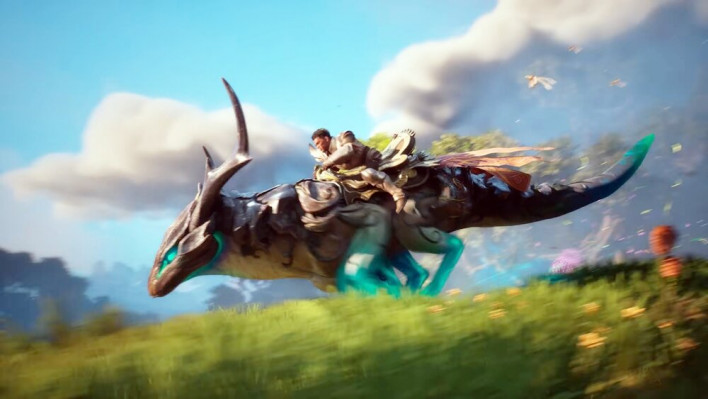
Action combat in 'Guild Wars 3' incorporates player velocity into actual attacks. In the demo, a warrior dropping from higher elevations dealt increased aerial attack damage and covered a wider area of effect. Scaling a wall to gain height before performing a plunging attack into enemy lines demonstrated how movement and combat merge seamlessly.
Momentum also affects knockback distance. Even massive enemies that are normally immovable can be displaced if attacked with sufficient momentum. In short, how a player moves right before combat directly factors into their attack power. Rather than treating traversal mechanics like wall-running and gliding as standalone features, carrying speed and inertia from movement into combat is one of the defining highlights of 'Guild Wars 3.'
Momentum Carries Over into 'Combat'
If momentum connects movement and combat, the next dimension is where players fight. Battlefields in 'Guild Wars 3' are not passive arenas for trading skills. Surrounding terrain—walls, cliffs, and elevation changes—directly impacts combat. For example, knocking an enemy hard into a wall inflicts extra damage and stuns them. Near a cliff, enemies can be knocked off entirely.
Naturally, these rules apply equally to players. Being knocked into a wall by a large boss causes damage and stuns the player as well.
As a result, 'where you fight' is just as crucial as 'what you fight' in 'Guild Wars 3.' Even when facing the same enemy, available strategies shift based on whether there are walls to utilize, cliffs nearby, or high points from which to build momentum.
Enemy anatomy and weak points serve as additional combat variables. In the demo, a 'Burner' from the Mavenlight Guild trapped Vael spirit power in a back-mounted device to power a flamethrower. While formidable from the front, the device on its back had low durability.
While one player drew the enemy's attention from the front, another flanked to target the weak point, detonating the device to instantly take down the Burner. Rather than treating an enemy as a single health bar, specific parts of character models function as targeting points integrated into party play.
Skill combinations between players are equally essential. In the presentation, a shield-wielding warrior boosted another player into the air like a launchpad. Teammates could use this to execute high-angle aerial strikes or reposition behind enemies. Instead of using abilities in isolation, players can combine them to trigger brand-new actions.
In certain scenarios, a party's skill loadout serves as the direct solution to a battle. A spider-like enemy sprayed webs across the ground and players, drastically reducing both movement and attack speeds—a tough match for melee warriors.
However, when a teammate imbued surrounding allies' attacks with fire, the situation changed completely. Fire burned away the surrounding cobwebs and dealt bonus damage to the flame-vulnerable spider.
Furthermore, signature 'Guild Wars' build crafting returns to prominence. The developers explained that they are re-emphasizing the concept of 'build countering' seen prominently in the first game. Even if a character learns numerous skills, the number of active skills brought into an adventure is limited, requiring players to tailor their loadouts to specific regions and targets.
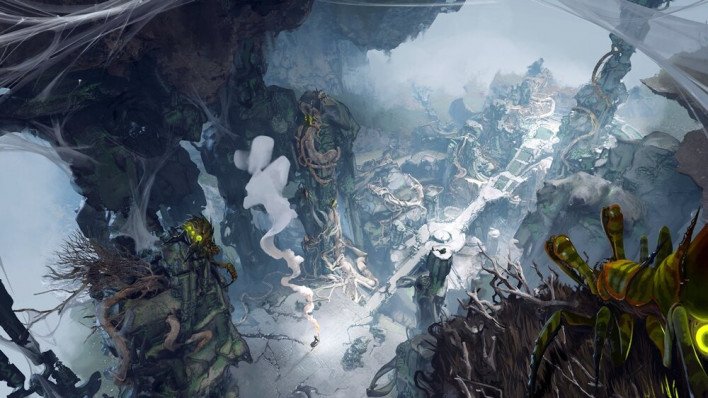
Ultimately, combat in 'Guild Wars 3' does not aim to be just another twitch-reaction action MMORPG. Instead, player movement speed and direction, surrounding terrain, enemy weak points, and party skill choices all simultaneously impact battle.
ArenaNet views this synergy of fluid movement and action combat as a foundation to push MMORPG gameplay forward and create a more modern player experience.
As the game remains in early alpha, the demo revealed only a fraction of this vision. ArenaNet plans to share further details later regarding additional traversal systems including mounts, character progression, professions, build crafting, and skill mechanics.
The Return of Tanks, DPS, and Healers — Why?
In Guild Wars 2, skills were determined by weapon choice. Will Guild Wars 3 follow the same approach, or will weapon-skill relationships be more flexible like in the first game?
Colin Johanson: The build customization system is still actively in development. Exactly how each element will come together isn't finalized yet, which is why we aren't ready to share specific details just yet. Once the system is locked down, we'll reveal more. Our combat team is currently testing various approaches.
This is the first time in the series supporting consoles. Were there any challenges during console development?
Colin Johanson: Consoles themselves weren't a major issue. While our engineers had technical challenges to solve, developing for PlayStation wasn't an overwhelming hurdle from an overall tech perspective.
The real challenge was designing for gamepads. We've been a PC-focused studio for 26 years. Designing a game from scratch for a device with far fewer inputs than a keyboard and mouse was a massive shift.
Initially, given our long PC history, we naturally approached design with a mouse and keyboard mindset. However, controller constraints actually became the catalyst for evolving our combat system.
Because of this, 'Guild Wars 3' features many situational abilities. For instance, certain attacks are available only after a dash, or morph into different forms while wall-running.
With a limited number of buttons on a controller, we had to get creative with skill triggers. In a standard MMORPG, available skills sit on an action bar, and players manually click or press them. But many of the skills shown today become available only contextually, triggered by performing specific actions.
While designed to overcome gamepad button limitations, it ultimately resulted in making combat itself far more engaging.
Will cross-play be supported between PC and consoles?
Colin Johanson: Yes. Players across PC, Steam, and console will all share the same world and play together.
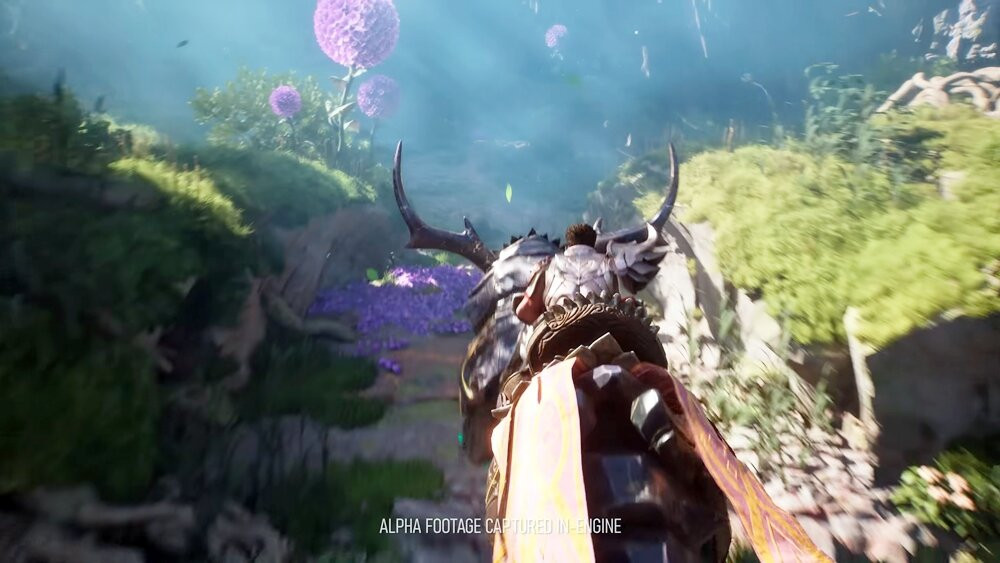
In Guild Wars 2, the team tried to move away from the traditional trinity of Tank, DPS, and Healer. However, today's demo featured an aggro system. Will roles be clearly defined again in Guild Wars 3?
Colin Johanson: Yes. 'Guild Wars 3' moves closer to the traditional Tank, Healer, and DPS framework. Roles are distinctly defined compared to before.
However, even when performing the same role, execution varies by profession. For instance, if a Necromancer tanks, they might summon swarms of minions to absorb hits. In contrast, the Warrior shown today stood directly on the front lines with a sword and shield to block attacks.
So while both function as tanks, their methods differ by profession. Role separation is clearer than in 'Guild Wars 2,' making it feel closer to 'Guild Wars 1' in that regard.
Are there elements present in Guild Wars 1 that vanished in Guild Wars 2 that you are bringing back for Guild Wars 3? For instance, specific professions or archetypes?
Colin Johanson: We'll talk about other professions down the road. Today we only revealed small portions of the Warrior and Necromancer. I could mention a few examples regarding the Ranger, but the rest will be revealed later.
If I had to pick the single biggest element inspired by 'Guild Wars 1' from today's showcase, it would be the build counter system.
In 'Guild Wars 1,' enemies possessed very specific capabilities, forcing players to think carefully about their build depending on where they were going. You crafted builds specifically to counter regional enemies and formed parties with NPCs or other players accordingly.
In 'Guild Wars 3,' we are placing heavy emphasis on this mechanic again. Especially in high-difficulty areas, our goal is to encourage players to experiment with diverse builds and find optimal team synergies to clear dungeons and challenging content.
The UI is remarkably minimalist. Are status effects like Bleeding or Burning conveyed through visual changes on characters and the battlefield rather than icons?
Colin Johanson: There is indeed very little UI overall. This also ties directly into console development.
On console, players can't hover a mouse over icons to read tooltips. Therefore, players need to comprehend what's happening in the world visually without relying on UI elements.
As a result, reading combat situations became significantly easier. While it wasn't our initial goal, designing for console and living-room environments naturally led us in this direction.
We also put far more effort into rendering status conditions. For instance, as multiple characters and skills inflict Cold damage, the enemy visibly shivers, slows down, and eventually freezes solid.
This status effect system ties into cooperative play as well. If different builds and characters stack Cold attacks, even bosses and large enemies can be frozen.
In conventional RPGs, bosses are often immune to crowd control like Freeze or Knockback. We allowed players to coordinate and achieve these effects together. Consequently, refining status effect visuals naturally fostered better teamwork.
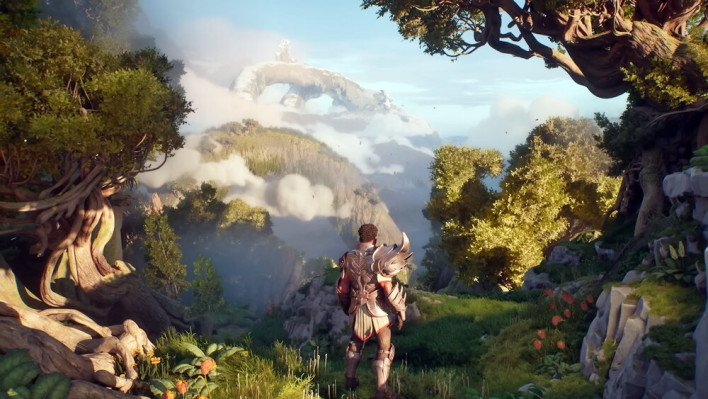
Is the Vaelwarden Camp shown earlier similar to the outposts in Guild Wars 1? A hub where players meet, stepping outside into separate instanced zones?
Colin Johanson: It's similar in that it serves as a safe hub to progress, tweak builds, form parties, and interact with other players.
However, unlike 'Guild Wars 1,' these camps exist seamlessly within the open world. You can walk in and out without loading screens or instance transitions.
The entire world of 'Guild Wars 3' is one massive open world with far fewer loading screens than previous 'Guild Wars' games. Our goal is to let players travel seamlessly from one end of the world to the other.
Entering major cities or towns naturally brings you into contact with more players, much like how major hubs functioned in 'Guild Wars 1' and 'Guild Wars 2.' While Vaelwarden Camps were inspired by 'Guild Wars 1' outposts, they now exist directly within a shared open world.
In that case, will large-scale PvP like Guild Wars 2's World vs. World (WvW) be integrated into this open world?
Colin Johanson: World vs. World will remain a signature feature exclusive to 'Guild Wars 2.'
If you view the series on a spectrum, 'Guild Wars 1' is closer to the smallest-scale MMO we could build—mostly instanced spaces where you can play solo if you choose. 'Guild Wars 2' sits on the opposite end, where hundreds of players assault massive castles and take down world bosses in an open world.
We already have both of those games, and we will continue to update and support both for years to come. Dedicated teams are operating each title right now. 'Guild Wars 3' sits somewhere in between. Internally, we refer to it as a 'Meaningfully Multiplayer MMO.'
The overwhelming scale and spectacle of 'Guild Wars 2' are fantastic, defining what that game is. But we don't need to make the same game again. With 'Guild Wars 3,' our focus is on creating a structure where player actions provide genuine assistance to one another, generating meaningful gameplay experiences through cooperation. The combat system demonstrated today reflects that philosophy.
Therefore, extreme mass-scale content like World vs. World will remain unique to 'Guild Wars 2,' which we will continue to support.
Recently, many MMORPGs have adopted systems influenced by Guild Wars 2. Conversely, were there elements in developing Guild Wars 3 directly inspired by other MMORPGs?
Colin Johanson: We rarely look at a specific game and think, 'Let's copy that.' Our development process is actually the opposite.
Whenever we create a new 'Guild Wars,' we analyze the entire MMORPG landscape at that moment. We list the friction points players face, what frustrates them, and where the genre hits limitations, then spend years finding solutions. Opting for a no-subscription MMO model with 'Guild Wars 1' was a direct response to genre limitations at the time.
In 'Guild Wars 2,' we wanted to solve the issue where having other players around ruined the experience. We asked why encountering others in an open world didn't make the game more enjoyable, leading to open-world content designed for seamless cooperation.
We followed the exact same process for 'Guild Wars 3.' About four years ago when development began, we conducted a comprehensive analysis of the MMORPG industry to identify player pain points and genre constraints.
For instance, one key question was, 'Why is MMORPG combat so static?' We questioned why combat couldn't be more fluid and traversal more natural, spending years experimenting with systems until arriving at what we have today.
So rather than lifting features directly from specific titles, it's about evaluating the whole genre—including 'Guild Wars 1' and 'Guild Wars 2'—and identifying unresolved gaps.
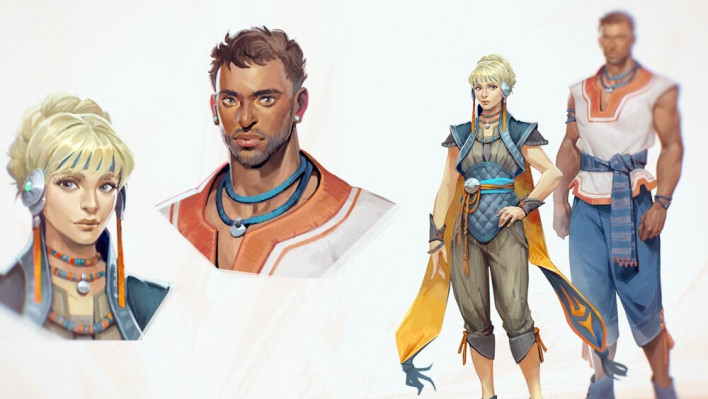
Why decide to create Guild Wars 3 now? Was it an accumulation of ideas that were difficult to implement in Guild Wars 2, or did you determine over time that a new game was necessary?
Colin Johanson: It's both.
We've been discussing this kind of combat system since 'Guild Wars 2: Heart of Thorns.' Even back then, we built various prototypes to explore what a new combat system could achieve.
However, much of what we wanted to accomplish couldn't be realized within the 'Guild Wars 2' engine and structural constraints. So we shelved those ideas, intending to revisit them when building a new title. Over time, features that required a fresh game accumulated.
From the perspective of 'why now,' market shifts played a role.
Particularly in the West, there have been few new MMORPGs over the past decade. While Eastern markets saw many ambitious new MMORPGs, Western releases were scarce, and those that launched often repeated past formulas with few bold, innovative leaps.
We observed massive player rushes whenever a new MMORPG debuted in that climate. A recurring sentiment emerged: players craved something fresh, calling for new ideas and different MMORPG experiences. As those voices grew loud enough, we decided the time had come to create a new game.
That is the kind of game we want to make—one that shakes up the genre and tests bold, innovative concepts. If three or four work brilliantly while a few fail, that's perfectly fine; trying new things inherently involves that process.
Ultimately, we hope our fresh approach to MMORPGs inspires other developers. Seeing future games adopt some of our ideas would be wonderful. The industry needs a game like this right now, and MMORPG players are asking for it. So many people are echoing the same thought: they are waiting for a new, major AAA MMORPG.
Guild Wars 3 is set over 1,000 years before Guild Wars 2. Does that mean the world's technological and magical advancement levels differ significantly?
Colin Johanson: It is much closer to pure high fantasy. In 'Guild Wars 2,' the Charr build tanks and firearms, while the Asura construct massive floating cities. But in the era of 'Guild Wars 3,' those haven't been invented yet. It's even before Abaddon granted magic to the mortal races of the world, making magic a far more scarce resource.
Even when magic is wielded, it's done by siphoning power from Vael spirits or drawing upon the energy stored in small magical artifacts called Signets. Since the supply of craftable Signets is limited, a black market for magic thrives, serving as a key narrative element. The overall atmosphere feels much closer to a lower-tech, pure high fantasy.
If you imagine setting the world of 'Guild Wars 1' back another 1,000-plus years, you'll get a similar feel. Technology itself is rare, and what exists consists of cobbled-together mechanisms or devices powered by siphoned Vael spirit magic.

Sort by:
Comments :0