In June, Red Brick House, a publisher specializing in indie games, opened its doors. The company was founded by three individuals who previously worked together at NEOWIZ's Investment Division. Hong Ji-cheol, formerly a director, and Kim Hyeok-jin, formerly an indie investment lead, serve as co-CEOs, while Lee Min-jeong, formerly a China business lead, serves as a director.
Just over a month after its launch, the company secured strategic investment from WEMADE MAX and financial investment from five venture capital firms, including Kakao Ventures. This is an exceptionally fast pace for a startup that has yet to release a single game.
In Korea, indie game publishing has long existed only as a department within large game companies. This is reportedly the first instance of business development (BD) professionals, rather than developers, leaving their companies to establish a specialized publisher. We met with the three founders to ask why they left and what they aim to achieve.
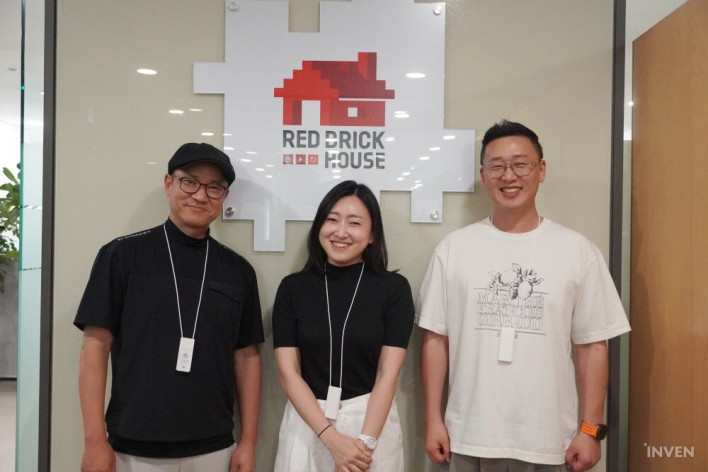
Building the Red Brick House
What kind of company is Red Brick House.
Kim Hyeok-jin = We are a publisher specializing in PC and console indie games. It took us three weeks just to decide on the name. It was the topic we discussed the most, and the process was intense.
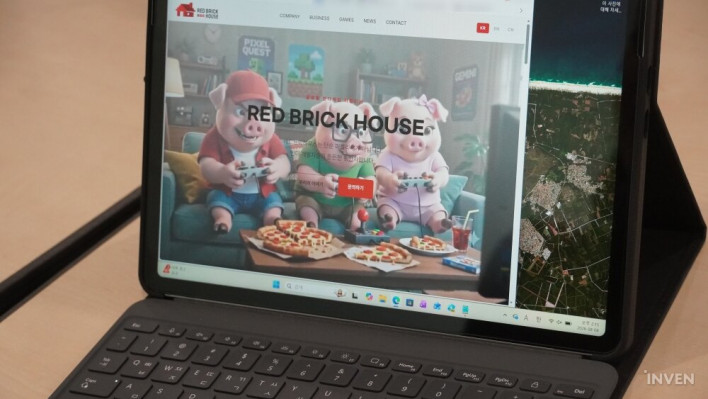
I believe building trust is the core of this scene—trust with users and trust with development teams. We wanted to convey the feeling of a publisher that lays bricks one by one. Ultimately, like the brick house built by the youngest pig in 'The Three Little Pigs,' we wanted to build a sturdy house that Korean indie game development teams can trust and rely on.
Is there a backstory to 'The Three Little Pigs' reference.
Hong Ji-cheol = It wasn't a planned concept. I saw a red brick house and thought it was pretty. While talking about how we wanted our company to be like that, someone jokingly said the space would be too small. Then CEO Kim Hyeok-jin said he would set up a military tent on the terrace. We joked back and forth about it blowing away in the wind, and that led us to 'The Three Little Pigs.
We really wanted to include 'House' in the name. Most of the people we meet are lacking something—whether it's funding or team members—and they are struggling to produce results with small teams. We didn't want the experience of meeting a publisher to feel too stiff. We want people to feel a sense of warmth and relief when they visit our office.
How are the roles divided among the three of you.
Kim Hyeok-jin = CEO Hong handles overall management, including decision-making, investor relations, IR, and PR. I oversee the publishing business. Director Lee Min-jeong is in charge of business development, focusing on our first agenda: partnerships in China.
Hong Ji-cheol = We all worked in the same division previously. I was the director, and the other two were team leads. I oversaw investment and internal strategy, while CEO Kim focused on indie games. In fact, he is much better suited to be the CEO of Red Brick House than I am. I am more of an investment expert, while he is more of a business expert. Director Lee is someone who handled sales of Korean games in China and sourcing of Chinese games overall.
The team has grown to nine people. It consists of the executives, one person in management support, one business lead, and the rest are brand managers. They are the ones in charge of individual projects, and we plan to keep growing. As the number of contracts increases, we will continue to hire more.
Do you have specific criteria for hiring brand managers.
Kim Hyeok-jin = I believe brand managers are the core of our company. Interestingly, none of them have prior experience in the game industry. Our motto is that while we—with my 20 years of experience and our business lead's 10 years—can teach the work, we cannot teach the passion for games. We found that hiring people who truly love a specific genre and then onboarding them yields much better results. It's not that industry veterans can't do the work; it's just that the level of immersion is different. It's the difference between someone who has approached games as a job for a long time and someone who has approached them as a fan.
Hong Ji-cheol = People in the game industry are all busy. After working overtime, they don't have time to play games. People who are truly immersed in games are a better fit for us. Even if they can't develop games, we welcome those who have been active in communities because they love games. Professors tell me that those kinds of students are often the hardest to place in jobs.
The Reason for Founding: For the Indie Scene
Couldn't you have done this at your previous jobs.
Kim Hyeok-jin = It comes down to the speed of decision-making. In large companies, there are so many stakeholders and factors to consider that even if a game is great, you can't bring it on board if there isn't a dedicated service manager available. In a small company, I can just start the service and handle the practical work myself. I can then find and hire the right person for that game and work together. You can't move that flexibly in a large organization. We concluded that a small organization is the right fit for an indie game publisher.
Hong Ji-cheol = To add to that, even if a large company limits its focus to indie games, the people who source the games and the people who service them are separate. There are testing teams in between, and many organizations involved in a single decision. Every single one has to say 'yes' for a contract to be signed. I experienced a lot of pain there. There were too many cases where I wanted to do something but couldn't.
Ultimately, it should be a matter of people who want to do it coming together, but it fails when you try to align the interests of those who want to do it, those who don't, and those who don't care. Our conclusion is that it's nearly impossible to do indie publishing properly in a large company. We didn't want to do indie games on the side; we wanted to try 'doing only indie.'
Kim Hyeok-jin = Let's say there's a game with an expected sales volume of 50k units. Companies in big buildings would never touch it. But we want to work on those games, too. It was heartbreaking to see games that had a small but passionate fan base never get the chance to be born.
Did you have experiences where you missed out on projects you worked hard to nurture.
Kim Hyeok-jin = That was one of the reasons for starting the company. While I was busy trying to persuade internal stakeholders, we lost them to overseas publishers like Devolver or Hooded Horse. It was infuriating to lose them after putting so much effort into consulting and nurturing them. But I had nothing to say, because we couldn't get the contract signed anyway.
Hong Ji-cheol = If the waiting period was three or four months, I could understand, but losing them after one or two years is understandable. It takes years to discover a game and get it through final testing. You give guidance along the way, saying 'this version isn't working, let's aim for the next one.' I was convinced that it was a business model that couldn't work that way.
Now that we're on our own, we only need to agree among ourselves. We can see a game today and sign it tomorrow. We've already signed four contracts, and I expect that to reach about eight by the end of the year. If we had tried this at our previous jobs, we wouldn't have signed a single one. We are signing contracts at a stage that large companies don't even see.
What is the scale of your investment.
Hong Ji-cheol = We raised about ₩10 billion. But the 10 billion isn't what's important. Rather than what we can do with this money, I wanted to build an ecosystem. The indie sector is a raw, untapped area that has received almost no support, financial benefits, or help from experts. I believe players need to enter this space as well. By establishing Red Brick House, we have essentially recruited financial partners who will move with us.
Are there any unique characteristics to your shareholder composition.
Hong Ji-cheol = There are six firms, including WEMADE MAX, and they all have one thing in common: they all have cultural fund accounts and are committed to continued investment in games. Some have already achieved results by investing in indie games, and others are currently doing so. I made a promise to them: if we were just going to end with our company, I would have gone elsewhere to get funding. I asked them to join this plan, and we received investment from those who readily agreed. I am very proud of that. It's a realization I've had for a long time that this is the only way the indie industry will survive.
What kind of verification did you undergo during the investment review.
Hong Ji-cheol = It's rare for BDs to leave and start a publishing company. While there are cases of star developers or star producers leaving to start development studios, I haven't seen a case of starting a publisher without in-house development from the beginning. Our individual work capabilities weren't heavily questioned because the market knows what we did in the past. Instead, we were asked if a publisher specializing in Steam indie games could actually exist as a business and if it was commercially viable. Since it was a business model that didn't exist in Korea, their final judgment was that it was worth a try.
What do you look for? "We only look at one strength"
How does Red Brick House define an indie game.
Kim Hyeok-jin = Our thoughts differ slightly, but by my standard, it's whether the team can complete the game even if the capital runs out. They must have had a driving force to keep the team going, whether through support programs or investment, to get this far. Anyone can start, but not everyone can finish. I believe that team spirit—finishing to the end even when capital is truly depleted—is the indie spirit.
Hong Ji-cheol = I never considered whether something was 'indie' or not when starting the company. I just started it to work on Steam games. It would be great if we expand to consoles and later to mobile, but I had no intention of servicing mobile games at the start. We are focusing on Steam first, and we can't handle games that are too large in scale. Rather than approaching it philosophically, I just want to work happily with people who make good small games. Age doesn't matter either. People in their 40s and 50s make them, and college students make them too. In fact, I want to help college students because they often don't know anything and are too scared to start.
Kim Hyeok-jin = If you look at the youngest and oldest CEOs among the titles we've signed, they are like father and son.
What do you look for in a project.
Kim Hyeok-jin = A game with clear 'fun.' Usually, people end up diluting the game by cutting things out, saying 'this won't work because of that.' We only look at one strength. We have reference titles for everything we review, and we don't look at games that try to overcome the weaknesses of another game. We only look at games that maximize their strengths. That is the core. We also look at whether the team can maximize that strength. Many people say they are experts in action roguelikes or platformers after playing the genre for 50 hours. I ask them, 'If you're a genre enthusiast, shouldn't you have played for 500 or 1k hours.
You must have to judge at a stage where there are no metrics.
Kim Hyeok-jin = It's inevitably subjective. There is a moment when a project just 'clicks.' If I play it and it's fun, I start thinking about why it's fun. If I organize my thoughts and it still feels persuasive when I look at it again the next day, I view it positively. Sometimes the team itself is more attractive than the project. There are teams where the current project might be less appealing, but the team is clearly growing, and their next project will be truly great. In those cases, I might review the current project with an eye on their next one. We don't make decisions based on specific parameters.
Hong Ji-cheol = We went through that process at our previous jobs. We have accumulated some statistics: games that were fun during testing ended up doing well, and those that weren't didn't. Not everyone can discover a game that will succeed. But we have practiced filtering out games that are definitely not it. At the very least, we are confident that if we choose it, it won't fail.
Are there cases where you judge a project is good, but 'not now'.
Kim Hyeok-jin = Even if a project is good, we don't sign it immediately. It might be good at the current stage, but I don't know the team. Without knowing them, I can't tell if the team is on an upward or downward trend, or if the current state is a peak or a trough.
That's why we watch the build-up process more closely. If it's truly attractive and we miss it because we were watching, so be it. I have never made a decision based solely on the current build without observing the team's activities. No matter how beautiful the current state is, whether this team can finish it is a separate issue.
Hong Ji-cheol = There are also problems that reveal themselves when you meet them. The game might be good, but the team looks like it might fall apart next month.
Kim Hyeok-jin = There are many projects where the build is fine, but the core developer has already left, and the CEO is just trying to keep it alive somehow. They confess later. It's like, 'If we get a contract, I'll rebuild the team.
Do deals fall through due to non-game issues.
Hong Ji-cheol = Some companies are sitting on a ticking time bomb. They've promised to split profits equally among themselves. Because the CEO didn't know better, they promised employees long ago that they would split the money when it came in. But when we sign an MG (Minimum Guarantee) contract, that money isn't for them to split; it's for development costs. If they don't split it, the team falls apart because of the publishing contract.
Kim Hyeok-jin = At one company, I gathered the whole development team and bought them dinner several times over six months to explain. I explained why splitting equally doesn't work, what equity means, and what risks a CEO takes. Eventually, it was settled with individual incentive contracts, and the CEO kept the equity. It took six months.
That seems to be what makes us most different from other publishers. It's not about the team's financial situation or company structure; we look deeply into why this team came together and what keeps them going. We think about what this team needs first and design a custom solution. Large companies move company-to-company, so it's hard to do that. We go a bit more human-to-human.
Hong Ji-cheol = You'll have a chance to find out about CEO Kim Hyeok-jin in the industry; he has managed his reputation very well. He has helped people even without contracts or financial interests, and those things have built his current reputation.
Kim Hyeok-jin = I always carry bread in both hands. There probably aren't many people in Korea who spend ₩2 million a month on bread. It's our rule that CEO Hong and I never go to a development studio empty-handed. People I've met in my life never forget the person who bought them food.
"A Publisher That Does Everything from Morning Calls to Property Visits"
Are you acting as both an investor and a publisher.
Hong Ji-cheol = We are not an investment firm. We are a publisher. We can perform investment functions and will invest, but we are not professional investors. If a development studio lacks development costs during the publishing process, we take on that role instead of them running around looking for investment. If they are a partner to draw a big picture with, we can strengthen the IP through equity investment, or help them raise funds by introducing them to our shareholders or external parties. Ultimately, it's an issue of securing development costs, which is a function that is essential to our core business of publishing, yet one that others don't do. Since we come from an investment division, we intend to make that our competitive edge.
What happens in the first three months after signing with Red Brick House.
Kim Hyeok-jin = It depends on the stage. Whether we signed at the prototype stage, a public demo version, or just before launch, there is an action plan tailored to that stage. Before signing, we define the version—whether it's 1, Early Access, Next Fest, or a public demo. Then, the things that need to be verified to get from this version to the next emerge. We proceed one by one according to the milestones. Sometimes we need to gather Discord users, sometimes Reddit activity is needed, and sometimes we need to gather micro-influencers to spread the word all at once.
Hong Ji-cheol = Sometimes government funding is involved in between.
Kim Hyeok-jin = There are times when global PR is needed, and times when participation in online/offline events is necessary. Distributing that at the right time and place is important. If you're asking about our role as a publisher, we do everything from A to Z. Everything except game development.
Hong Ji-cheol = That's why it's ambiguous to say, 'This is what we do when we sign.' For some companies, helping with funding is the most important thing at that moment, while for others, hiring people is the priority.
Kim Hyeok-jin = We even help find apartments and offices, and we go on property visits together.
Hong Ji-cheol = We actually did that. We went around looking for apartments together. Some people even ask for morning calls. That's also very important.
It's hard to get a sense of how far you go.
Hong Ji-cheol = We are living in the same small industry. Since we are playing as players rather than giving advice as mentors who have internalized various experiences, we are likely a bit more detailed.
What about IP ownership and profit sharing.
Hong Ji-cheol = It's case-by-case, but in principle, Red Brick House does not hold IP. The IP belongs to the development studio. I don't think it will be like that forever. We wouldn't be human if we didn't want to own IP. But we must acquire it fairly. We should either invest and go together, or take on the risk to justify even joint ownership. I can't say we aren't interested, but in a publishing contract, we don't take it in principle.
However, if we expand the business more actively using the IP, such as for mobile, we sometimes secure rights in the form of additional business rights. This is something CEO Kim Hyeok-jin has a very clear philosophy on, so I follow him. I tend to be greedy, but he is not.
Kim Hyeok-jin = I hear that I'm naive a lot. I'm just confident that I'll do well. If I do well, won't they give it to me even if they don't want to? I tend to rely more on human trust. That's how I've worked.
The company itself is a startup. Is there no pressure to survive.
Hong Ji-cheol = That's what's scary. I couldn't sleep and suffered from insomnia for a while. Even after finishing the investment, it was the same. It wasn't an issue of investment, but a fear of what the future of this company would be. Other startups go through the same thing.
Kim Hyeok-jin = However, the director of the investment division, the indie investment lead, and the China business lead have left to do indie game business and China business. Since we are doing exactly what we were doing, there is more stability than a typical startup.
A Changed China, "You Can't Leave China Out of Indie"
Please introduce Director Lee Min-jeong's career.
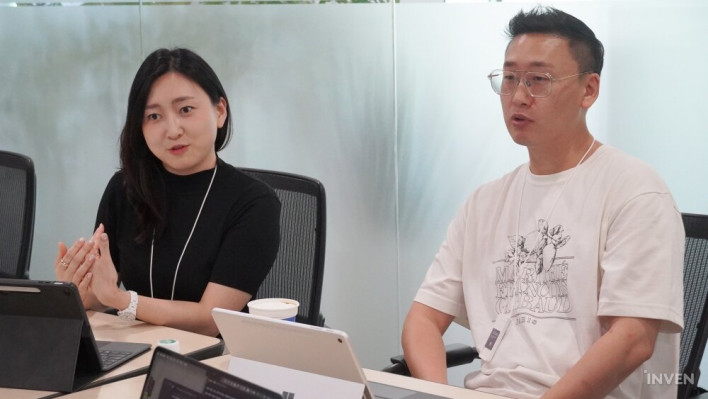
Lee Min-jeong = I entered the industry as an overseas business PM because I loved games. At Kakao, I sourced Chinese content like Kung Fu Panda and Onmyoji and did business development with local partners. At NEOWIZ, I led IP sales and business expansion by selling A.V.A and Cats & Soup. Based on this experience, at Red Brick House, I intend to integrate overseas sourcing and sales to provide comprehensive support so that indie games can go global and expand beyond a single game into IP.
What kind of opportunity is the Greater China region for indie games.
Lee Min-jeong = Half of the game market is Chinese users. From the perspective of global business, it's a market we have to consider as the most important. If Korean developers enter independently, they face various regulations and constraints. It's not just about the ISBN (game license). Even if they go in directly, there are cultural differences between users and localization issues, so we intend to collaborate strategically with trusted local partners. China is a huge consumer market and also a place where new games are developed most actively. We see China as important from both of these aspects.
What is the basis for your confidence in your China network.
Hong Ji-cheol = The targets we worked hard on in the past have all changed. The lineups of successful companies have changed, and the people in charge have changed. Now we have to break through again. Community companies and SDK platform companies that fit the characteristics of the Chinese console or Steam market have emerged, so we have to build all the connections from scratch.
Fortunately, we have been doing that for several years. It was possible because we did indie games. If even large companies are only now at the stage of getting close to them, we are no different, or perhaps even closer. The way of playing also changes every year. The players change, the methods change, and new events are created every year. In the past, ChinaJoy was important, but these days no one cares.
What is a realistic entry path.
Lee Min-jeong = The integration required by each platform is complex, which often becomes a barrier to entry itself. Currently, Steam is the most certain and universal channel. In line with the Steam launch, we cooperate with key local distribution partners to carry out launch marketing that maximizes initial sales momentum and global exposure.
How do you build a community before launch.
Lee Min-jeong = That part is a trade secret, so it's difficult. I'll tell you if you sign a contract. (Laughs)
Kim Hyeok-jin = Indie game developers know it all now. It's not that we're hiding it as a secret; we're going around telling everyone as consulting. But even if they can do it once, they can't do it consistently.
Hong Ji-cheol = The strategy that fits the timeline keeps changing. The world changes, too. Actually, there is no right answer.
Kim Hyeok-jin = That's the core. There are no experts and no right answers. Steam last year and Steam this year follow completely different grammars.
What kind of impression do you want to give gamers.
Kim Hyeok-jin = Since it's indie games, the graphics might not be good, and it might be inconvenient. But I hope it's a place where games with their own unique fun are gathered. Hooded Horse only does strategic games, and Playstack mainly collects games that feel light, but we don't have such characteristics. The Korean indie scene is too small to collect only specific genres.
Whether many people like it or only a very few do, I hope it's literally a 'house' where works created with one core fun are gathered. A feeling that if you go to this house, everything is okay. One of the companies I respect is Ubisoft; even if everyone criticizes them, it's not easy to create that flavor. I hope it's an indie house where there's always a game worth playing whenever you stop by.
Hong Ji-cheol = The publishers just mentioned are mostly in North America or Europe. There isn't a single Asian company in the indie game scene ranking. No China, no Korea, no Japan. So we will naturally have our own color. If we do a lot of Korean games, that's what happens. Characteristics of genres are still a luxury for us. For now, we are just going with those who trust us and go with us.
A time will come when we want to have a color as time passes, but wouldn't it be created naturally by then? Since there is no Asian publisher, if we hit the top there, I think we will become a company that is always mentioned when talking about K-Indie, a place with many games with Asian colors.
To a Company That Can Continuously Produce Next Works
What kind of company should you be in three years.
Lee Min-jeong = Global Top 10.
Kim Hyeok-jin = Top 10 is Top 10, but to be honest, one of my favorite IPs is 'Heroes of Might and Magic.' The 'Olden Era' that came out recently is a Ubisoft IP, and Hooded Horse is publishing it. I hope we become a publisher trustworthy enough to be entrusted with such a really big IP.
Hong Ji-cheol = I'm not the type to calculate operating profit percentages, and that's not the company's goal either. I just hope we are the company that services the most in Korea. Whether it's the number or the performance, I think we should hear people say, 'Isn't Red Brick House the representative of Korea in three years.
Any plans for listing.
Hong Ji-cheol = When I first started the company, I naturally wanted to make money. Why do business if you don't want to make money? But that calculation doesn't work now. Not only can I not do it, but I don't want to. None of the three of us are that type.
Shareholders also asked what I thought would happen in three years when investing. What I answered was, 'I'm dying of a headache from establishing the company now, so why are you talking about three years later?' Our company is one where the start is important, and once we start, it will roll somehow. It's a company that will run the moment it starts, so let's start quickly. Development studios might take one or two years, but we are on the side that has to do very small things constantly every day.
What does that first milestone look like? Is it something like 'selling one million copies'.
Kim Hyuk-jin = Honestly, I don't know about one million. My benchmarks for success are 200k or 300k copies. Up to that point, I can judge whether we've succeeded based on my own design, but anything beyond that is out of my hands.
Hong Ji-cheol = Even with 'Shape of Dreams,' the initial goal was 200k copies. Just before launch, the business department said we could sell 300k or 400,000, and when we opened it, it sold much more than that. But we can't set the goal of this business at 1 million. It's too dramatic. Our goal will continue to be in the 200k to 300k range.
In Korea, 1 million copies are recognized as the standard for success.
Hong Ji-cheol = That's the standard for large companies. It's meaningful enough for us to sell even 200k to 300k copies.
Kim Hyeok-jin = Our standard for success is this: if the development studio and we have completed one project and sent it out into the world, and the profit obtained from it is at a level where we can do the next work one more time, that is success. Because we want to be business partners who can continue to go together.
Guide for Indie Game Companies
How do I propose a project.
Kim Hyeok-jin = You can leave a game introduction and demo on our official website. Quite a lot is already coming in. And I will visit most of them first.
Is the planning stage okay too.
Kim Hyeok-jin = The planning stage is also good. However, it is realistically difficult to go to a contract with just a plan. We are helping as much as we can even in the pre-contract stage.
When is a good time to approach a publisher.
Kim Hyeok-jin = I think it's the point where you can receive user feedback through the community. If it's a point where closed testing is possible through STOVE's 'Wise Demo Life' or our own Discord, not only us but other publishers will be able to make decisions.
Can I get feedback even if it doesn't lead to a contract.
Kim Hyeok-jin = Of course. I want to help as much as possible. There are teams that occasionally miss important opportunities due to unverified rumors, so we provide as much feedback and consulting as possible, except for things about game quality.
Are overseas development studios also targets.
Kim Hyeok-jin = We are reviewing many projects from overseas development studios as well. However, we prioritize Korean teams. Korean teams are good.
What is the most frequent misunderstanding development studios have about publishers.
Kim Hyeok-jin = They sometimes see it as a transaction. A transaction where I give what I have and receive what someone else has. If you look at the contract, it might look like that. But after the contract, the publisher and the developer are business partners. They are allies running together for a common goal. I hope they think more about what to do together rather than what to give and what to get.
How do you see the domestic indie game ecosystem.
Kim Hyeok-jin = I think it's just the beginning. It might sound unpleasant to those who have been active for a long time, but I think the fact that there was no indie game specialized publisher only in our country is proof that it's just the beginning. Even if it's not a popular genre, even if it's not a major genre, I will be a small strength to developers who are building games while believing in the fun of the games they make. I want to be a business partner for development studios from starting with 0 Discord members to becoming a global IP.
Please say a word to developers who are worrying.
Kim Hyeok-jin = I think indie game development is a job where you have to move forward little by little with the thought that every moment is the last step. You might also think that you are torturing yourself with hope, thinking it will get better soon. You might think everyone else is going easily, but why am I like this? But the absolute majority of indie game developers around the world are going through the same time. If you communicate with users while thinking only about the fun of your game, investment and publishing will naturally follow. You might have many worries about whether this game can be completed or serviced, but I want to be a partner to worry with you.

Sort by:
Comments :0