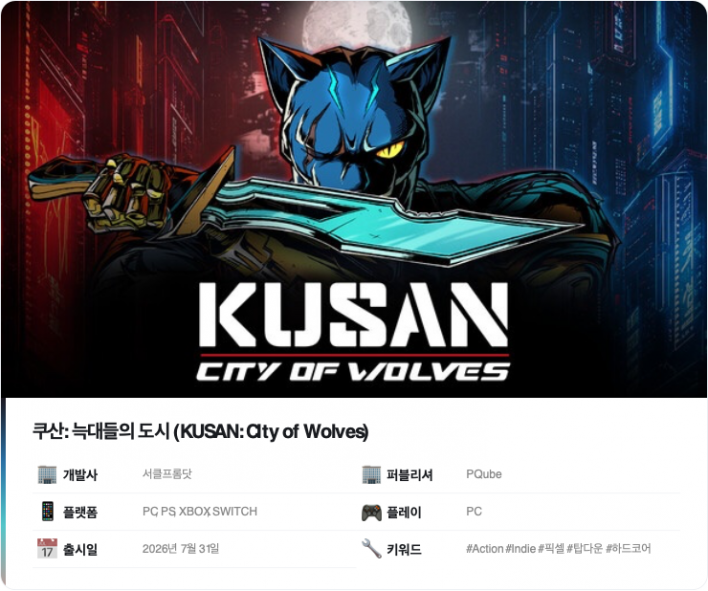
'Kusan: City of Wolves' is a hardcore top-down shooter developed by Circle From Dot. Given the developers' consistent expressions of respect and homage toward 'Hotline Miami,' the game's basic impression is quite familiar. The top-down perspective, the life-or-death stakes of a single attack, and the fast-paced progression of identifying enemy positions and clearing zones all evoke that title.
In 'Kusan,' a fictional city with a name subtly reminiscent of Busan, death always comes in an instant. You die if you get shot, and you die if you get punched. Just as you are focused on taking down a nearby enemy, a stray bullet from off-screen can abruptly end your impressive run. It is a game of one-hit kills for everyone.
That is why quick hands alone are not enough. You must decide in a split second which enemy to take down first, how to retrieve your thrown knife, and whose movement to interrupt with your current firearm. Planning, failing, and then clearing enemies in a slightly better way is the core of 'Kusan.'
Fast-paced action fueled by fists, knives, and guns
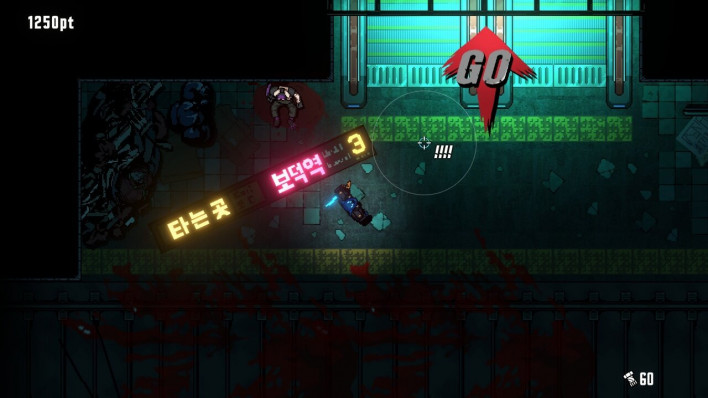
While the homage to 'Hotline Miami' is naturally woven into the game, the actual feel of the combat is quite different. This is precisely why the developers describe it as 'the meeting of Hotline Miami and John Wick.'
The protagonist, Jin, uses three primary means of combat: his prosthetic 'War Hand,' the throwable 'Quantum Knife,' and a ranged weapon chosen based on the mission. Players must combine these three tools to clear all enemies in a zone.
The War Hand is your most basic attack. It can instantly take down a nearby enemy, and holding the button allows for a charged attack. It is not just for hitting enemies harder; it is also used to interact with the environment, such as kicking open a door to strike an enemy behind it.
The cybernetic prosthetic serves as a narrative device to reveal Jin's past, while also providing a plausible justification for the game's 'one-hit' combat rule. It is the reason Jin can send even the largest enemies flying with a single punch, and it provides the visceral impact of close-quarters combat.


The other weapon, the Quantum Knife, can instantly eliminate enemies out of reach. It is also useful for clearing out enemies approaching from multiple directions. You might throw a knife at an immediate threat while using the War Hand to deal with an enemy that has closed the distance. Because it is especially useful against ranged enemies, you will naturally find your finger resting on the spacebar throughout the game.
Of course, there are limitations. A thrown knife remains where it landed after an elimination. To use it again, you must move to that location to retrieve it. If you mindlessly throw your knife at the furthest enemy, you may find yourself unable to use it when you actually need it. Thanks to this, combat in 'Kusan' often functions like a small puzzle where you must determine the order of elimination while enemies approach from all sides—all while maintaining a frantic pace.
Ranged weapons add another layer, helping players define their own playstyle. Since you can only carry one type of firearm at a time, your choice of weapon fundamentally changes how you experience the same stage.

The pistol has high ammo capacity and is easy to handle, but it cannot take down an enemy in one shot. That does not mean it is ineffective; you can use it to interrupt a distant gun-wielding enemy, allowing you to prioritize closer threats and manage the flow of combat.
The weapon that suited me best was the crossbow. While you have to accept the risk of needing to charge it, a well-fired arrow can pierce multiple enemies in a straight line. The satisfaction of lining up enemies and clearing them with a single shot is immense.
Conversely, the shotgun is specialized for dealing with multiple enemies clustered together through its fan-shaped spread. No weapon is objectively superior; the choice depends on your preferred combat distance and style.
Filling in the gaps for 'my own combat'

The War Hand, Quantum Knife, and firearms are enough to make the basic combat in 'Kusan' solid. However, the game adds a progression system called 'Tech-trix' that allows players to customize each combat tool to their liking.
You earn bolts by defeating enemies, destroying crates on the map, or clearing stages. These bolts are used to purchase various abilities from Nemo, who manages Jin's loadout.
Unlocked abilities are not applied immediately. Each ability is shaped like a different puzzle piece, and players must manually place them within a limited Tech-trix grid. It is less about 'equipping' abilities and more about fitting them perfectly into the given space.

The effects of these abilities significantly change your combat style. You can make the Quantum Knife return automatically after a certain time, or use a charged War Hand to blow up mechanical enemies. Counter-attacks that deflect bullets at the right moment are also activated through the Tech-trix.
Firearms are also selected and upgraded here. The problem is that the more upgrades you add, the larger the piece becomes. If you upgrade a weapon too much, you may run out of space for other useful abilities. You have to decide whether to focus on one powerful weapon or equip a variety of abilities to handle different situations.

This process provides a satisfaction similar to inventory management games where you cram items into a limited bag. Successfully rotating the unlocked pieces and fitting in abilities that wouldn't fit before offers a different kind of satisfaction than combat itself.
Most interestingly, the Tech-trix is not just about stat increases. Rather than passive growth like increasing damage by a few percent, many abilities change your actual controls and decision-making, such as how the knife is retrieved or the functions of the War Hand.
While the Tech-trix allows you to customize your abilities, it does not mean the game's overall difficulty is lowered. As you progress through stages, the variety of enemies increases, and from the mid-game onward, you are frequently faced with enemies of different types attacking from all directions simultaneously. At some point, no matter how well you plan, pure reaction speed and manual dexterity become necessary.
There will inevitably be moments where you cannot help but wonder, 'Is my physical skill lacking?' However, because there are many approaches available using various weapons and Tech-trix abilities, the difficulty is not impossibly high. Bashing your head against the wall in the same way is not the only answer. Changing your firearm, rearranging your abilities, and adjusting the order in which you eliminate enemies are all valid solutions.

Even the pistol attacks that seemed intimidating at first can be deflected if you equip the 'Counter-attack' ability. Timing it is never easy, but the reward for success is clear. Attacks that were best avoided at first can become new opportunities through practice and build optimization.
If you lack confidence in your skills, you can play relatively safely by focusing on ranged attacks. Conversely, a highly skilled player can deflect bullets, switch between the War Hand and knife, and create scenes worthy of a short-form action video.
The boss battles that appear periodically test the player in a different way than regular stages. Bosses do not fall after a single hit, but Jin dies if he is even grazed by a boss' pattern. This requires a different approach than the rhythm of standard combat.

A blood-stained port city, neon lights shimmering above
As mentioned, Kusan is a city that started from Busan, where the developer Circle From Dot is located. What would it look like if a war broke out in a near-future Busan, and abandoned war supplies flowed into the underworld after the armistice? The developers completed this fictional port city by adding the night streets of various Asian cities, including Hong Kong and Tokyo, to this imagination.
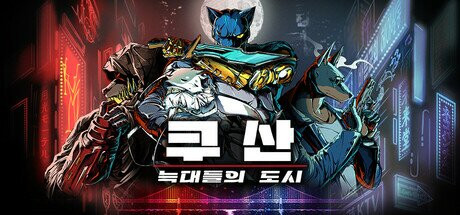
The city's nights are dark, but the screen never feels dull. Neon signs filling the roads and buildings emit sharp colors, and beneath them, human-like animals deceive and kill each other. Like the developers' intention to layer intense light over the mood of black-and-white noir, Kusan is both gloomy and glamorous.
The choice to depict characters as animals fits this atmosphere perfectly. The animals' appearances intuitively convey each character's personality while making the brutal violence feel like a genre-based expression slightly removed from reality.
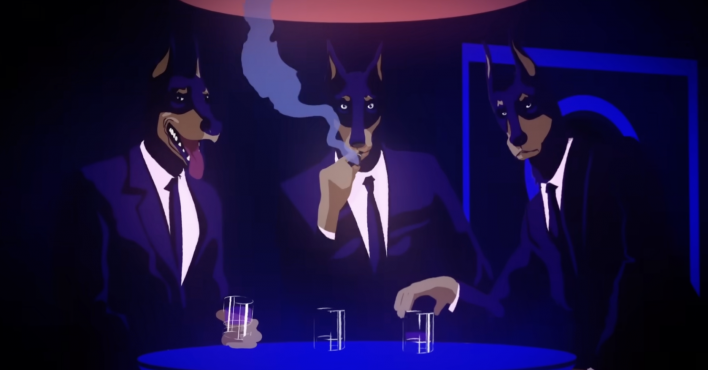
If you have seen the music video for Caravan Palace's 'Lone Digger,' you can easily imagine the first impression of 'Kusan.' The animal characters filling a dark space, the flashy lighting, and the sudden, bloody violence share many similarities. If that music video caught your eye, you will surely find similar enjoyment in the visuals of 'Kusan.'
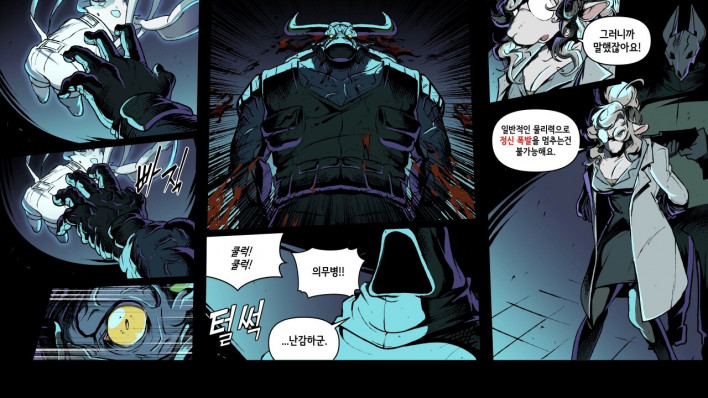
The story unfolds primarily through graphic novel-style cutscenes. Jin, a former soldier turned mercenary, gets caught up in a request involving a girl with powerful abilities, and in the process, faces his own past and betrayal. While using static cuts, the game maintains its fast pace through split screens, sharp compositions, and intense colors.


Not all direction happens within the graphic novel format. In the early part, there is a scene where Jin gets out onto the road to deal with enemies chasing him, and I really liked the direction that followed. The scene, which started with a short QTE, transitioned seamlessly into actual gameplay, and the player is suddenly handed the reins of the action.
'Ah, I don't want to ruin this cool moment with my mediocre controls...'
That was my honest feeling at the time. The screen and music were already at their peak, and all that remained was for the player not to break the flow. Because of this, I found myself watching the screen and moving my fingers more desperately than usual.
Easy to restart, but hard to put down

As I said at the beginning of this review, anyone who sees 'Kusan: City of Wolves' for the first time will easily think of 'that game.' The developers had no intention of hiding that influence. The top-down action where one mistake leads to death and the stage design clearly show respect for the original.
However, as you continue to play, you can confirm that 'Kusan' is not just a work that borrowed the appearance of a familiar game.
The combat, which combines the War Hand, Quantum Knife, and different firearms, gives players many more options. The Tech-trix system then modifies those options to suit individual tastes. One person might safely pick off enemies one by one from a distance, while another might dive into a hail of bullets to pull off consecutive counter-attacks and melee strikes.
It is not an easy game. As the variety of enemies increases, the information you need to process grows rapidly, and a single mistake still results in death. If you are not used to hardcore action, the difficulty after the mid-game may feel like a significant barrier.
It is also a shame that you cannot use the mouse in the PC menu. The mouse is convenient for quick aiming, but when you finish combat and organize your Tech-trix, you have to adapt back to directional key-based controls. It is as if combat and the menu require different control sensibilities.
However, if I had to pick the most disappointing part, it would be the save system. When you die during a stage, you can restart in the blink of an eye by pressing the R key, but if you exit the game and return, you have to play the chapter you were in from the beginning.
Even after passing a difficult stage, you cannot immediately relax. Because of the thought, 'If I turn it off here, I'll have to start from the beginning,' I don't easily reach for the exit button. The fact that repetitive play itself is fun is one thing, but having to replay sections you have already passed at an unwanted time is another.
Nevertheless, the reason I keep coming back is clear. I checked what went wrong before I died, and I thought about what order to move in next time. I change my firearm, rearrange my Tech-trix pieces, and try to time my parry in front of a gun-wielding enemy, thinking that this time, I will definitely succeed.
Dying is a moment. And it doesn't take that long to kick the door down again.
- Combat system that provides diverse options
- Neon noir visuals and the perfect harmony of Loptimist's music
- Adrenaline-filled action for under ₩10k
- Difficulty that still tests the player's physical skills
- Restart from the beginning of the chapter if you exit in the middle
Review Platform: PC (Review Build)

Sort by:
Comments :0