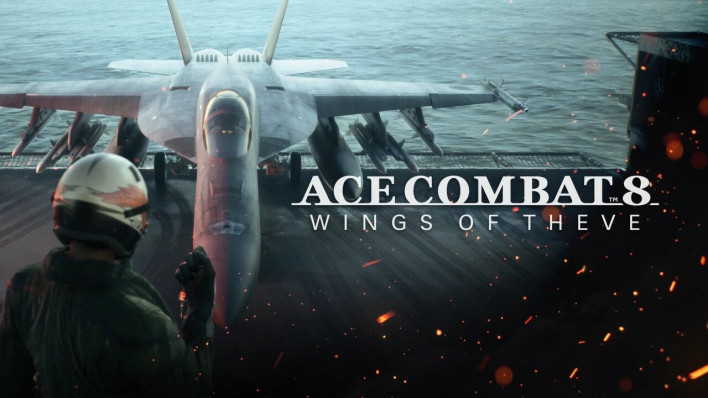
The Ace Combat series, a hallmark of the flight-shooting genre, celebrates its 30th anniversary this year. Its commemorative title, Ace Combat 8: Wings of Theve, was first unveiled at The Game Awards (TGA) 2025 and marks the first numbered entry in the series in seven years, following 2019's Ace Combat 7.
With the home nation's navy decimated and the Federation of Central Usea (FCU) collapsing under the invasion of the Republic of Sotoa, the protagonist takes on the mantle of the 'Wings of Theve.' Developed by Bandai Namco Aces (Project Aces) using Unreal Engine 5 and proprietary technology, the game is set for release on PS5, Xbox Series X|S, and PC (Steam).
In a joint interview held ahead of the launch, the development team shared their design intentions for the new title. They acknowledged feedback that the seventh installment was somewhat difficult, and noted that for the eighth, they refined the difficulty, tutorials, and training modes to make the series more accessible to newcomers. They also explained that as a 30th-anniversary title, they focused on gathering and refining features from past games that were well-received but had since disappeared.
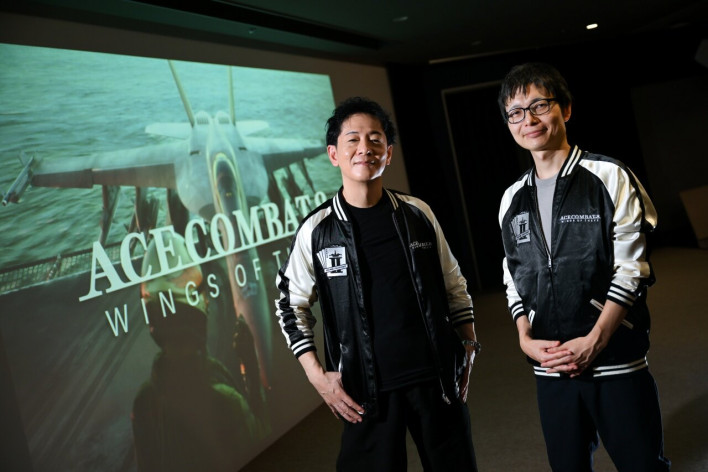
The premise of becoming the 'Wings of Theve' for propaganda purposes is intriguing. I am curious if there were any specific inspirations behind the story for this title.
Manabu Shimomoto = The Ace Combat series has always depicted a fictional world called 'Strangereal,' set in a near-future slightly ahead of our own reality. We consider the 'reality' of each generation, and around 2020, when we began development, we saw that information warfare would become a key theme. That is where the setting surrounding media and propaganda in this title originated.
In the previous game, there was a lot of feedback regarding campaign difficulty, such as regular enemies using flares and tight time limits. Conversely, this title feels more casual in terms of controls and missile accuracy. What was the most important factor in adjusting the difficulty.
Manabu Shimomoto = I am glad you felt that way. I believe the adjustments we intended are being felt by players.
As you pointed out, some missions in the seventh game were quite difficult. In truth, we did not expect the seventh game to be as successful as it was, so it was designed more for long-time fans of the series. For the eighth, we ensured that not only series veterans but also those who started with the seventh game or are joining with this title can adapt more comfortably. The tutorials and training modes were implemented with that same goal in mind.
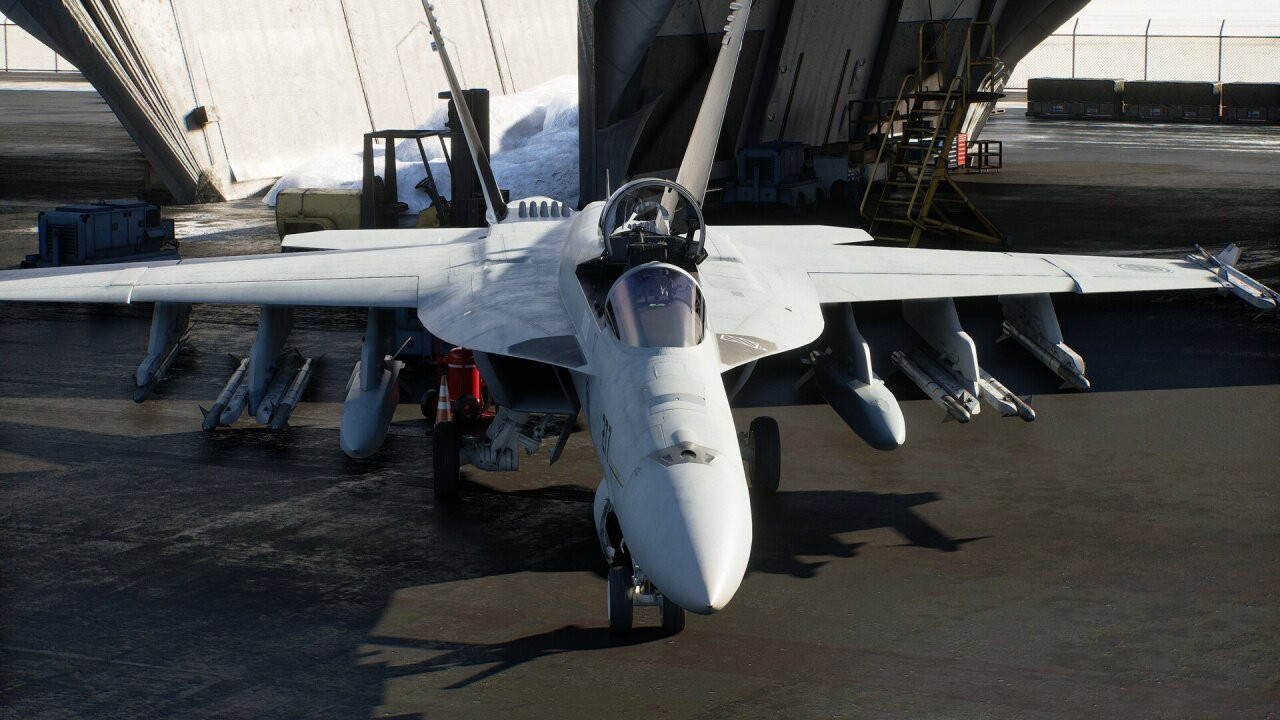
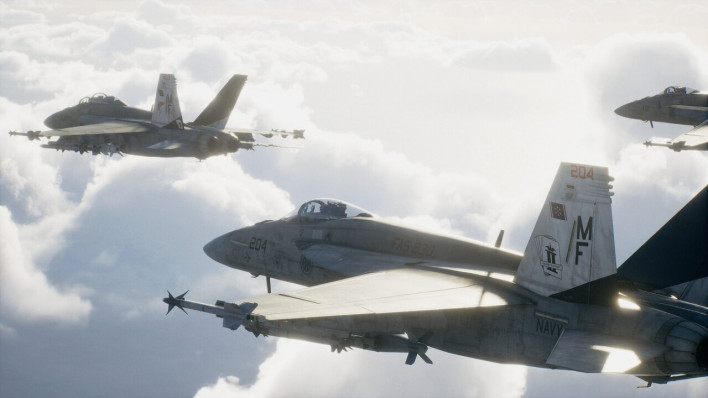
The starting aircraft is essentially another protagonist of the game. Why did you choose the F/A-18E Super Hornet as the first plane.
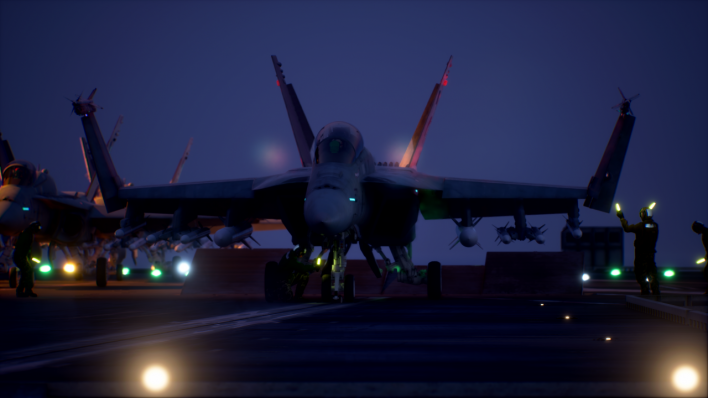
Manabu Shimomoto = As seen in the key visual, the F/A-18E Super Hornet is a carrier-based aircraft. Since the story revolves around fighting across the Usea continent with an aircraft carrier as the base, we chose a carrier-based plane with high global recognition as both the key visual and the starting aircraft so that players would immediately understand the nature of the story.
We also conducted surveys with series fans to see how they perceive different aircraft, and we designed it so that fans and those knowledgeable about fighter jets would be able to guess the nature of the story just by looking at the key visual.
Compared to the seventh game, the colors of the sea and sky, as well as the OST, seem brighter overall. Is this an intention to keep the game's atmosphere from feeling too heavy, or is it a result of aiming for a more casual direction.
Kazutoki Kono = It was not made brighter by design. Since the mission you played was from the early stages, it likely featured brighter elements like the blue sky. As you progress through the campaign, you will encounter missions with various atmospheres, such as night scenes and twilight, so overall, you will still get that classic Ace Combat feel of beautiful skies.


I heard that the proprietary 'Cloudly' engine implements a space of about 10k square kilometers, multi-layered clouds, and even light reflecting off the canopy. How has this brought evolution to the graphics, flight physics, and battlefield environment, and what is the biggest change in the actual play experience regarding the 'sensation of flying,' which is the core of the series.
Kazutoki Kono = The proprietary engine renders various types of clouds in multiple layers. Through low-altitude rain clouds or high-altitude wispy clouds, you can tell what altitude you are flying at.
Contrails and light on the canopy also act as visual cues in the game. For example, if you follow a contrail, there is an enemy at the end, or if light reflects on the canopy, there is an enemy in that direction. We made it so that players can play using only visual information without relying on instrument UI numbers.
Also, as the visuals evolved, the feeling of flight, the sense of speed, and the sensation of cutting through the atmosphere have improved significantly. A major point is that while the seventh game could not represent a 'sea of clouds' covering the entire sky, the eighth game has dramatically improved cloud rendering, allowing players to clearly experience the world above and below the clouds.

For the first time in the series, you can select up to two special weapons, and the squadron command function from the fifth game has been revived. What was the intention and background behind introducing these two systems.
Kazutoki Kono = Allowing players to select up to two weapons is to increase the strategic depth. You can equip both air-to-air and air-to-ground special weapons, or choose just one to increase the ammo count. It is intended to broaden the player's tactical style.
Reviving the command function from the fifth game is also linked to strategy. In addition to selecting two special weapons, you can also choose the aircraft types for your wingmen. If you compose the team entirely of fighters, your anti-air capability increases; you can balance it with multi-role aircraft, or increase ground-attack capability with attackers. You can also utilize electronic warfare aircraft.
Furthermore, the revival of the fifth game's command system also has a narrative aspect. This title is structured around fighting through the battlefield with allies, and we felt that the experience of communicating and fighting alongside them, as in the fifth game, was very important.
The command function in the fifth game was excellent, but it disappeared over the course of several series entries. As the eighth game is a 30th-anniversary title, we carefully reviewed the good features and specifications from past series that had been lost and refined them for re-introduction. In the sense of being a culmination of 30 years, we learned from past games and incorporated those good features into the eighth.
I am curious if the game's setting and the 'FCU' vs. 'Sotoa' war structure were built with the connections between the seventh, X, XI, and third games in mind.
Manabu Shimomoto = This title is set 10 years after the seventh game, on the same Usea continent. In the history of Strangereal, the story of the third game takes place around 2040 on the same Usea continent. Therefore, we constructed the world view with the flow from the seventh game, this title, and the third game in mind.

This might be limited to the test build, but ground combat felt somewhat more difficult than air combat. Is this an intentional design.
Kazutoki Kono = Many people find ground combat in Ace Combat difficult. While air-to-air combat with fighter jets is not difficult, ground attacks tend to involve getting closer to the ground, which increases the number of approach segments and, consequently, the probability of colliding with the ground or being hit.
I think this is one of the hurdles of the game, and once you get used to it and find the tricks, you can create your own play style. I think this is one of the ways to enjoy Ace Combat. Personally, when I watch others play, I see cases where they hit targets without getting that close to the ground, so I sometimes feel like offering a little advice.
Manabu Shimomoto = Mission 9, which we showed in the demo, is the biggest highlight of the early game, a boss fight, so it is one level higher in difficulty than other missions.
Also, the difficulty level in this demo was set for series fans who have enjoyed past games, so it might have felt a bit difficult. The standard difficulty setting for the actual release will be set slightly lower than this demo.

Mission 5, which was included in the demo, was also focused on ground combat. Could you explain that as well.
Kazutoki Kono = Mission 5 is the first ground-attack mission. You perform combat while providing remote escort, and in the latter half, there is a section where you must escape from enemy railgun attacks. In this mission, we intentionally raised the difficulty and thrill to give players a taste of the terror of the 'land battleship' they will experience in Mission 9, creating a tense progression.
As I mentioned, the difficulty mode in this demo was adjusted so that veteran 'Ace Combat' players would feel a certain level of challenge and thrill. The impression will be different when playing on the standard difficulty after release. You will still feel some thrill, but I think it will be more comfortable to enjoy.
How many types of fighter jets appear in this title? Will SF-style equipment or aircraft, such as laser weapons, also appear.
Manabu Shimomoto = I cannot give a specific number, but you will be able to encounter over 30 types of fighter jets. Also, a unique feature of this title is that you can use original aircraft from the series, not just real-world fighter jets.
Please explain the planning intention behind allowing allies to use special weapons based on the player's commands. Also, it seems there is a limit to the allies' special weapon capacity; could you give some tips on when it is most effective to issue an authorization command.
Kazutoki Kono = The special weapon on/off function was also in the fifth game, but this was also introduced to increase strategic depth. Good timing would be during boss fights or when you are in a difficult situation, but the decision of when to use it is left to the player. If wingmen could use special weapons infinitely, the player's own presence might be diminished, so we adjusted it by setting limits, allowing the player to freely choose when to use them.
Developing the wingmen was quite tricky. If everything produced immediate results according to the player's commands, the wingmen would be nothing more than simple options. So, we made it possible to control whether they attack the front, provide support, disperse, or when and how much to fire their special weapons directly in the game. It was important to develop them so that they feel like human pilots rather than everything moving instantly according to the player's commands.
Manabu Shimomoto = As a recommended tip for using the special weapon on/off function, if you choose an electronic warfare aircraft as one of your wingmen and authorize special weapons when fighting a strong enemy, you can receive a buff that improves the missile guidance performance of allies within a certain range due to the electronic warfare effect. Fighting in this state makes combat much easier, so please use it as a strategy.
Scenes proceeding from the player's first-person perspective have increased significantly, and there are many scenes that require simple interactions. What is the intention behind this structure.
Kazutoki Kono = We adopted the first-person perspective this time to strengthen the game's concept of 'you yourself going beyond the monitor to become an ace pilot,' that is, to enhance the ace pilot experience. Through the first-person perspective, we strengthened the feeling of standing on the same ground and seeing the same scenery as your allies, increasing immersion. We also wanted to increase the immersion of those scenes through interaction.
You can move the camera freely in first-person, but by making you press buttons in important parts, I wanted to give you the feeling that you are participating and acting in that scene.
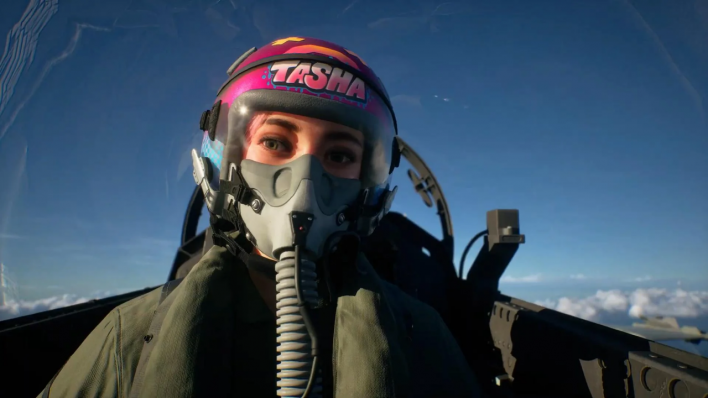
It seems to be the first time we are seeing real-time 3D modeling of fellow pilots. What was the motivation for this decision, and what was the most important thing you considered when designing the appearance of the fellow pilots.
Kazutoki Kono = We attempted wingman modeling in the fifth game as well, but the difference this time is that everything is real-time rendering. In the fifth game, there were only pre-rendered CGs, but this time it is real-time graphics, and above all, a major feature is that you can see the faces of your wingmen wearing helmets inside the cockpit. We intended this to make you feel closer to your allies.
For character design, we first considered the narrative aspects, such as the past of each ally, the growth elements to be depicted in this story, and the settings. In the early stages of development, we organized settings such as appearance, age, and height only in text, then delivered those settings to character designer Yusuke Kozaki and created each character while discussing them.
I was a bit surprised when the character designer first suggested making Tasha have pink hair. There had not been a female character with pink hair in Ace Combat before, but I thought it would be fine this time. We aimed for an image that is easier to understand and more likable to everyone than previous character designs.
I understand that Director Sunao Katabuchi is in charge of the story again, following the seventh game. While depicting Strangereal 10 years after the seventh game, where do you think his touch is most prominent in this title? I am also curious about the possibility of characters from the previous game appearing in this title.
Kazutoki Kono = The story of Ace Combat has always been worked on by Director Katabuchi, and he hoped to take it on for this eighth game as well, so we worked together.
It is the same for both the seventh and eighth games; the development team first creates the game's missions and the stories that happen within them. For example, the development team first constructs the narrative, such as the part where allies are hit by the tactics of a land battleship. Then, we request the scenario for the theme of 'what the work depicts,' the emotional parts of the characters, and the humanity that everyone can empathize with from Director Katabuchi, and we work together to connect it to the mission narrative created by the development team.
I worked with Director Katabuchi on the seventh game as well, and since this is a story 10 years later, he has a very deep understanding of the settings, era settings, and what happens after that in Strangereal, including the third game. It is fine if you do not know the seventh game at all, but if you played the seventh game, there are characters who appear with the feeling of "This character was there..!" However, the volume is not large, so you do not necessarily have to play the seventh game.
As an aside, Director Katabuchi's novel is a content that connects Ace Combat Zero, the fourth, seventh, and eighth games, and it can be said to be a grand epic drama depicting the history of Strangereal.
Does it support 60 frames per second on regular PS5, not PS5 Pro, and Xbox Series X.
Manabu Shimomoto = On regular PS5 and Xbox Series X, users can choose between a resolution-priority mode and a frame-rate-priority mode. If you choose the resolution-priority mode, it is 30 frames, but you can enjoy the final output in 4K. If you choose the frame-rate-priority mode, you can play in 60 frames at FHD.
Xbox Series S cannot choose between both resolution-priority and frame-rate-priority functions, and I will withhold mention of the specific figures as they are currently being adjusted.
PS5 Pro has improved frame rates and image quality in both of the above modes. Specifically, the frame-rate-priority mode maintains 60 frames but supports WQHD, which is one step up from FHD. The resolution-priority mode is the same at 30 frames, but the internal resolution before being upscaled to final 4K is improved compared to the regular version.
Lastly, please say a word to the Korean fans.
Manabu Shimomoto = When the previous seventh game was released, we held a fan event in Korea once, and I met Korean fans for the first time then. I was very happy that many people talked about Ace Combat. I hope there will be another opportunity to meet after the release this time as well. I am looking forward to meeting you again.
Kazutoki Kono = I met Korean fans at a community event at G-STAR last year, and at that time, it was just before the information on the eighth game was released, so I really held back the desire to talk about the new game while talking to fans. I almost revealed it for the first time at the community event (laughs).
The latest Ace Combat 8, which you have waited a long time for, is finally coming out. I hope many users will enjoy it, and I hope the media will also enjoy it together and hype up the atmosphere of Ace Combat.

Sort by:
Comments :0