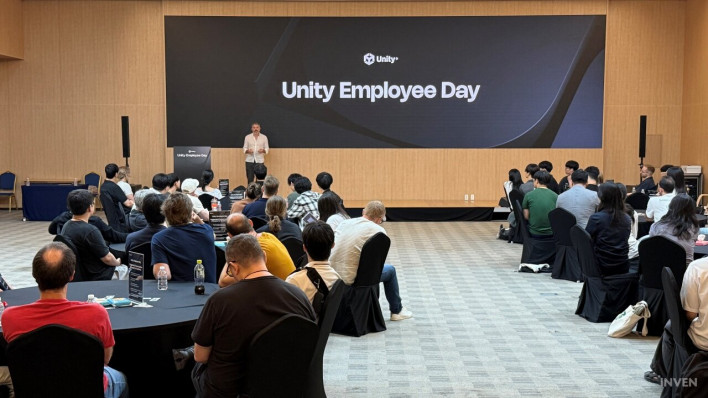
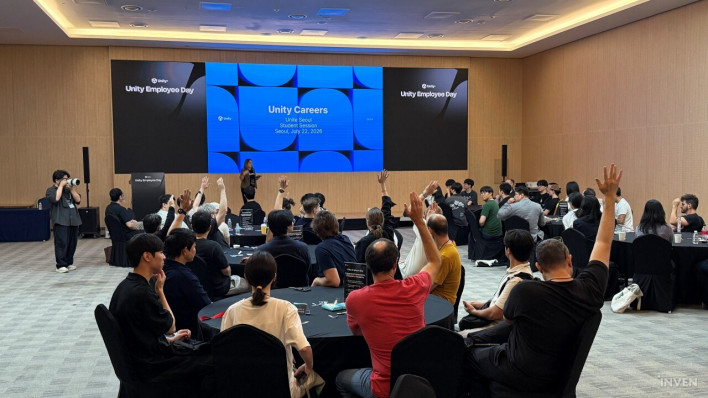
Unity hosted 'Unity Employee Day' today (the 22nd) at the Korea Science and Technology Center. The event was designed to facilitate communication between Unity's global employees and Korean university students on topics of career development and technology. Attendees included Gaby Rios Giacona, Unity’s Head of Talent Acquisition; Hugo van Hoeyven, Senior Product Designer; and Kim Bum-joo, Unity APAC Advocacy Lead, along with various other global and Korean staff members responsible for recruitment and diverse job functions. The program featured mentoring sessions and Q&As aimed at broadening perspectives on global tech careers.
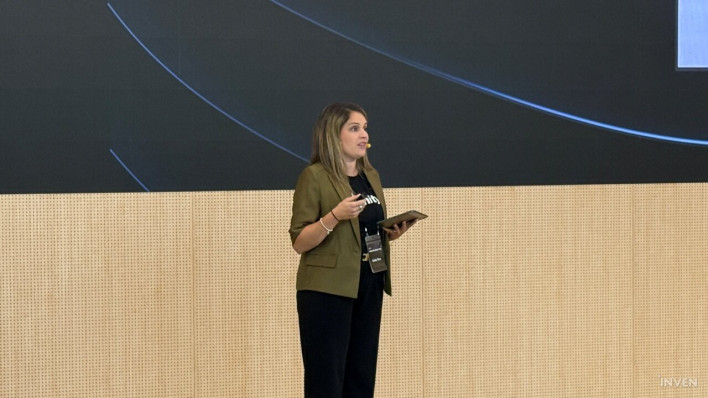
To kick off the event, Giacona spoke about Unity’s core values, talent acquisition philosophy, and mentoring programs, as well as insights into hiring "AI-native" talent—a hot topic in the industry. She identified "Lead with empathy and respect" as a core value at Unity, emphasizing the importance of honest, sincere communication and expanding conversations in ways that benefit everyone.
She also highlighted 'honest communication' and 'bold action' as key values. In this spirit, she added that Unity often asks interview questions such as, "Tell us about a time you had to change your goal's direction and the process behind it. How did you handle this issue over time?" Finally, she emphasized 'optimization for creators,' which aligns with Unity’s core philosophy. She explained that this refers to optimization not just for oneself or one's team, but for the entire customer and creator base.
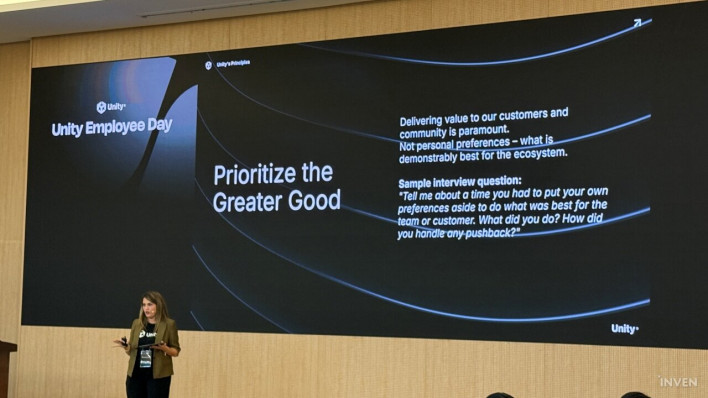
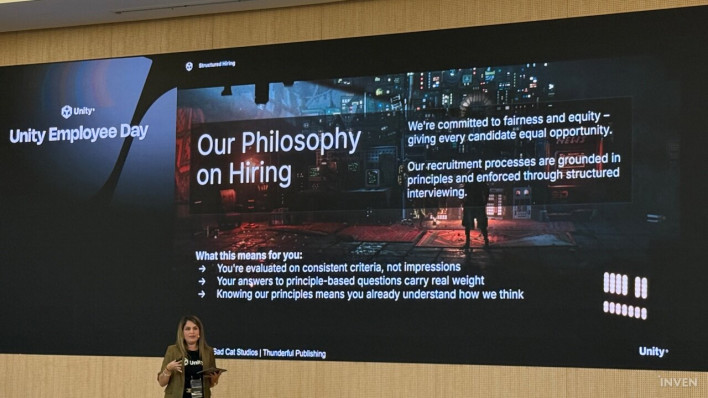
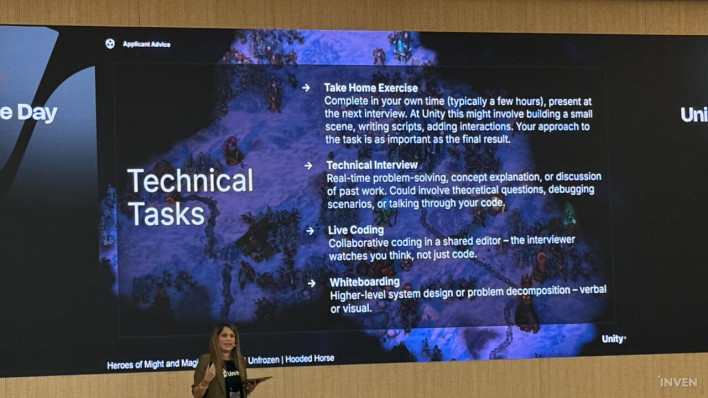
Following the explanation of Unity’s four core values, the session covered the recruitment process and tips for document submission. At Unity, the process typically involves submitting an application, followed by a phone call with a recruiter, and then an interview with a hiring manager. Depending on the role, candidates may also undergo practical assessments such as technical tasks or coding evaluations, followed by an on-site panel interview with 4–6 people to determine the final hiring decision.
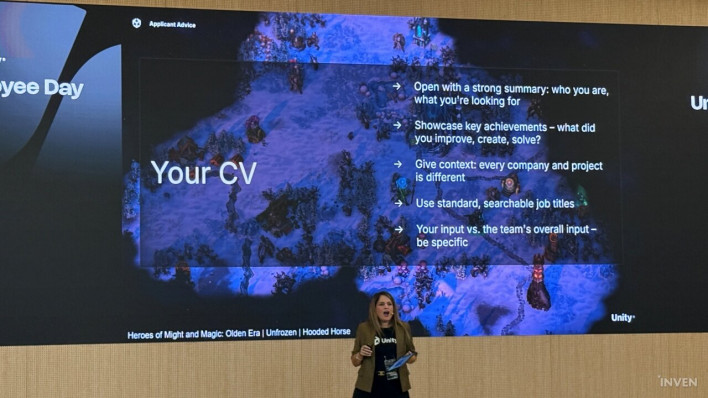
The first step in this process is the resume, which recruiters review for only about 10 to 30 seconds on average. Because Unity received over 150k applications as of 2026, it is difficult to examine each one in detail. Therefore, she explained that it is crucial to write documents that immediately resonate with recruiters. She emphasized presenting clear data focused on expertise and achievements rather than extraneous information like hobbies, while warning that dishonesty or exaggeration is strictly prohibited.
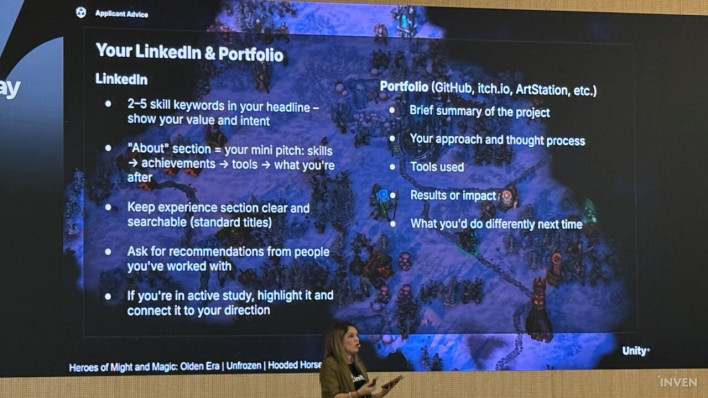
In addition to the resume, she advised that managing pages like LinkedIn is essential, and that it is beneficial to include letters of recommendation from professors, teaching assistants, or colleagues, as well as to express professional skills using clear keywords. For example, specifying clear areas like XR, C#, or 3D animation makes it easier for recruiters to grasp a candidate's profile. She also explained that cover letters should not simply repeat the resume but should instead use storytelling to convey one's personal journey and values.
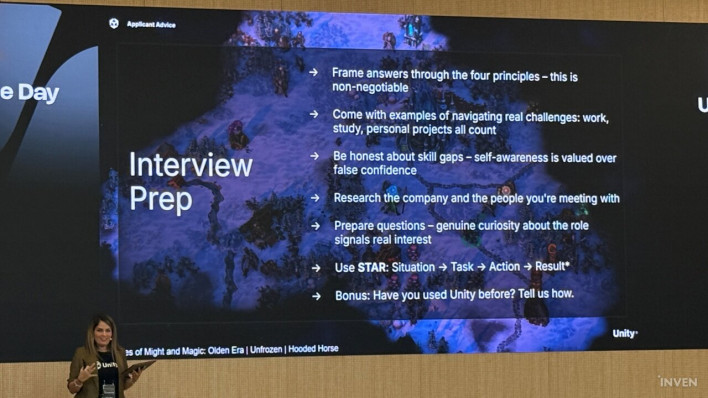
For tips on reaching the interview stage after resume screening, she recommended the STAR technique, which is frequently cited in other industries. The STAR method—Situation, Task, Action, Result—is a logical way to present experiences that is currently favored because it allows interviewers to clearly identify a candidate's problem-solving skills and actual contributions to work. She also advised using 'I' instead of 'we' as the subject when answering questions to clearly explain one's own role.
Furthermore, she noted that candidates can leave a lasting impression on interviewers by researching Unity’s developer conferences, earnings reports, and news to use company-specific terminology. She also emphasized the importance of preparing questions in advance for the standard "Do you have any questions?" prompt at the end of an interview to determine if the company is a good fit.
Finally, she discussed the current state of recruitment in the AI era and Unity’s perspective on it. With some companies attempting to use AI to increase efficiency at senior levels rather than hiring entry-level or junior staff, the 'top-heavy' phenomenon is accelerating.
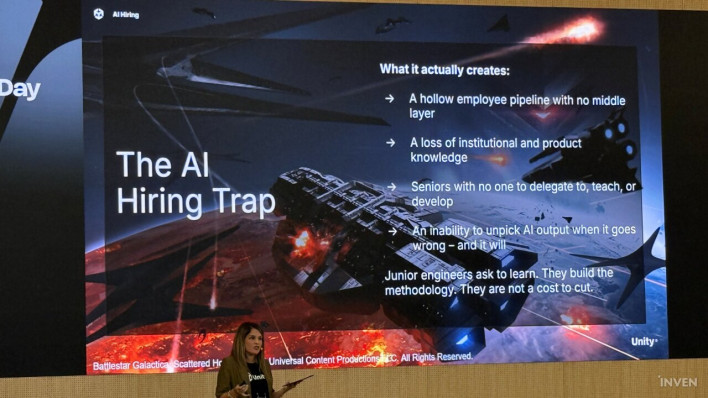
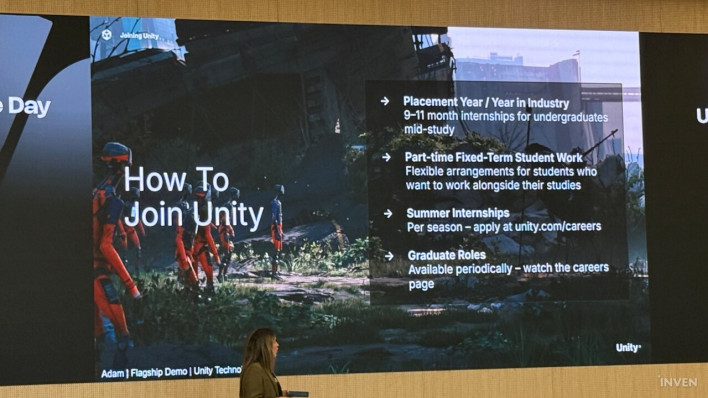
Unity views this as an 'AI hiring trap' where the middle layer and pipeline between junior and senior roles disappear. To minimize this, the company is expanding its internship and recruitment programs. In particular, Unity continues to invest in various programs, including internships, 9–11 month fixed-term part-time student roles, and rotation programs. Furthermore, the company aims for workflows where junior engineers can solve problems alongside seniors so they do not become disconnected in the AI era. Unity is also investing in mentoring and engineering education programs while strengthening onboarding processes for engineers at all levels.
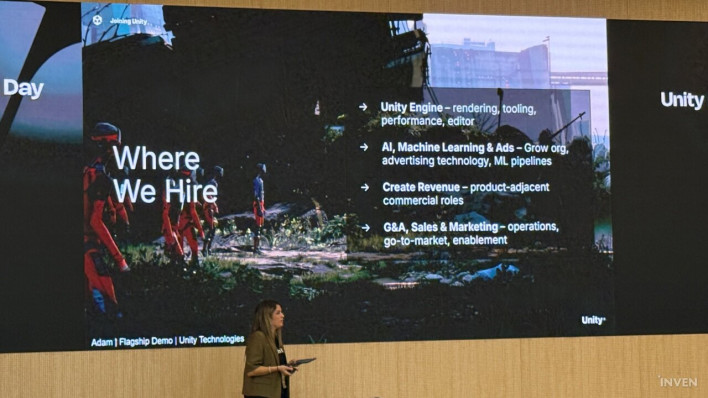
Giacona concluded, "Unity is currently hiring across all departments, including engineering, AI/machine learning, advertising, and engine monetization. We welcome applications from global talent, including those from Korea."
Following this, Senior Designer Hugo van Hoeyven provided mentoring on the competitiveness creators need in the AI era, based on his 25 years of experience in the industry, dating back to the Flash era.
Van Hoeyven began by sharing a recent anecdote regarding AI. He had a conflict with his boss over the direction of a new product, but when he input the conversation history into Gemini for analysis, it provided a diplomatic and sophisticated response that avoided triggering emotions. This experience led him to wonder if future conversations might eventually become exchanges between AIs rather than between people.
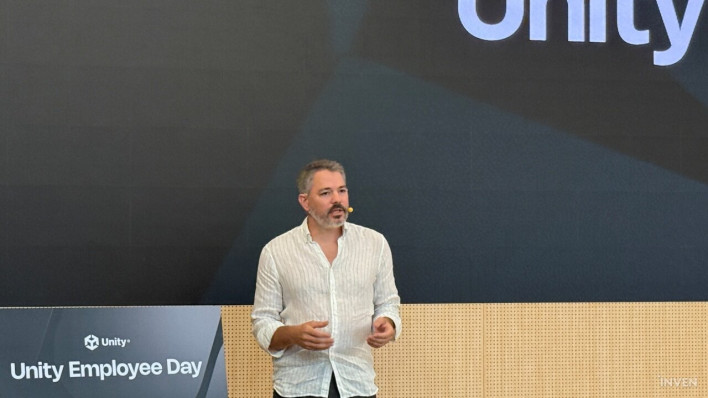
This shift is occurring across the entire industry. Van Hoeyven, who began his career in 2000, learned everything from DTP graphic design to various 3D tools and programming languages like C# and JavaScript. However, because he could not effectively use Git and the terminal, he did not call himself an engineer. With the advent of AI, however, AI has begun to handle Git commits and terminal tasks, blurring the lines between designers and engineers. At the same time, he expressed doubt about whether inexperienced entry-level or student applicants would be able to spot potential issues in the work produced by AI, given the reliability concerns involved.
Van Hoeyven emphasized that "AI has no motivation or soul" and cannot exercise creativity without human direction. In other words, humans use AI to unleash creativity, and humans must be the ones to notice flaws in AI-generated code or systems. He advised developers to cultivate the foundational skills, critical thinking, and discernment necessary to identify these errors.
To achieve this, he stressed not neglecting the process of creating things from scratch and learning from mistakes by writing code oneself. While it is fine to use AI as an assistant for repetitive tasks or bottleneck resolution, it is difficult to develop the discernment to spot AI errors without the critical thinking, trial and error, and failure that come from personal struggle. Finally, he advised, "Do not let AI replace your growth," urging them to become creators who move forward with creativity and discernment rather than just entering prompts.

Sort by:
Comments :0