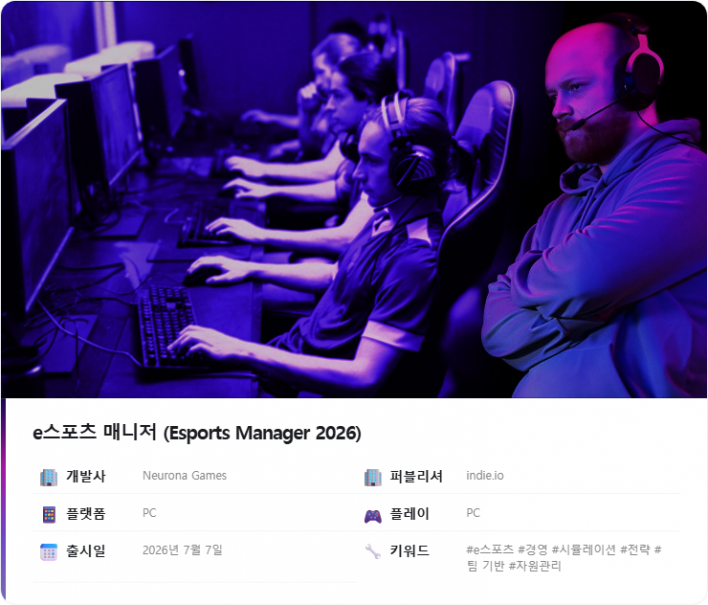
If you are a fan of the Football Manager series and esports, you have likely imagined it at least once: 'Wouldn't it be great if there were a similar game for esports?' The dream of scouting top players, devising strategies, and leading your team to the finals. Esports Manager 2026 is the game that turns that imagination into reality.
In truth, this game did not appear overnight. Neurona Games began development back in 2019 under the title 'Esports Manager: MOBA,' but that project was eventually scrapped. However, the developers did not give up, and after a long journey of development, the game has finally been released.
The more you play, the more you feel how seriously the developers approached this management simulator. First, the featured title is Counter-Strike 2 (CS2). Interestingly, they have secured licenses for actual CS2 organizations and players. Real teams like FaZe Clan, NAVI, GamerLegion, Eternal Fire, and Copenhagen Wolves are included, as are the names of real-life pro gamers like ZywOo (Mathieu Herbaut) and s1mple (Oleksandr Kostyliev) in the database.
Real figures from the CS scene, such as host James Banks, commentator Ne0kai, and coach BIT, also appear in the game. If this title proves successful, could we see games for other esports titles from this developer in the future?
A familiar first impression for FM veterans
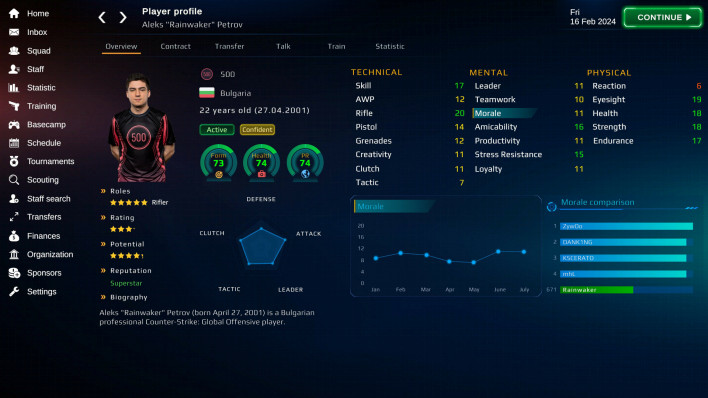
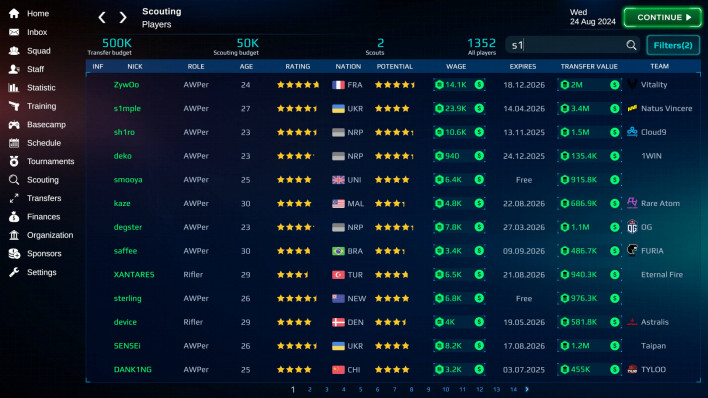
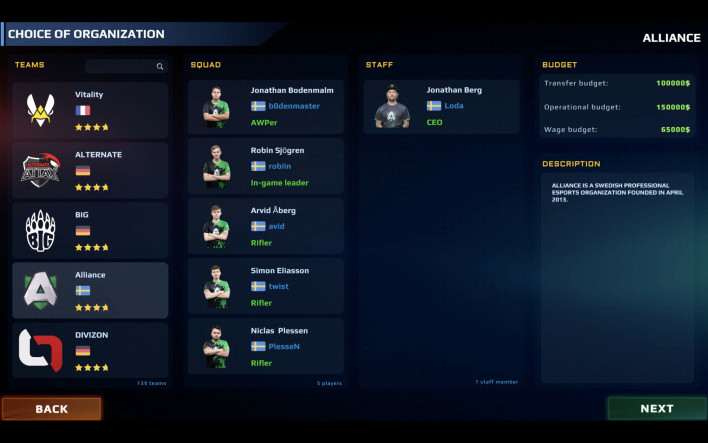
The overall interface will feel immediately familiar to anyone who has played FM. Menus for Squad, Staff, Training, Tactics, Scouting, Transfers, Tournaments, and Finance are lined up vertically on the left, and following the tutorial makes it easy to grasp the flow. While it does not support Korean, the amount of English text is not overwhelming and does not pose a significant barrier to gameplay.
Examining the details is quite interesting. You find yourself looking into why certain stats were set the way they are, how the operational needs of a team are organized, and what factors influence player development and management—the process itself is engaging.
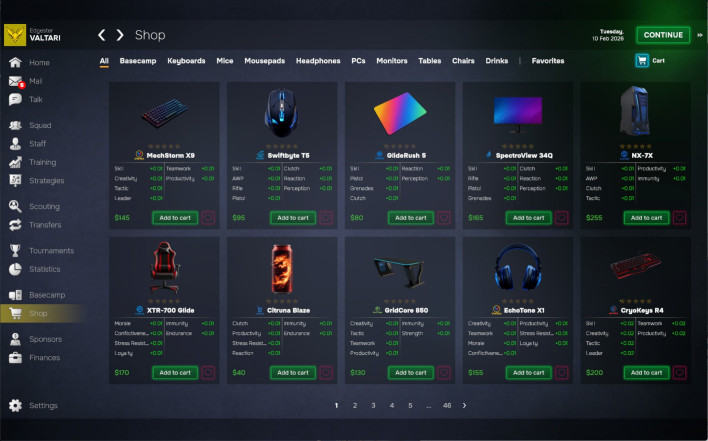
A manager's actual workload is more varied than one might think. A significant portion of the job involves behind-the-scenes tasks like purchasing team supplies, booking flights and hotels for tournaments, and monitoring training status. The attempt to bring the 'off-stage' aspects of esports organization management into the game is noteworthy. Sponsorship contracts are tied to in-game metrics like kills, headshots, and bomb plants/defuses, creating a structure where performance and financial health are intertwined.
The 'messenger interface' that FM abandoned can be seen here
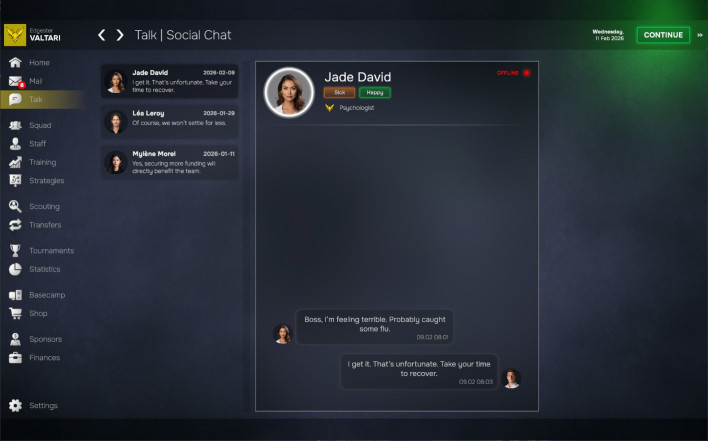
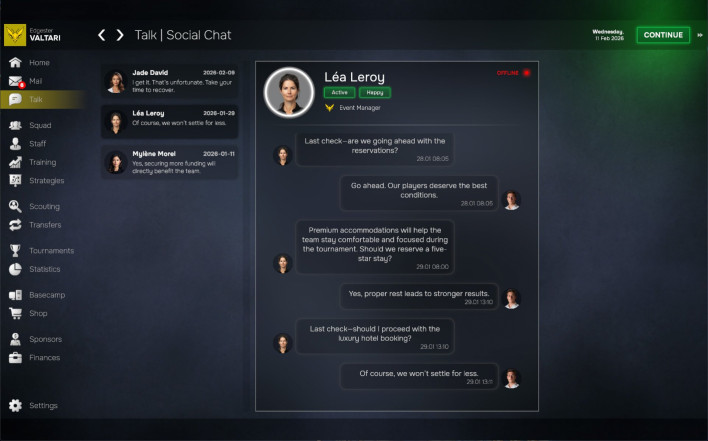
The most striking feature of this game is how you manage the team. As you play, staff members frequently reach out via messenger. Decisions the manager must make—such as where to book accommodation for a tournament or how to allocate the budget—arrive as messages, and you manage the team by selecting replies. This is the 'Talk' module the developer has highlighted, which reportedly contains hundreds of interactions and 50 unique chat scenarios in the final version.
Interestingly, the Football Manager series once envisioned the exact same thing. At the 'FM26 Manager Roundtable' held at Gen.G GGX in Jung-gu, Seoul, on July 11, Ant Farley, Senior Feature Designer at Sports Interactive, noted that one of the most debated aspects during FM26 development was the attempt to model the communication interface after WhatsApp, the popular Western messaging app. Since most Western users rely on WhatsApp just as Koreans use KakaoTalk, and real-life managers communicate via smartphone, they wanted to bring that experience into the game.
However, the conclusion was to 'scrap it.' Farley explained that once implemented, they realized FM was not a game suited for mobile-style communication. They realized this late and reverted to the current UI, where news is received via email on a laptop. While it was difficult to abandon after significant design, development, and QA time had been invested, there was an internal consensus that it was fortunate they did not move toward a mobile-centric direction.
In other words, the messenger interface in Esports Manager 2026 is the result of actually walking the path that Football Manager started but ultimately abandoned. Given the subject matter, it is a natural choice, as the esports scene runs on Discord and instant messaging. I was initially skeptical about why Esports Manager chose this approach, but after hearing the perspective of the Football Manager developers, it makes perfect sense.
However, the hands-on experience was slightly different from my expectations. The people I talked to were mostly staff like event managers rather than players, and their questions rarely felt significant. It lacked the weight of the player-to-player interactions in FM, where you could build rapport and manage team morale. Of course, this series could improve in feel as time and experience accumulate.
Surprising tactical depth and realistic faces




The most impressive part of this game was the tactics. In the pre-match detailed tactics screen, you can create named strategies for each map and side (Attack/Defense), and specify buy strategies, individual player starting positions, and timing rules for the early, mid, and late rounds in 30- or 60-second increments. The maps include the seven active-duty rotation maps used in actual competitive play, such as Dust 2, Mirage, Inferno, Nuke, Overpass, Ancient, and Anubis.
Once in a match, you can choose to rush A-site, focus on B-side defense, contest mid-map, or opt for an eco-round to save money. There is a certain satisfaction in seeing players execute your commands exactly as ordered. It is a clear strength that such a simulation game offers such a dense layer of tactics. For users who find real-time control cumbersome, there is also an option to switch to an automatic tactical system.
The player faces cannot be ignored. The game officially states that player faces and team logos were generated by AI, and many of them are surprisingly plausible compared to the real thing.
However, international reception is divided on this. A reviewer from the CS2-focused media outlet Hotspawn pointed out that some teams look jarring with 'PES 2005-era' crude faces, while the French outlet InsertCoins noted that AI-generated faces and logos undermine the authenticity of a game that features real teams. The fact that a game featuring real players uses AI for their faces is a point worth reflecting on, regardless of the game's overall quality.
From scouting to training: What it means to run a real team
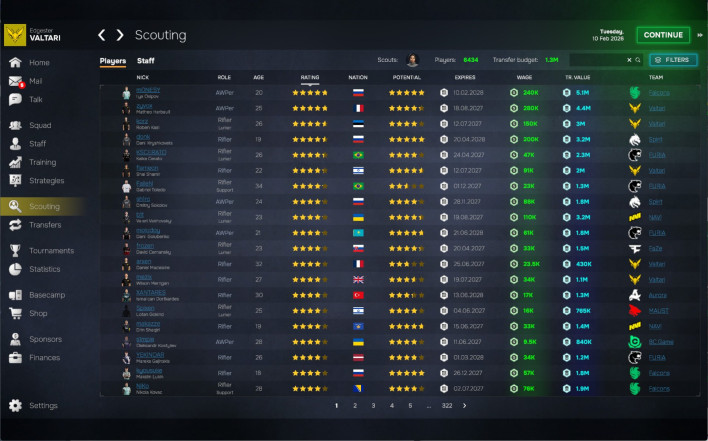
The core of building a squad lies in scouting and the transfer market. In transfer negotiations, you adjust transfer fees, contract durations, and conditions, with the structure relying on advice from scouts and the CFO. You can buy, sell, and loan players, and timing and negotiation are key to success. In fact, stories from international users about how one bad star signing derailed their entire roster are common. The Steam page's claim that "one wrong star signing can ruin your team" is no empty boast.
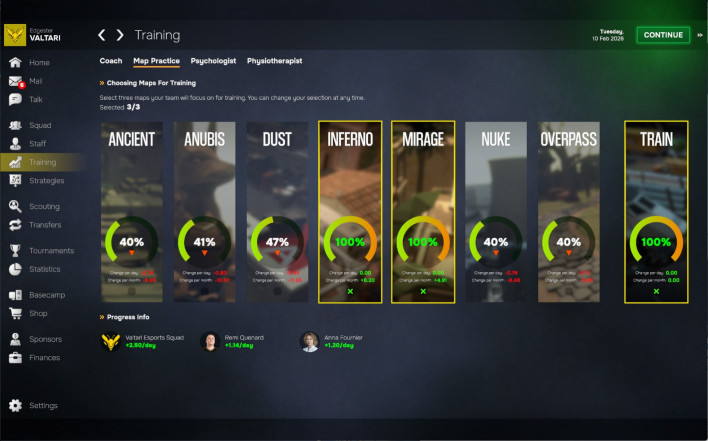
The training module is divided into four sub-tabs: Coach, Map Practice, Psychologist, and Physiotherapist. Each player's 'readiness' percentage and detailed stats are displayed, helping you decide who to train and how, and you can schedule 'Map Practice' to prepare for specific upcoming opponents. After each match, metrics like kills, deaths, assists, headshot percentage (HS%), damage dealt, and MVP are aggregated for each player, feeding into the next training cycle. The systems do not operate in isolation; scouting determines the roster, the roster determines the possible tactics, and tactics influence match metrics. This is why the game defines itself as prioritizing "management depth over simulation."
The most disappointing aspect was the 'viewing experience'
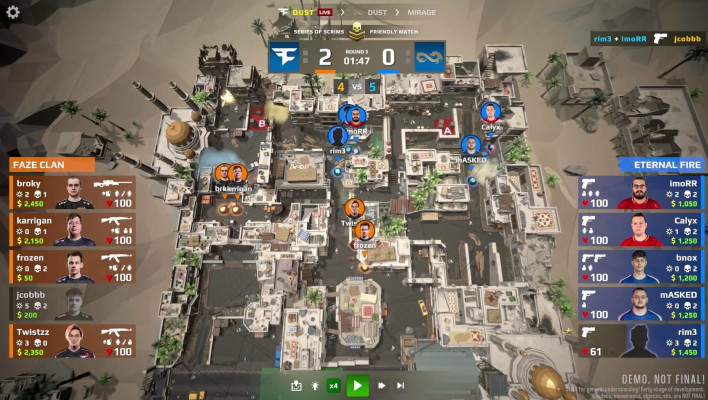
Matches are viewed from a top-down perspective, watching player movements on the map. Think of it as similar to the 2D match engine in FM. While it doesn't feel like watching an actual CS2 broadcast, it gives the impression that a lot of effort went into the simulation. Live scoreboards, economy, and kill feeds are displayed on screen, and the inclusion of commentary lines from real casters like Affinity and Boggs adds a nice touch of detail.
The problem is that it is hard to find a reason to keep watching the matches. In FM, there are few highlight moments where goals are scored throughout a long match. That makes those rare moments precious, and the process of building a goal feels like art, making it 'fun to watch.' In contrast, while every set in this game progresses and winners are decided, the process is generally repetitive, and decisive moments worth calling 'clutches' rarely occur. There are no highlights or replays. For a game about a spectator sport, the lack of 'viewing fun' is a significant drawback.
The AI's maturity within matches also has a long way to go. International users have pointed out that even after fully taking over a site, players sometimes inexplicably rotate to a different bomb site, handing over the round, or fail to react when an opponent is defusing the bomb right in front of them. There are also complaints about the tournament structure. The lack of lower-tier tournaments means a newly created team starting from the bottom is forced to face top-tier teams like NAVI or Heroic in their first tournament and get crushed. One user described it as "putting Bradford City against Arsenal in their debut match."
The lack of variables follows a similar theme. In two hours of play, there were no sudden player transfer demands, sponsorship contract disputes, or unexpected upsets. Most things went exactly as predicted. Interestingly, this wasn't just my impression. The InsertCoins review also acknowledged the appeal of the tactics but pointed out that once the bottom of the system is revealed, the sense of control you have as a manager can feel like an illusion. A reviewer who played much longer than I did saw the same limitations.
Nevertheless, it is a meaningful step
Honestly, having spent two hours with it, I am cautious about recommending this game. It is hard to confidently answer whether it is worth the money, and above all, the 'hook' that keeps you glued to the screen is not clearly visible. You would need to complete at least one full season to grasp the overall flow, and the lack of motivation to push through that first season is the biggest challenge right now.
However, one thing must be noted. There have been many attempts to create an FM-style game based on esports, but few have achieved this level of polish. Because the IP for esports titles is held by game companies, it is never easy for an external developer to bring in real teams and players to create a simulation. In that sense, simply managing to bring in real CS2 teams and players to build this framework is a clear achievement in this genre. In fact, the reaction from international media and the CS fandom is much more generous than in Korea (the initial Steam rating is 'Mostly Positive'), and the symbolic significance of having a proper CS management game for the first time in over a decade supports much of that praise.
What is encouraging is the developer's attitude. Neurona Games released its first patch just one day after launch, addressing over 25 issues, and has announced plans to continue improving the simulation throughout July and August. Through a community database, users can manually edit teams and rosters to match the real-world esports scene, and the developer has hinted at future platform expansions, including mobile. There are clear aspects to praise, such as the tactical depth, and as these efforts and updates accumulate, we may one day see an esports management game with the depth and density of Football Manager. While Esports Manager 2026 is not the final, perfect version, it deserves to be remembered as a meaningful first step in that direction.


Sort by:
Comments :0