


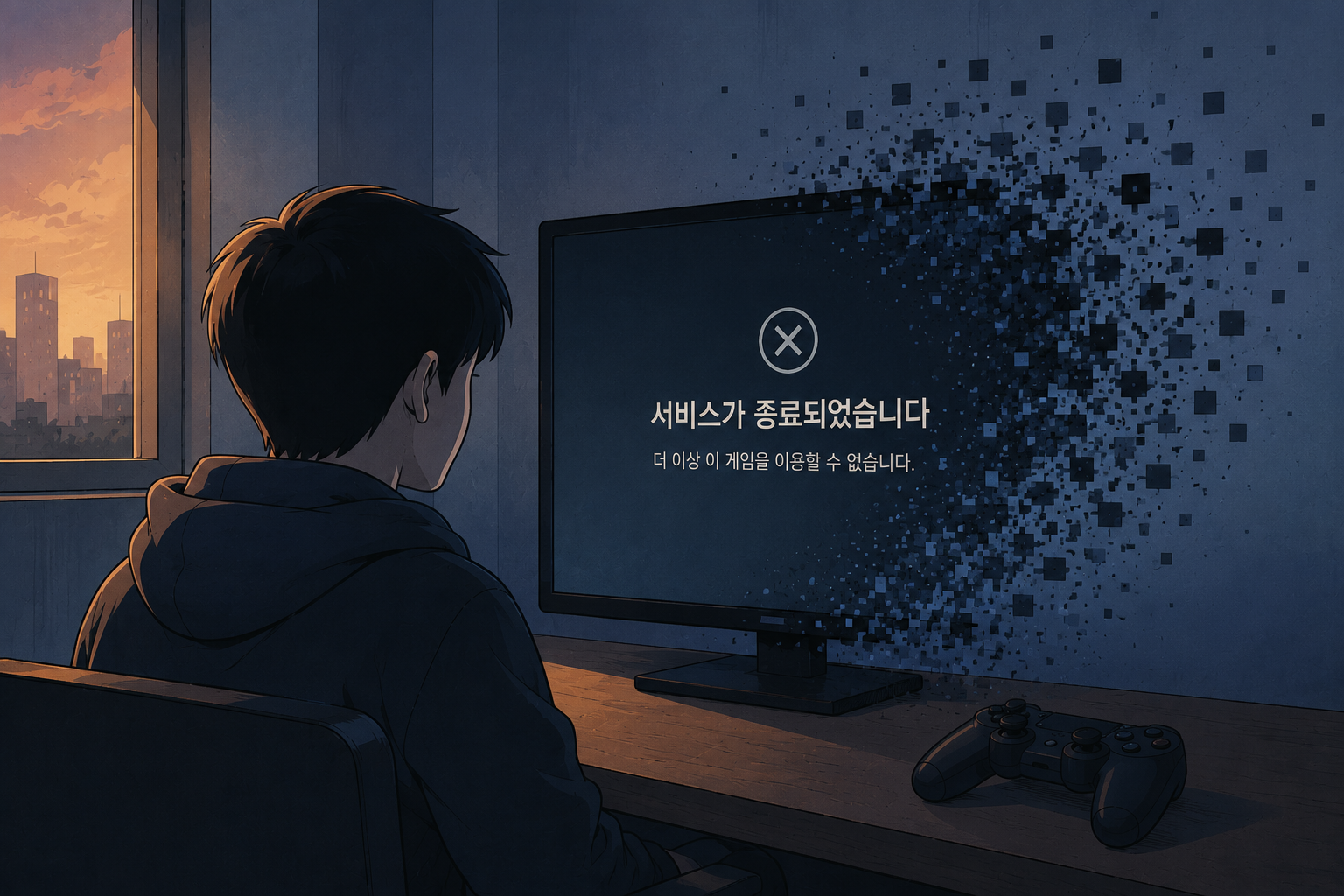
In the past, the math was simple. You paid, you received the item, and that was it. Through this straightforward process, ownership was naturally transferred, and the transaction was complete. From that moment on, the item was mine.
However, as time has passed, this simple transaction has become subtle and complex. At some point, the market stopped selling 'goods' and started selling 'rights.' The right to watch a video for a certain period. The right to use data. The right to use a water purifier or an air conditioner. And, of course, the right to play a game.
This leads to a strange situation. The expiration date for these 'rights' is rarely clear. They may claim it is a 'permanent purchase,' but no one expects a server to stay up until the end of the world. Ultimately, most 'permanent purchases' become meaningless the moment the service ends. It is a tragedy of the information age, but from a classical economic perspective, it is an ambiguous, uncomfortable, and unsettling transaction.
That is how hundreds of e-books I paid for were buried along with the death of their platform. I seem to recall seeing the phrase 'lifetime ownership' somewhere. It was unpleasant, but I figured there was nothing I could do since I had already finished reading them. In truth, I assumed that whenever the term 'service termination' is involved, someone is bound to suffer a similar loss.
On the other hand, consumers in the West did not just sit back and take it. Ubisoft’s 'The Crew,' released in 2014, announced its service termination after 10 years, leaving those who had purchased the game unable to play it anymore. Consumers launched the 'Stop Killing Games' movement, demanding that games remain playable even after service ends, and the movement spread across Europe.
The consumer group 'UFC-Que Choisir' has filed a lawsuit against Ubisoft and is heading toward a legal battle, while the 'Stop Killing Games' petition gathered over a million signatures, prompting a review by the European Commission. While the Commission announced it would not propose new legislation on this specific issue, it did state it would work to establish industry self-regulatory codes for service termination and strengthen guidance on consumer rights.
The United States has been a bit quicker to act. Anticipating such issues, California Assemblymember Jacqui Irwin introduced Assembly Bill (AB) 2426. The law, which is already in effect, requires that digital goods—such as games, movies, music, and e-books—be clearly labeled as access rights or 'licenses' rather than as purchases or ownership of physical 'goods.
Furthermore, Assemblymember Chris Ward recently introduced AB 1921, known as the 'Protect Our Games Act.' The bill’s key provisions require companies to provide at least 60 days' notice before shutting down a server and to offer a way to continue playing after the shutdown, such as through offline patches, community servers, or standalone versions. If these options are not possible, the bill mandates that refunds be provided. The legislation has passed the State Assembly and is currently awaiting review by the State Senate.
And so, a resident of California might soon have their games protected, while a resident of France is currently battling Ubisoft in court. My question is this: If a domestic package game ends its service, is it gone for good?
The E-commerce Act focuses primarily on the difficulty of withdrawing a purchase after a 'download' or 'start of provision.' It is centered on sales, with no mention of service termination. The Content Industry Promotion Act also lacks any reference to the right to use content after service ends. Even the government’s 'Digital Content User Protection Guidelines' specify various obligations, but they contain nothing regarding permanent usage rights, post-termination access, or server-shutdown play. Neither the Fair Trade Commission’s standard terms for games nor the consumer dispute resolution standards address post-termination gameplay.
The reason these gaps haven't been a major issue until now is that the domestic legal system has treated digital content as a contractual relationship between a business and a user, rather than the traditional 'ownership of goods.' The E-commerce Act, the Content Industry Promotion Act, and the Fair Trade Commission’s standard terms are all designed around service usage, contracts, refunds, and notification obligations; they do not explicitly define the right to continue using content after the service has ended.
That’s right. Perhaps we never actually 'owned' our games. At least, that is not how the law sees it. The law looks first at the contract, not ownership. It asks whether the contract was fair, whether it was sufficiently disclosed, and whether refunds were handled properly, rather than questioning the right to keep playing after the server goes dark.
Korea is no longer just a country that makes online games. The industry is rapidly shifting toward consoles, PCs, and global digital stores. As the industry reaches out to the world, the rights of consumers surrounding digital content will no longer remain a distant issue. Overseas, they have already begun to redefine the meaning of 'purchase' through law. How long can we continue to ignore that question?
When that day comes, will we still be able to use the word 'purchase' without any doubt? Or will that be the moment we finally realize that we never actually bought a game in the first place.


Sort by:
Comments :0