
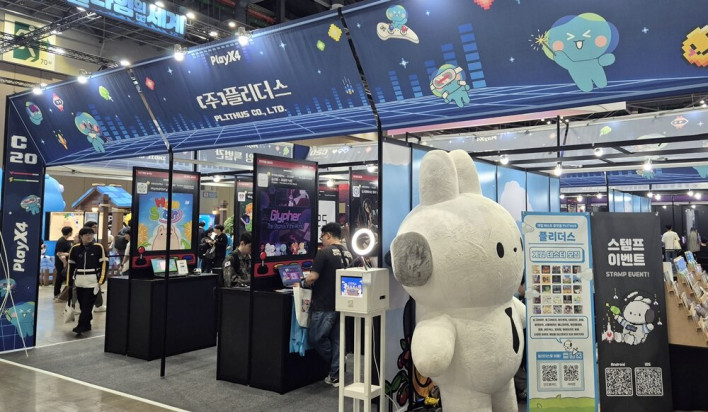
I visited 'PlayX4', which is being held at KINTEX in Goyang City, early in the morning. Usually, one would make various coverage plans before visiting a site, but this time I had absolutely no plans. I had a rough idea of which companies were participating, but the actual site was always different from the plan. The immediate challenge was figuring out what to cover.
One slightly unusual thing was that a separate 'FGT Application' corner was set up next to the pre-registration badge collection booth. Although I was curious because it was the first time I had seen FGT applications processed in this manner, I headed to the exhibition hall first to examine the site. And, while walking around the site and meeting various people, I was able to find the answer regarding 'FGT'. We live in an era where it is no exaggeration to say that users dictate the direction of development. I met with a representative from 'Fleedus,' a company specializing in game testing, and listened to a brief introduction. Intrigued by the introduction that they supply testers perfectly suited for companies requiring FGT and even ensure market fit, I asked on the spot if I could meet the CEO, and after a brief phone call, I was able to meet Lim Chan-young, CEO of Plithus. Lim Chan-young, CEO of Plithus ©INVEN First, I would like to ask this. "What exactly is the role of the service 'Fleaders'?" 'Fleaders' is a company established in 2022 that serves as a platform supporting pre-launch testing and feedback collection by connecting users who match a game's 'market fit.' It is not simply a concept of recruiting testers; rather, it is closer to a model that connects users who have played a specific genre for a long time or those with a high likelihood of purchasing based on their gaming history. For example, it is possible to request the recruitment of only users who have played a specific genre for over 30 hours. By integrating with Steam and mobile platforms, they recruit users based on actual play data, thereby providing more accurate feedback and reports. In a way, it could be viewed as a service that acts as a kind of safety net, catching potential mistakes in advance. It is the same. That is accurate. Because every single problem discovered during the testing process could potentially determine the success or failure of the game. Additionally, we are playing a role in finding and connecting markets suitable for the game. As you know, preferences, trends, and dynamics vary by region in the global market. Even if a work is unlikely to succeed in the domestic market, there may still be a market with sufficient potential for success. Do you accept global companies as clients as well as domestic ones? “ We actually have foreign employees at the company. There are people from Germany, Spain, and Japan. They are all employees who speak Korean well, and they handle the communication with overseas companies. Focus Group Testing (FGT) for various games was actually underway at the site ©INVEN So, in this situation, are you only connecting tests and reports? Are you also handling direct publishing? “We are not in a form of direct publishing. Instead, we actively support connections with publishers and investors, and last year alone, we connected dozens of games with publishers. At events like 'PlayX4,' we also conduct business matching to connect global game companies with domestic publishers, and we continue to create opportunities for indie teams to receive actual user feedback. Then, in what form are the reports that clients receive produced? What level of report will you receive? It is not a method that simply presents numerical data. It provides data-based analysis on where user reactions differ compared to games in similar genres and what elements are strengths. For example, it quantifies and shows how suitable our game is for a specific market, the level of risk, the potential revenue, and what is strong and weak when compared to games in the same genre. If you conduct tests multiple times, you can also cumulatively check changes at each stage. Publishers and investors also view this data as very important. This is because they can verify how quickly the development team is repeating updates and even which user base they are targeting for testing. One of the Plithus report samples. In reality, a considerably vast amount of information can be verified. ©Plithus
For this level of in-depth testing, it seems that ‘who conducts it’ is ultimately important, so how do you recruit focus groups?
“We operate it centered on VIP users. We manage the platform based on users who have participated in over 50 tests or have been selected as excellent reviewers, and we link all game history and play records to ensure that only users with actual experience in the genre can participate.
We believe the most important thing is to connect ‘users who are truly likely to purchase and play this game.’
I am also curious about the reason you started Fliders. How did you come up with the idea to build a company like the one you have today? I originally ran a game community for a long time. While doing so, I saw so many games fail. I tried hosting tournaments, making promotional videos, and doing all sorts of things to make games succeed, but in the end, those things couldn't stop them. So, through constant trial and error, I realized that the process of meeting users suited to the market and receiving feedback based on data before a game launches is truly crucial. We believe that it's not enough for just one game to succeed; we need teams that can create a second and even a third game to keep emerging. I heard that you are also incubating university teams. What exactly does that entail? We are collaborating extensively with university teams and early-stage indie development teams. In fact, initially, it wasn't easy to even persuade game companies. There were many reactions asking, "Why do we need user feedback?" However, most teams that have experienced it once continue to conduct tests. This is because they feel firsthand that it is actually helpful. University teams, in particular, often improve and respond very quickly when connected with user feedback. That is why we continue to collaborate with university clubs and indie development communities, and we also provide exhibition opportunities and testing environments in conjunction with organizations like Unidev. We also initially wondered, "Which teams would be more data-driven?" and in that process, we came across many university teams. We found that they actually absorb feedback very quickly and improve at a rapid pace. Therefore, we are conducting the incubation in a direction that goes beyond simply creating a single game, helping the team grow into one capable of continuing to make games in the future. On weekends, the B2B hall is converted into a demonstration space for university team projects. ©Plithus Incubation likely doesn't generate much profit, so how is the revenue structure created? "Is it structured so that you receive referral fees or testing costs?" "Basically, it is a structure where game companies pay for testing or user recruitment costs. However, since we connect users based on actual play history or genre experience rather than simply gathering numbers, the costs vary depending on the difficulty of recruitment. For example, costs increase when recruiting users who have played a specific genre for a long time or users from a specific country. In fact, about half of major domestic corporations use our service." "Is revenue distributed to testers as well?" "That is correct." Costs are also paid to them at a certain percentage. If it is a 'test specialist company,' it seems likely that there are many cases where one sees somewhat unfortunate situations. What is the most common case? It is common to check market reaction only after the game is completely finished. This often happens because fear is high at the point where one feels the game is not yet complete; however, if this actually occurs, sunk costs have already increased, and the scope of modifications becomes too vast. Therefore, I believe it is important to receive user feedback much faster from the early stages and to gain experience in actual sales as soon as possible, even on a small scale. For small startup teams, the experience of earning money directly, even a relatively small amount, is a significant experience in itself and serves as good motivation. Early testing can reduce sunk costs and risks. ©Plithus Since I heard that you are also conducting incubation, I assume you have met many indie and amateur teams. Even if they do not become your clients directly, can you offer any helpful advice? “Ultimately, what matters is how well you listen to and accept user feedback and the market. Of course, the team's unique direction and identity are important, but I believe you must act with a clear understanding of what needs to be verified. Also, a structure that allows for data-driven decision-making is necessary.” If you really want to turn games into a business, I believe the process of quickly creating an experience where they are actually sold and succeed, even on a small scale, is crucial.

Sort by:
Comments :0