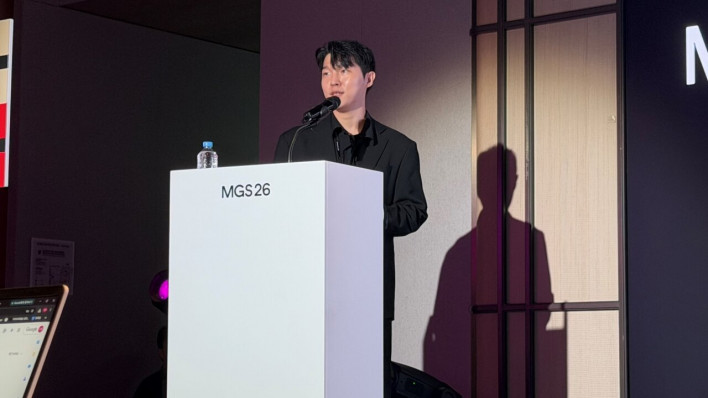
For any professional, the ultimate challenge is finding ways to work more efficiently and quickly amidst a daily deluge of tasks. Jeong Yeo-won, a Growth Marketing Manager at KRAFTON, opened her presentation by expressing her hope that the session would provide practical help in leveraging AI to streamline workflows.
Reducing Repetitive Tasks and Overcoming Limitations
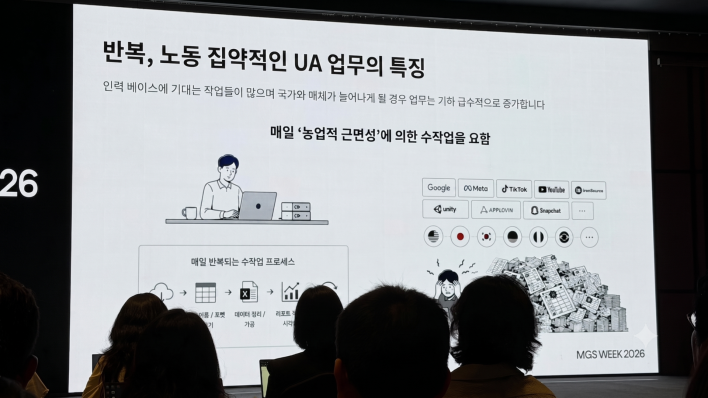
Jeong noted that the core goal of a User Acquisition (UA) marketer is to efficiently attract high-potential users, a process often bogged down by repetitive tasks. She expressed frustration that marketers must manually download data from various media sources, align columns, verify consistency, and compile reports—a process that grows exponentially with campaign scale, often pushing critical decision-making and insight discovery to the sidelines.
She also explained the limitations caused by the structural mismatch inherent in the gaming industry. While new game release schedules are flexible—often subject to delays or early launches—the resource expenditure structure, including headcount and partner solutions, remains rigid.
Jeong emphasized that these two factors were her primary motivations for taking action. Her goal was to reduce repetitive work and use AI to improve capabilities not just for the UA team, but for the organization as a whole.
Securing Organizational Buy-in Before Coding.
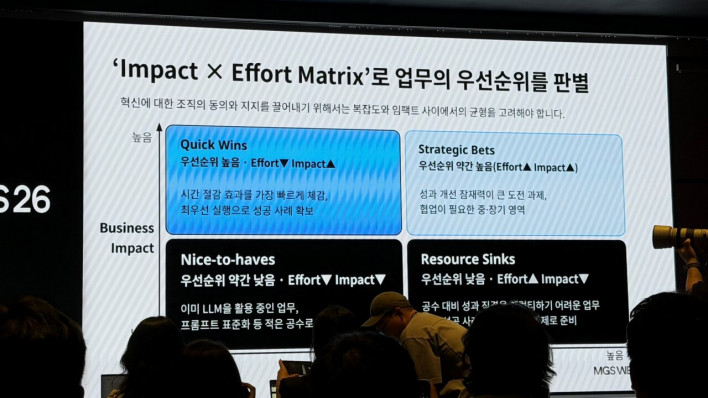
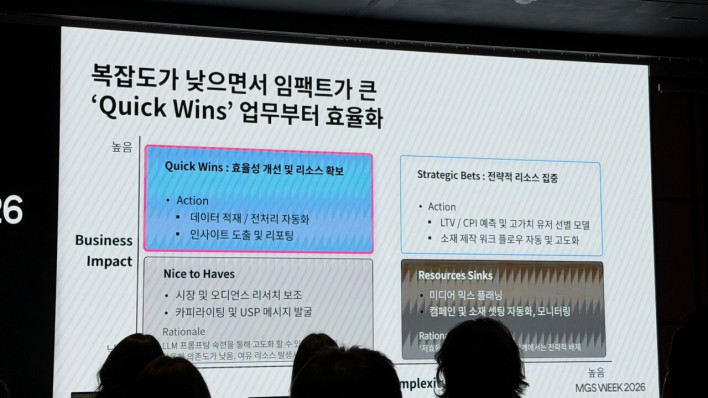
Rather than diving straight into AI implementation, Jeong first focused on securing organizational buy-in by documenting the need. She analyzed the team's workflows, recording the personnel involved, time spent, and repetitive pain points. She then mapped these tasks onto a matrix defined by two axes: effectiveness and automation difficulty.
Jeong explained that she prioritized 'quick wins'—tasks with low automation difficulty but high impact. She added that she temporarily deprioritized high-impact tasks that were difficult to attempt in the short term, fearing the accumulation of failure within the organization. "This matrix became a powerful weapon," she explained. "When requesting a budget for expensive AI subscriptions and support, I wasn't asking to change everything at once; I was persuading the organization to support a phased transition." She stressed the importance of securing this buy-in before starting any technical work.
Think of AI as a Tool to Free You for More Important Work.
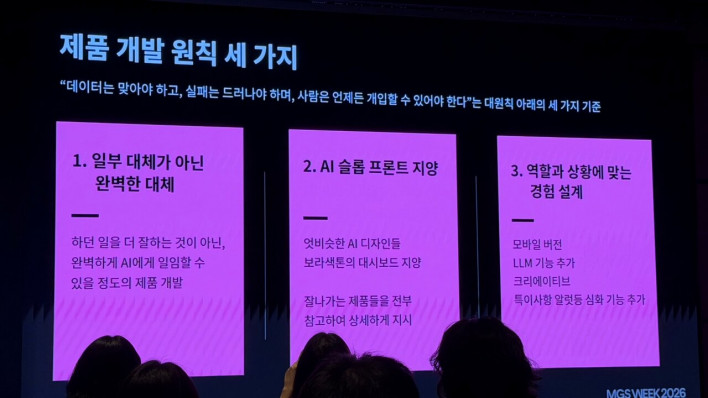
Jeong then moved on to system construction. With the organization on board, the next step was building the automated AI system. She advised designing AI to achieve 'complete replacement' rather than partial assistance. "Some may feel anxious that AI is replacing their work," she acknowledged. "But it is important to adopt the mindset that once AI perfectly handles those tasks, you will be free to focus on more important work."
She also shared tips for AI design, emphasizing that prompts containing specific work context are more effective than those relying on adjectives. Because AI tends to focus on aesthetics when given adjectives, the results are often useless. Instead, Jeong provided the AI with the team's data screening sequences, decision criteria, key factors, and priorities, resulting in a dashboard that was both casual and highly functional.
Finally, she highlighted the importance of designing a customized experience that satisfies everyone. To this end, she developed a mobile work tool that allows users to grasp key trends and respond to issues within one minute of starting their commute.
How to Use AI, and the Results
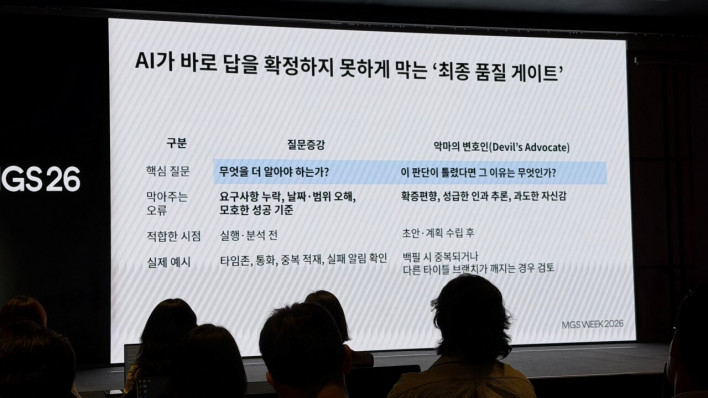
Jeong explained the specific strengths of the AI tools she uses: 'Claude' for its ability to grasp overall context in data structure and backend design, 'Cortex' for screen implementation, and 'n8n' for its ease of debugging when running daily sequential processes.
She also shared best practices for AI utilization: △Since AI has context limitations, avoid giving all instructions at once; instead, provide clear initial instructions and build upon them. △Rather than giving complex, detailed instructions, clearly define the destination and completion criteria—focus on the 'what' rather than the 'how.' △Use 'question augmentation' techniques, where the AI is prompted to ask itself multiple questions to refine its output.
Jeong emphasized that this process has led to a dramatic improvement in operational speed and structure within her company. Approximately 95% of data aggregation and analysis tasks have been automated, and repetitive work that once took 60 hours now takes only 5 hours.
She concluded her presentation with a witty remark regarding the headline, 'The UA Manager Who Reclaimed Their Evenings.' "Some of you might be wondering if I actually have more free time in the evenings and how I spend it. To be honest, I've become even busier (laughs). But because this work allows me to spend my overtime on valuable tasks like product stabilization or brainstorming new ideas, rather than just filling in data, I'm happy to be able to focus on the growth of my games and explore new opportunities for tomorrow."
She encouraged others to take the leap, saying, "Building something with AI requires more care and effort than you might think, and your life might not change drastically right away. However, for those who pursue work efficiency and still hold onto their initial dreams as marketers, it is a challenge well worth taking."
Sort by:
Comments :0