The most intense battlefield in South Korea is, without a doubt, the mobile gaming market.
Major new titles appear every quarter, and developers pour weapons they have spent 4–5 years creating into the market within just three months. The fate of a live-service game, which must struggle to avoid losing its user base, is truly desperate. Updates, patches, and events are the bare minimum; if you don't show something fantastic—even if it's just hanging a banner—falling out of the rankings is a natural progression.
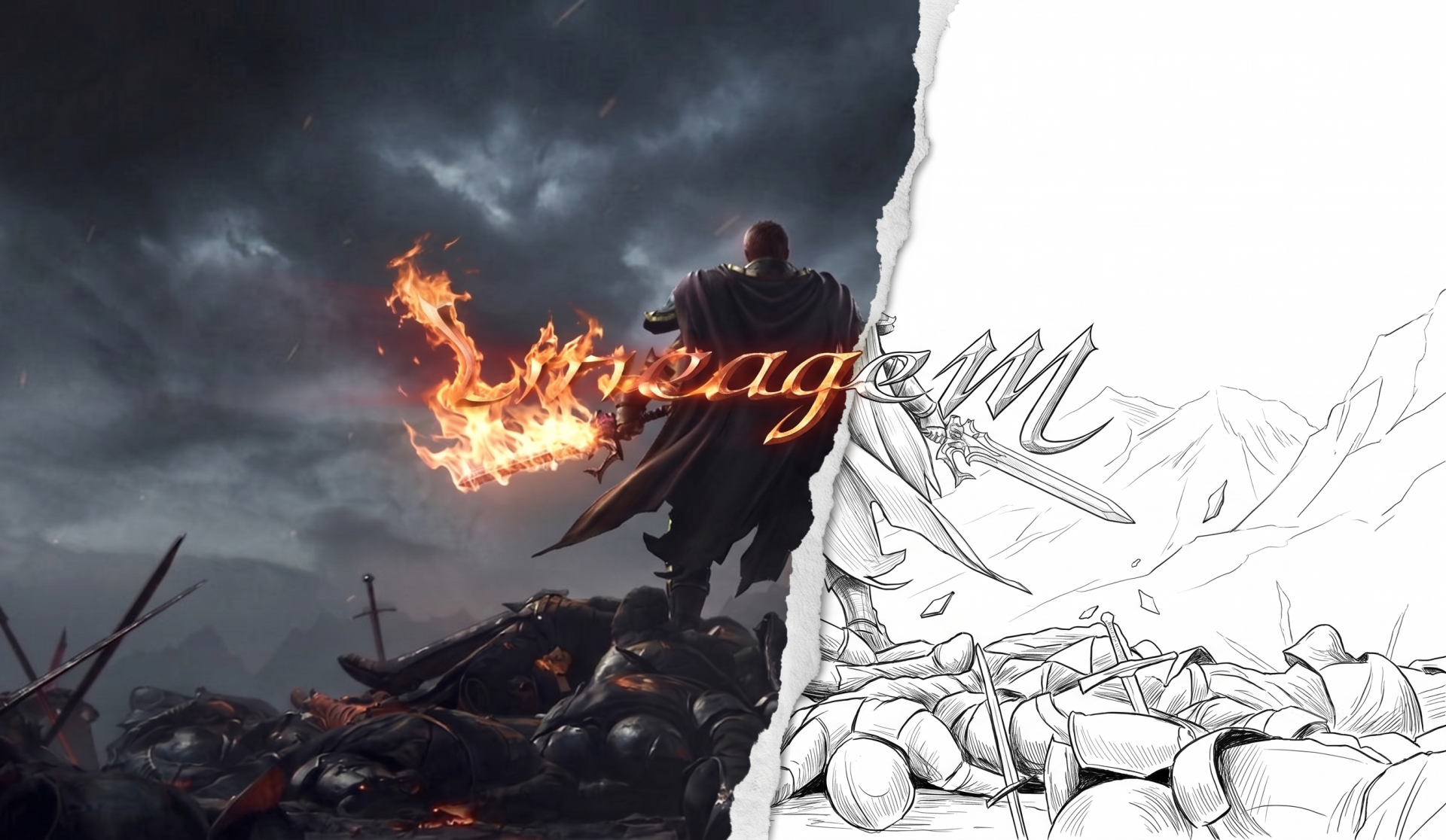
On a morning in June, a familiar name appeared at the very top of the revenue rankings in this fierce battlefield: 'Lineage M.' This is a game released in 2017. A game that has survived every imaginable trial—on land, in the air, and in space—has reclaimed the number one spot in revenue.
Predictions that Lineage M would falter upon the arrival of Lineage Classic have proven wrong. Instead, Lineage M, now in its 9th year, has returned to the top of the revenue charts without any loud fanfare. However, there is room to debate what caused this. It could be a testament to what has been built over the past nine years, or it could be a temporary indicator driven by the 9th-anniversary milestone.
# Reclaiming #1 After 210 Days
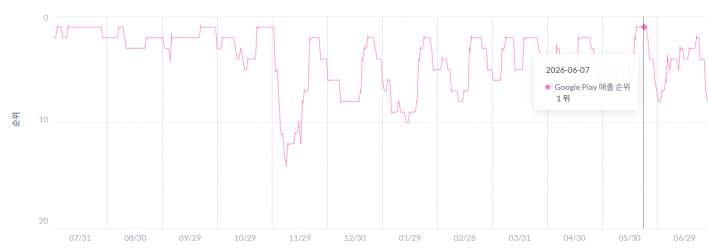
It was June 4th when Lineage M returned to the number one spot on the Google Play revenue chart. Just a few days prior, the game had been hovering around 7th place; it reclaimed the top spot 210 days after falling from the summit on November 5, 2025. It also rebounded to the top tier on the Apple App Store, drawing attention across both major markets.
A 'reverse run' by a long-term service game is not entirely surprising. However, the case of Lineage M is different. It didn't just ride a wave of fleeting hype; a game in its 9th year of service, in an environment where numerous similar games are released annually, re-entered the top of the rankings solely through live operations.
This rebound is difficult to explain through short-term factors alone. Even as Lineage Classic attracted both PC and mobile users (via PURPLE ON), the Lineage M user base remained relatively stable. This implies that despite the release of new games in the same genre, there was almost no exodus of its core user base.
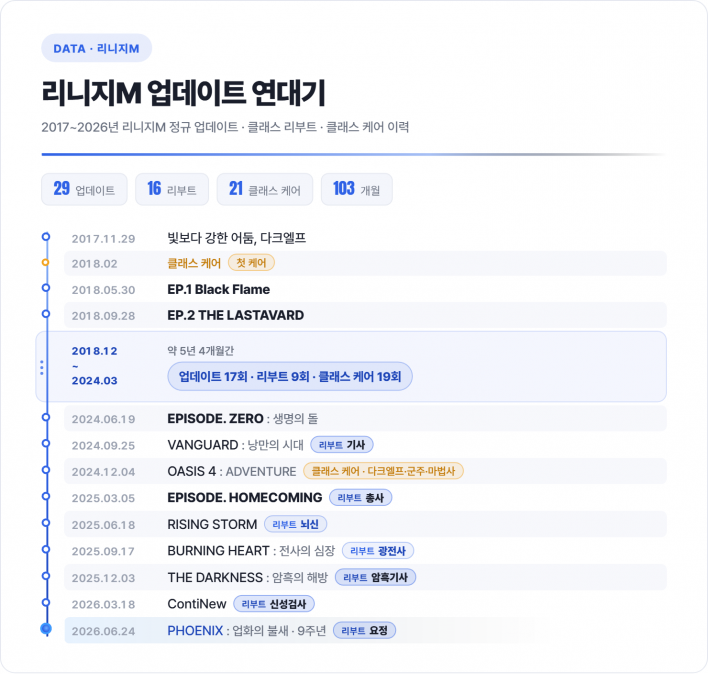
Expectations for the 9th-anniversary update, 'PHOENIX: The Firebird of Scorch,' which took place on June 24, also played a role. The update teased a class reboot for the Fairy, a new region called 'Forest of Hidden Barriers,' a new dungeon called 'Sanctuary of Flame,' and the unique-grade 'Girutas' weapon.
However, it is worth noting the nature of these features. The reboot world transfers, new servers, and 9th-anniversary hype are less about attracting new users and more about calling back existing ones. Whether this is the result of an increased user count or existing users opening their wallets again cannot be distinguished by revenue rankings alone.
# The 3-Month Hurdle New Titles Couldn't Clear, and the nine Years Lineage M Has Surpassed
There is one subtle aspect to this rebound. It is estimated that about 30% of Lineage M's revenue comes from PC payments via PURPLE (KB Securities report), but Google Play and Apple App Store revenue rankings only track in-app purchases within their respective markets. Revenue diverted to internal payment systems is not reflected in the rankings at all. In fact, immediately after the introduction of internal payments in November 2025, Lineage M slipped from 1st to 12nd place.
In other words, it returned to the top while having a significant portion of its total revenue excluded from the rankings. This means the mobile revenue ranking metric is actually underrepresenting the game's true scale.
NC is responsible for this result. The reason for introducing internal PC payments was to avoid the 30% commission charged by app markets. Even if it meant taking a hit in the rankings, it was a profitable choice; if the company saved on commissions while accepting a ranking drop, only to reclaim the top spot later, it is less of a loss and more of a double victory.
However, the ranking number itself is not the core of this story. What we should really pay attention to is the method by which they have been generating those numbers for nine years.
Short-term ranking spikes are relatively common. The important thing is whether that ranking can be maintained over a certain period. Looking at Lineage M's Google revenue ranking trend over the past year, it has maintained a top-10 position for most of the time, excluding the period immediately after the introduction of internal payments when it fell to 12nd–13rd place.
The background often cited for this is the capability of its live service operations. During this period, Lineage M has periodically rebooted its major classes. Like changing clothes with the seasons, the pattern of significantly refining major content every quarter has been repeated. In the span of two years, six classes—Knight, Gunslinger, Berserker, Dark Knight, Holy swordsman, and Fairy—have undergone large-scale reboots, while weekly patches, new server openings, and reboot world transfers have continuously altered the competitive environment.
This method of stacking small changes every quarter is identified as the factor explaining Lineage M's sustainability. In a market flooded with new titles, the power of an old game to hold its ground ultimately comes from its post-launch operations.
How exceptional this survival is becomes clear when placed alongside the new titles released during the same period. INVEN's comprehensive estimate of the top-10 revenue retention for 20 major mobile MMORPGs released in Korea between 2024 and 2026 shows that about half of them never reached the Google Play top 10 even once. Even those that succeeded in entering the rankings were pushed out within two or three months. They failed to overcome the so-called '3-month hurdle' where the initial launch hype fades. Only a handful of new titles managed to stay in the top 10 for more than four months, and only two cases continue to see success after launch.
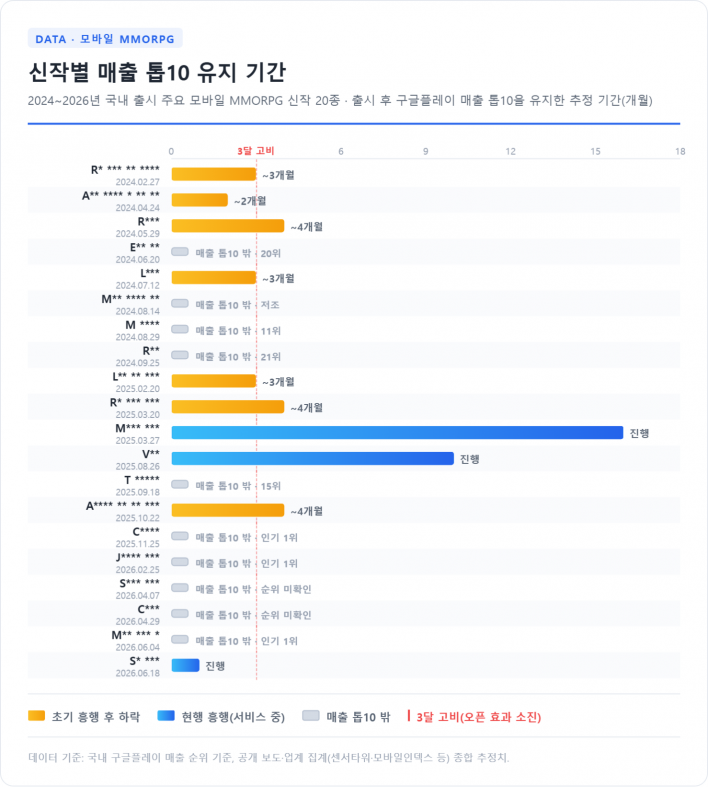
What is noteworthy is the point at which they collapse. In the past, the success of a mobile MMORPG largely depended on its graphics and hype at the time of launch. Now, it is different. As the market has become saturated and user expectations have risen, the battleground has shifted to the post-launch period. The ability to provide content without interruption, adjust balance, and engage with users after the initial interest fades is what determines survival. The '3-month hurdle' where new titles in the charts stumble is usually this point. They had the 'launch effect,' but lacked the operational stamina to follow through.
Of course, there is a trap in this comparison. New titles start from zero, while Lineage M starts with users who have accumulated nine years of spending history. It is not a race run on the same starting line. Nevertheless, the comparison holds: nine years ago, Lineage M was also a new title. It is difficult to find any games that were competing for the top revenue spots back then that are still in the same position today
While the lifespans of new titles are measured in months at best, Lineage M has continued its service for nine years since its 2017 launch, spending most of that time at the top of the revenue charts. A 18-month timeline capturing the rise and fall of new games cannot even begin to map its trajectory. Lineage M has been clearing the 3-month hurdle that new titles repeatedly trip over for nine years now.
# Conditions for Sustainability Remaining After the Rebound
Whether this number one spot is a temporary phenomenon due to the 9th-anniversary event or a level that will be maintained remains to be seen. The fate of a live-service game, always walking a tightrope, cannot be predicted a month ahead. In fact, with the release of a competitor's new title on June 18, Lineage M has returned to a competitive struggle for the top spots. The level at which the ranking stabilizes after the rebound will be revealed in the trends following the summer.
Yet, one thing is clear: in that desperate battlefield where veterans and newcomers clash every quarter, Lineage M has been clearing that same 3-month hurdle for nine years. Those nine years were not filled with a single spectacular reversal. It means the tightrope act has been repeated for nine years.
However, when viewed from the user's perspective, this dazzling act looks different. Reassembling classes every quarter and adding new grades of equipment on top of them is 'operations' for the company, but for the user, it is a competition that restarts every time. A rebooted class requires new skills and new equipment. It means having to re-optimize the character you finished setting up just yesterday, every quarter. If you keep up, it's motivation; if you're a step behind, it's stress.
The question Lineage M must answer, therefore, is not on the leaderboard. It is how long the method that has kept it going for nine years can continue to hold onto the users who have been with it for those nine years.
One question remains. During the same period, Lineage Classic stood at the top on PC, and Lineage M stood at the top on mobile. On different platforms, in different ways, but under the same name. One reached its position by reviving the original form from over 20 years ago, and the other by tirelessly refining it for nine years. Is this truly a coincidence? Part 3 will overlap these two achievements to examine the scalability of the original Lineage IP and what truly supported NC's rebound.

Sort by:
Comments :0