
[Peaceful Life Mode] A child descends from the mountains. The scene of a rural village unfolds around a child who looks no older than an elementary school student—a child whose gender is impossible to discern—bathed in warm light. In the well-tended fields, onions and carrots, grown with someone's hard work, are thriving, and the child chases a chicken that has hopped over the fence. Soon, the child enters the crumbling old shrine, and the logo appears amidst the chirping of birds. 'Village in the Shade'.
The same beginning, but a story that unfolds in entirely different atmospheres. The developers of 'Yomawari' created 'Village in the Shade' in these two distinct branches. One is a life simulation centered on farm management, carrying that bright atmosphere throughout. The other adds a layer of horror, filled with secrets intertwined with various types of dread.
These two pillars of gameplay could have resulted in a half-baked experience if either side lacked appeal. However, Nippon Ichi Software's new attempt demonstrates a level of craftsmanship that avoids such concerns. These two branches are not merely placed side-by-side; the key to expanding the farm happens to lie beyond the very rules one must follow.
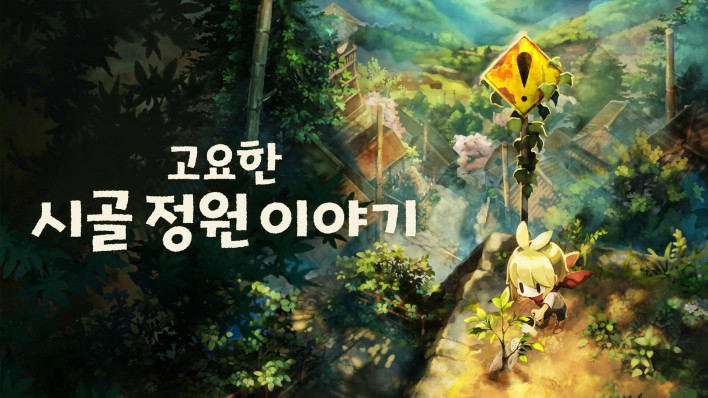
The game design, direction, and character design from the 'Yomawari' team previously evoked a cruel and gloomy atmosphere. Yet, even in a horror game, the uniquely charming character design and background art served to lighten that mood. When shifted to the life simulation genre, this becomes a distinct strength.
The development team chose a straightforward approach for the life simulation core of 'Village in the Shade' without unnecessary gimmicks. This means they implemented detailed systems within the genre's established framework without distorting its conventions. Since many successful games already exist in this genre, excessive variation could have shattered the premise of managing a farm in a quiet rural village.
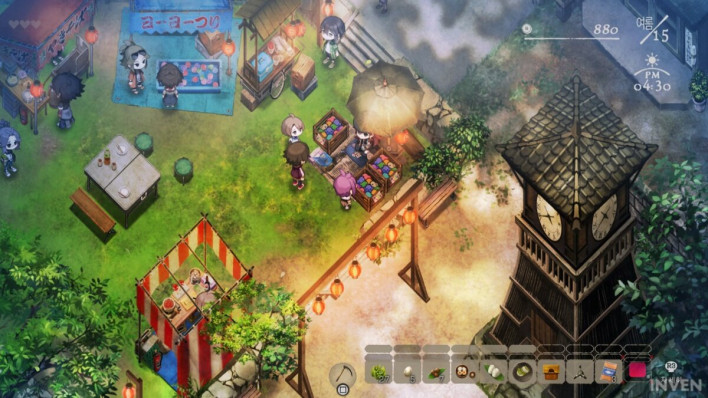
Consequently, the life simulation part of the game is filled with earnest, practical content. From hoes and sickles to shovels and watering cans, all the tools needed to maintain fields and paddies are provided. You buy seeds or seedlings, plant them, water them, and pull weeds. For anyone who has played this genre before, this part requires no explanation.
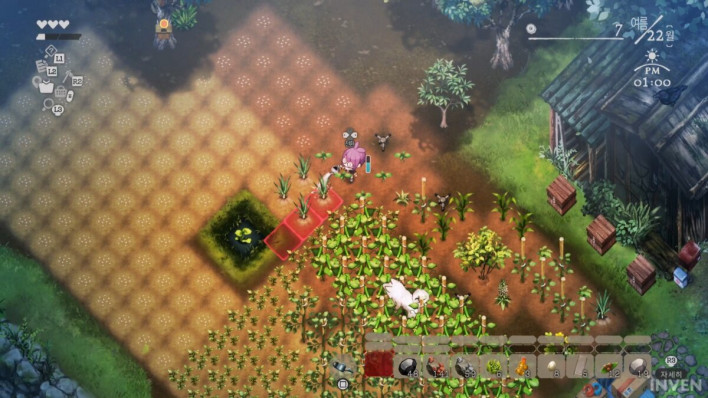
However, the actual sensation of performing these familiar actions is not entirely smooth. While convenience features for fine-tuning direction or parallel movement exist, aiming precisely at a single plot of land often misses the mark more frequently than expected. It is manageable early on, but as the farm expands, this stiffness gradually accumulates.
Since crops have a concept of succession, you can choose whether to grow crops like cucumbers, which take a long time to grow but can be harvested multiple times in a season, or crops like ginger, which you plant and harvest once for quick initial capital. There is also a concept of rice paddies in addition to fields. Crops in paddies do not require watering, but weeds must be removed consistently to prevent growth from stalling.
Various livestock, such as chickens, ducks, cows, and goats, contribute to farm development in different ways. Beyond the basic concept of cows producing milk and chickens laying eggs, letting ducks roam outside the coop allows them to float in the paddies and remove weeds that hinder grain growth. Eggs and milk can be used as cooking ingredients or processed into goods like mayonnaise.
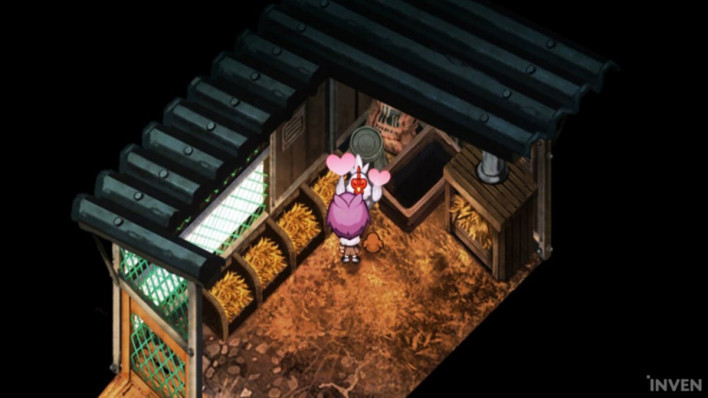
Processing works similarly. The results from pickling jars, stoves, and furnaces flow back into cooking, tool crafting, and upgrading farm equipment.
Thus, the life simulation is less a list of content and more of a circuit. Crops harvested from the field become food, food becomes stamina, and stamina becomes the time you can spend in the mountains and mines. Minerals extracted there pass through the furnace to become better tools, which then return to the fields. It is a structure where farming, animal husbandry, mining, and logging are tied together by money and materials, each fueling the next stage.
This circuit is faithfully implemented 'within' the authentic life simulation genre that began with 'Story of Seasons' and continues to this day. In other words, it does not venture outside the genre. Therefore, rather than feeling excessive, it feels familiar.
This familiarity blends naturally into the game's setting of a quaint rural village. Within the framework of farm management in a quiet village, the unique graphic style shown in 'Yomawari' creates a sense of novelty. The direction, which previously only dealt with darkness, shines more beautifully than expected when it meets the light. Warm, subtle lighting, orange fields at sunset, and leaves blowing across the screen expand the world—which might have seemed merely cute—into something warm and inviting. The sound follows the same direction; the music enveloping the fields is consistently calm, keeping your hands busy until the sun goes down.
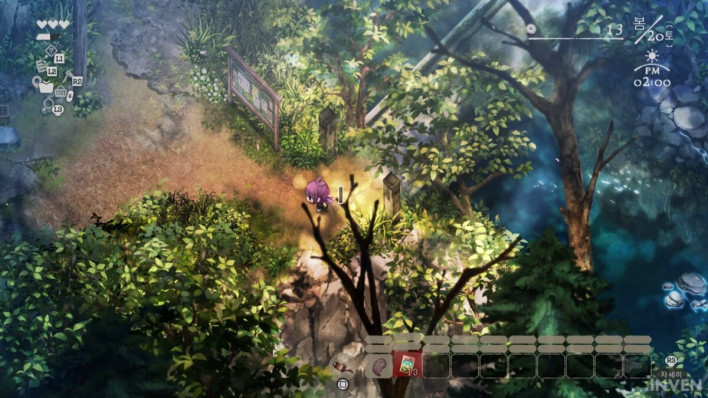
This creates a life simulation that is ordinary, yet not entirely the same. You can experience sufficient game density from this life simulation part alone. Although various processed goods or seedlings of the same crop are counted separately, the prospect of filling a compendium of over 2400 items guarantees plenty of playtime.
In fact, due to the nature of the genre, once the scale grew in the mid-game, I became so engrossed in this life simulation part that I almost forgot to push forward with the main story.
You, a child younger than the protagonist, visits the farm. You say you want to see the chickens—at night, of all times. The next morning, the chickens are gone. Only a large amount of blood and scattered feathers remain.
What 'Village in the Shade' layers on top of this solid life simulation is the sense of folk horror, where bizarre customs remain. Like Hinamizawa in 'Higurashi When They Cry' or Kuge Village in 'Gannibal,' it evokes the feeling of discovering something everyone knows but you shouldn't. It is not just horror that looks scary, but horror that exploits the curve between familiarity and disgust. Thus, the quaintness of a quiet rural village becomes the very material for the horror.
A child who lost their memory enters Kagatsu Village. The protagonist, who resembles a child who went missing in the village, is housed in a farm at the edge of the village under the guidance of the young village head, Rin. In exchange for living in the village, one must not break the rules.
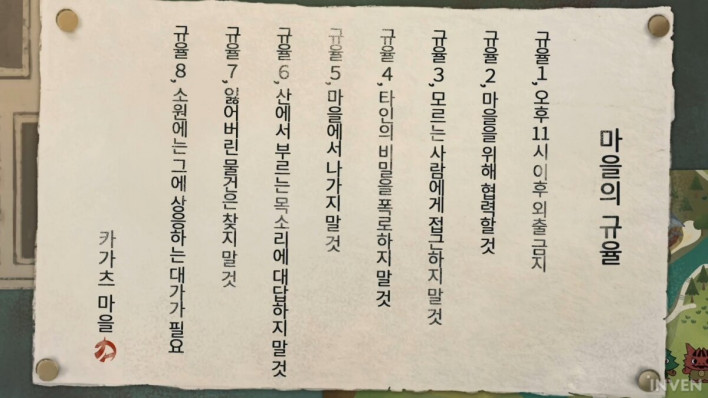
Do not go out after 11 PM, cooperate for the sake of the village, do not approach strangers, do not expose others' secrets, do not leave the village, do not answer voices calling from the mountains, do not look for lost items, and understand that wishes require a corresponding price.
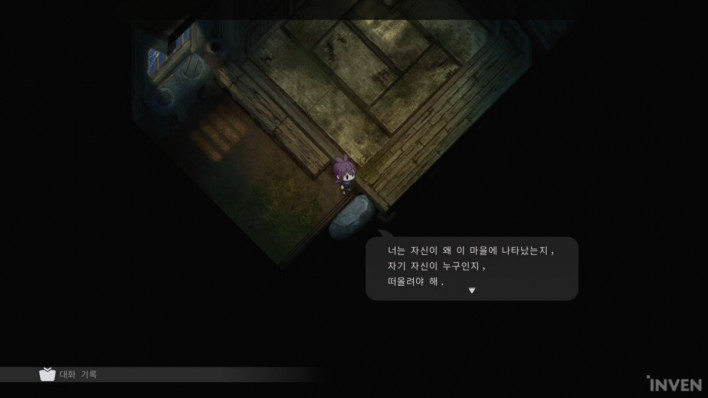
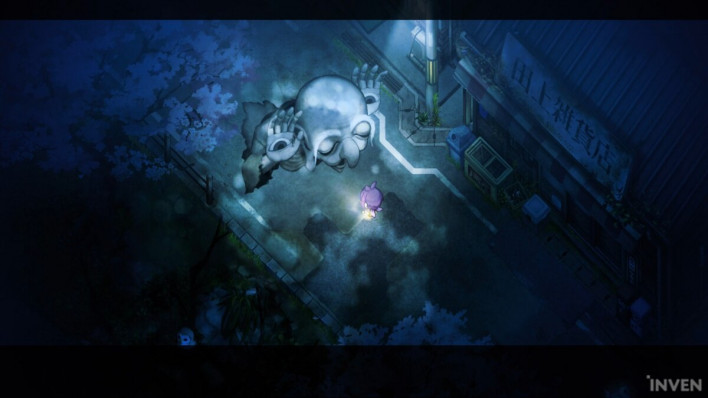
These rules are not mere decoration. The curfew after 11 PM cuts off the daily playtime, and the clause about not looking for lost items traps a character in the village. The voices calling from the mountains drive the entire story. The other clauses are generally tied to specific people or events, making the list of rules read like a list of the villagers themselves.
In reality, the people are bound by these rules. Even though a young child who lost their memory came down from the mountains alone, lives alone on a remote farm, and approaches them first, they do not answer readily, calling the child an outsider. A city official who visited the village to persuade them to install solar panels was cursed to be unable to leave the village after losing their wallet. They cannot even look for the lost item that would be the solution, all while staying in temporary housing in the village.
The protagonist hears voices from the mountains telling them to break these rules. As the story progresses, you realize how a large-scale past event in the village, the curse in the name of rules, and the villagers' relationships are encroaching upon this quiet, beautiful village.
Except for Tobari, a girl who hasn't adapted to the village, the people are generally kind. However, each harbors a secret within the boundaries of the rules—a secret that could lead them to break those rules. Between their obsession with the rules and the secrets that could shatter at any moment, people often lose their composure. In those moments, the calmness that enveloped the fields at the start of the game is abruptly cut off. What fills the void is something bizarre and chilling. In the silence, the villagers corner the protagonist.
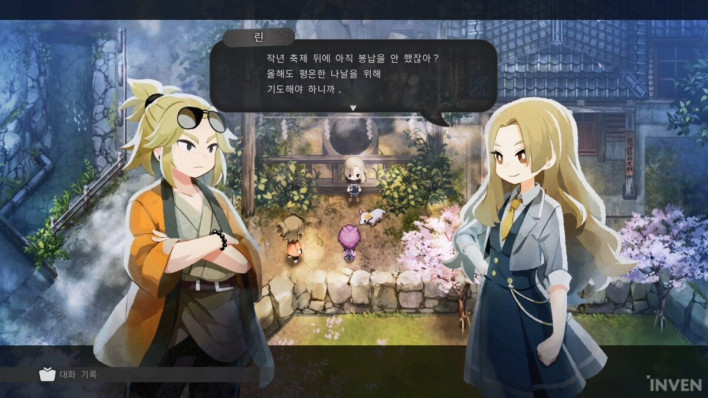
To become a member of the village, the protagonist offers vegetables. The very crops they worked so hard to grow, tilling, watering, and weeding. Not long after, a baby goat is thrown away. Without hesitation. Only then is the meaning of the rule that 'wishes require a corresponding price' revealed. It is the moment the cuteness of the ranch simulation is flipped into the material for a sacrifice.
It is a kind of constraint, but also a rule that must be broken. This ironic process acts as the core narrative of the game. The rules are depicted as things that must be followed. Beyond simply saying 'don't do this,' the game creates situations where you shouldn't, and by showing the problems encountered when they are broken, it emphasizes why they must be followed. At the same time, it explores the question of why one should follow these potentially unreasonable rules and what the people themselves are trying to protect by breaking them.
The first rule, the curfew after 11 PM, completes this horror part within the gameplay.
By consistently showing through the game's story that going out after 11 PM can lead to death, the game sets 11 PM as a constraint for daytime gameplay. All daytime content—farming, animal husbandry, fishing, and socializing—is conducted only until 11 PM according to the rules. Usually, time limits in life simulations are devices to regulate daily activity. In 'Village in the Shade,' it is depicted as something that has been observed for a long time.
However, this time constraint is also the rule most frequently broken in the game. After 11 PM, yokai visit the small cabin at the edge of the village. The yokai that wakes the protagonist from a deep sleep disappears, and yokai appear in the village at this time.
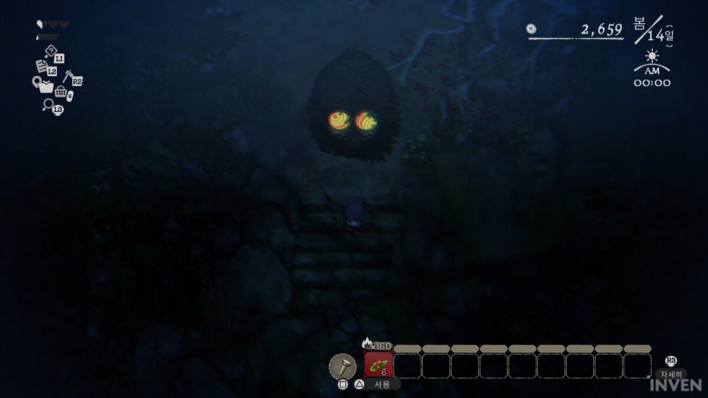
The yokai that appear change daily, and the methods of dealing with them change accordingly. As in 'Yomawari,' there is no way to fight back, so the methods are divided into four: playing tag, hiding, running away blindly, and repelling them with light. For the Daruma-san yokai, which has rules like 'Red Light, Green Light,' you must hide behind a rock the moment it opens its eyes, while other yokai are deterred only by the light of a red candle. Some yokai appear only when you swing a sickle, while others grab your feet from a pool of blood and cover the entire screen, erasing your vision.
Avoiding yokai in the village at night is usually done to obtain 'Jumul' (relics), except during periods with specific narrative elements. At the shrine, you can upgrade various growth elements, such as recipes or increased gathering probabilities. In particular, items that greatly increase gameplay convenience, such as sprinklers, are also upgraded through this shrine. The materials for these are the relics.
Relics like the four types of magatama, bronze mirrors, and bronze swords can only be picked up at night. The keys to making life easier lie in the darkness, meaning the player must break the rules and encounter fearful beings. You are essentially pushing yourself into horror.
The opposite direction also exists. Red candles and seasonal offerings for the Fox Shrine must be gathered by roaming the mountains and fields during the day. How long you can survive at night is determined by what you prepared during the day. Relics picked up at night make daytime farming easier, and what you gather during the day helps you survive the night. Day and night, life simulation and horror, thus become each other's preparation processes.

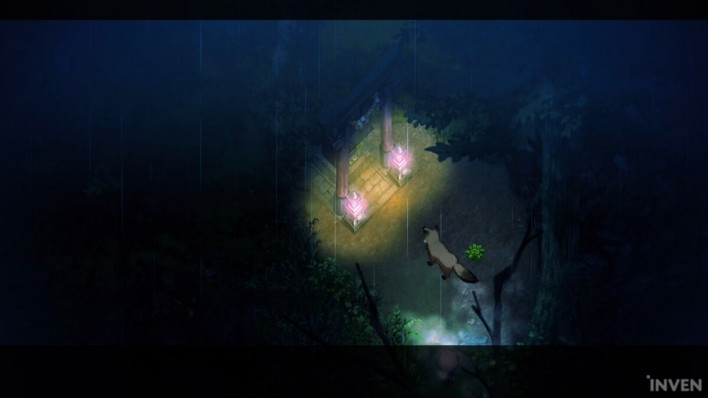
However, the danger at night is not as great as one might think. Even if you are caught by a yokai and your health is depleted, you usually wake up in the hospital. Thanks to this, there is no hesitation in heading out into the dark village, but the night becomes less scary the more it is repeated. It is a trade-off: lowering the entry barrier at the cost of the tension of the night road. Therefore, the horror of this game lies more in the grotesque entities and the eeriness of the people you meet throughout the game than in the gameplay itself.
The proportion of this cycle can be adjusted by the player. Since the game's events are mostly structured by incident, once the farm is somewhat established, you can reduce the time spent on the life part and just push through the story. Conversely, it is fine to stop the story and just expand the fields. This is why the two axes are interlocked without holding each other back.
Peaceful Life Mode' completely removes the horror elements. Since the life simulation itself is complete enough to meet genre standards, you can enjoy the game with this part alone, accompanied by beautiful graphics. But how can you experience the void in the narrative? 'Village in the Shade' did not simply leave the horror part removed in 'Peaceful Life Mode' as an empty space.
In 'Peaceful Life Mode,' the development of important events is depicted differently. Basically, the rules are the same, and the big framework to follow is identical. For example, Village Head Rin instructs the protagonist to deliver mandatory errand tickets as punishment for breaking the rules, requiring them to run errands for the villagers. In 'Peaceful Life Mode,' these errand tickets are introduced as local specialties to build rapport with the villagers. Naturally, Rin's high-handed and rule-abiding demeanor is also expressed as being a bit more caring toward the protagonist in this mode.
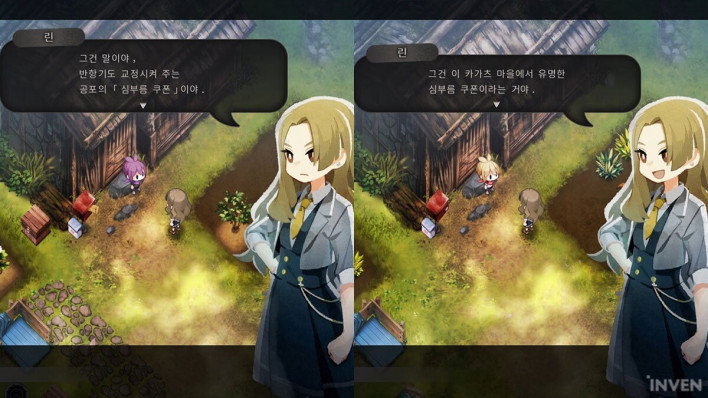
They refined the story within the big framework and diluted the eeriness of the characters by removing the horror elements. Furthermore, the game contains unexpected comedy-focused stories throughout. As this part is emphasized more, you can approach the game as a complete healing simulation.
The option to purchase relics at the shop exists in both 'Peaceful Life Mode' and the regular 'Quiet Mode,' and the number of items for sale is more generous. Even if you don't go out at night, if you have diligently increased your funds through the life simulation part, you can plan your growth with that money.
Of course, the horror elements of the entire game are not deeply profound, so trying out 'Quiet Mode' is also worth a shot. After all, you cannot change modes in the middle of the game.
Although they layered a life simulation on top of a framework completed based on the visuals and gameplay of the 'Yomawari' series, the center of gravity was placed on this new life aspect instead of horror. Thanks to this, the horror in 'Village in the Shade' does not pressure the player. It waits quietly at the edge of the field or at the village entrance after 11 PM, waiting for the player to approach on their own.
There is a price. The life simulation part is only faithful within the genre's grammar, so there is little new for those who have played this genre for a long time. Since the structure is such that you wake up in the hospital even if caught by a yokai, the tension of the night road fades as it is repeated. The horror of this game lies in the atmosphere and the people, not the gameplay.
Nevertheless, it was not a half-baked product. 'Peaceful Life Mode,' which completely removed the horror, is proof of that. Even if one axis is removed, the remaining side is filled enough to stand on its own, and the removed part is filled with a rewritten story rather than a blank space.
A red opening and a blue opening. 'Village in the Shade' does not make you choose one or the other. The daytime fields where the sunset settles in orange, and the night when you cross those fields to pick up relics. Moving between those two screens is what this game is all about.
- Rural life that faithfully fills the genre's grammar
- The moment 'Yomawari's' direction meets the light of day
- Music that fills both rural life and horror
- The eeriness and sticky horror created by people
- Peaceful Life Mode' with no empty spaces even without horror
- A farm that is faithful within the genre but lacks novelty
- Direction controls that occasionally miss the mark despite convenience features
- The tension of the night and yokai that dulls with repetition
- A gameplay structure where progression feels slightly sluggish
Review Platform: PS5 (Release Version)

Sort by:
Comments :0