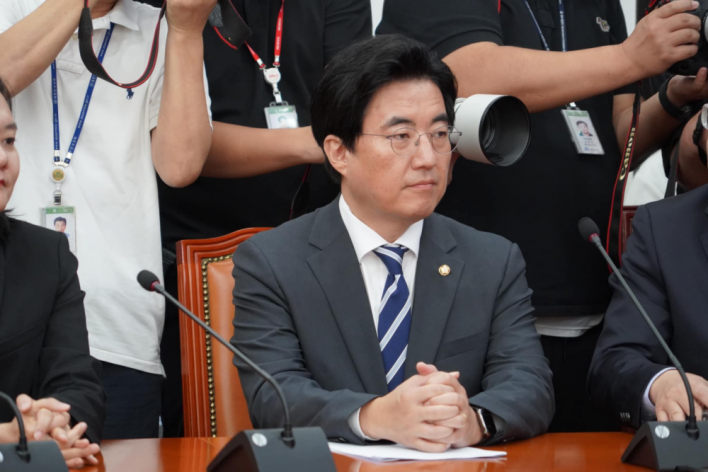
Representative Kim Sung-hoe of the Democratic Party of Korea proposed two special bills on November 25 to designate games as national strategic content assets and enable the state to directly foster the industry. The two proposed pieces of legislation are the "Special Act on the Designation and Fostering of National Strategic Content Assets" and the "Special Act on the National Strategic Fostering of the Game Content Industry." The former establishes a framework for selecting content sectors to receive focused support, while the latter establishes a support system for the game industry as its primary target.
According to the Special Act on National Strategic Content Assets, the Minister of Culture, Sports and Tourism (MCST) can designate national strategic content assets following consultations with relevant government ministries. While target sectors will be determined by Presidential Decree, the text explicitly specifies "games and related sectors." This establishes the legal framework for games to be designated as the first asset. Designations will evaluate the impact on the national economy and related industries, contribution to expanding cultural influence, and domestic and international growth potential.
The validity of designations will be reassessed every three years to decide whether to maintain, modify, or revoke them. The Minister of Culture, Sports and Tourism will formulate a comprehensive fostering plan every five years. Designated sectors may pursue initiatives in creation and production, R&D, intellectual property protection, international cooperation, and professional talent development.
The Special Act on the Game Content Industry establishes an intergovernmental coordinating body, the "National Game Content Strategy Committee," under the Prime Minister. The Prime Minister will serve as chairperson, the Minister of Culture, Sports and Tourism as secretary member, and up to 25 members will be appointed, including ministers of relevant agencies and private-sector experts. Meetings must be convened at least twice a year. The committee will deliberate on five-year basic fostering plans, tax, financial, and investment support, artificial intelligence (AI) transition, regulatory reform, and inter-ministerial coordination.
Measures against illegal private servers operating overseas were included as mandatory provisions. When the Minister of Culture, Sports and Tourism confirms the operation of private servers or the distribution of pirated games overseas, the minister must collect and preserve evidence and notify the affected business operators. It is also mandatory to request cooperation from overseas online service providers for content removal or access blocking, and to request investigations from law enforcement agencies. If requirements under the Copyright Act are met, blocking orders can be issued according to the procedures set out in that act.
If infringements occur systematically or repeatedly in specific countries, the Minister of Culture, Sports and Tourism must establish an emergency response plan. An annual report detailing infringement types, country-by-country status, and action performance will also be published. Practical operations such as monitoring and evidence collection may be entrusted to the Korea Copyright Protection Agency.
Support for AI transition was also codified as a government obligation. Supported initiatives include game planning and development utilizing generative AI, building game-specialized training data, and AI-based quality control and automated testing. Support for the costs of high-performance computing resources and cloud utilization is also included.
A channel for regulatory clarity was also introduced. If the Minister of Culture, Sports and Tourism requests clarification on the mandatory application criteria under the "Framework Act on the Development of Artificial Intelligence and Establishment of Trust" (hereinafter referred to as the AI Framework Act), the Minister of Science and ICT must respond with review results within 90 days. Requested items include notification and disclosure methods for games utilizing AI, disclosure methods for creative expressions such as backgrounds, characters, and music, and whether the system qualifies as high-impact AI. A proviso notes that making a request alone does not exempt an entity from legal obligations.
Regarding tax incentives, a recommendation procedure was established alongside legal grounds for tax reductions under relevant tax laws. The Minister of Culture, Sports and Tourism can submit recommendations to the Minister of Economy and Finance regarding the introduction and expansion of tax credits for game production costs, tax support for overseas localization and marketing expenses, and the potential implementation of tax credit refunds and transfer systems. The Minister of Economy and Finance must notify the review results and underlying reasons.
For financial support, the bills utilize the Credit Guarantee Fund (KODIT), the Korea Technology Finance Corporation (KIBO), and cultural industry guarantees. An obligation to endeavor to prioritize support for small and medium-sized and indie game developers was included. The bill establishes a new definition for an "indie game content business operator" and includes support programs to cover production costs annually for project periods of up to three years.
Clawback provisions are also included. If a foreign enterprise or individual substantially acquires managerial control of a game company that received subsidies from the national or local government, all or part of the subsidies must be reclaimed. The applicable period will be prescribed by Presidential Decree within a range of up to five years from the date the subsidy was received. The criteria for substantial acquisition and the specific clawback amounts are also delegated to Presidential Decree.
The Special Act on the Game Content Industry also incorporates provisions transferring the promotion clauses from the current Game Industry Promotion Act (hereinafter referred to as the Game Industry Act). The reference notes state that it is contingent upon the passage of a partial amendment to the Game Industry Act proposed by Rep. Kim. The definition of game content is based on game products as defined by the Act on the Protection of Game Product Users. This is interpreted as a plan to separate promotion and regulation, which had been combined under a single law, into distinct statutes.
Rep. Kim's office explained the background of the legislation, noting that although the game industry accounts for 60% of South Korea's content exports, a comprehensive national support system to maintain global competitiveness has been lacking. Rep. Kim stated, "Games are a flagship content sector in which South Korea possesses global market competitiveness, as well as a future growth industry combining cutting-edge technology such as artificial intelligence with cultural creativity." He added, "By fostering games as the first national strategic content asset, we will turn them into a new growth engine for South Korea's economy."
The two bills will take precedence over other laws. However, if another law is more favorable to business operators, that law will apply. The legislation will take effect six months after its promulgation. Representatives Lim Ho-seon, Jang Chul-min, Kim Ki-pyo, Kim Nam-hee, Kim Yong-nam, Kim Han-gyu, Mo Kyeong-jong, Park Yong-gap, Lee Ki-heon, and Hwang Jung-a joined as co-sponsors.