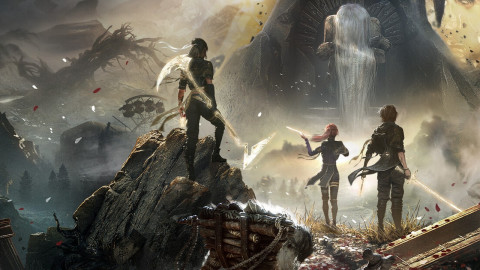
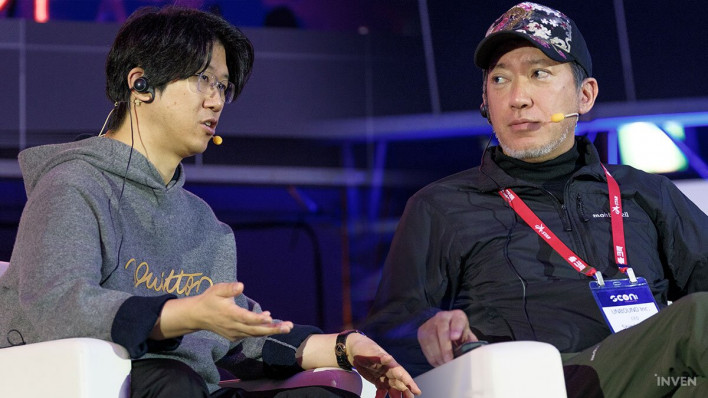
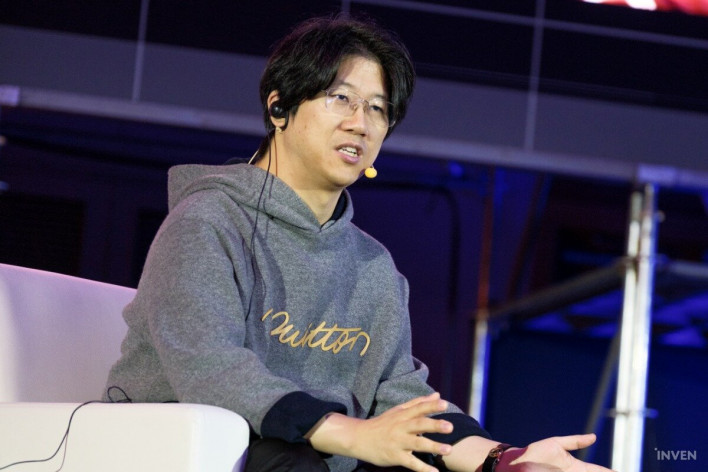
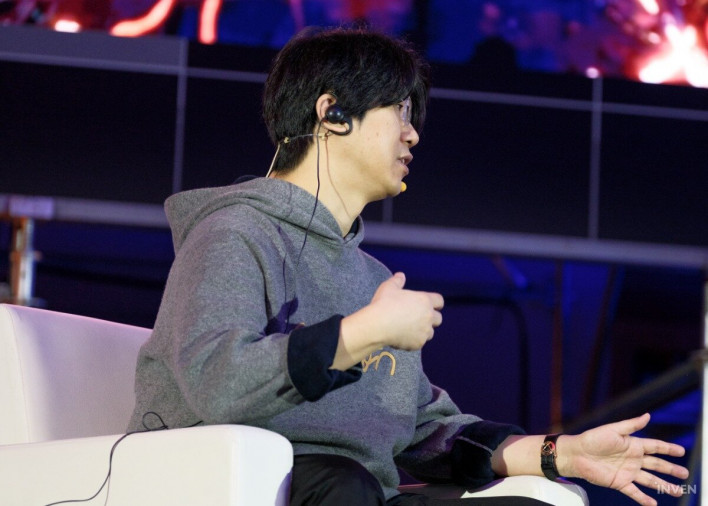
Shinji Mikami, who established the grammar of survival horror through the 'Resident Evil' series, and Kim Hyung-tae, who has conveyed lore and emotion purely through characters and visuals in 'Goddess of Victory: Nikke' and 'Stellar Blade'. Shift Up CEO Kim Hyung-tae and Unbound CEO Shinji Mikami took the stage together at G-STAR 2026 G-CON. At this year's G-CON, centered around narrative, the topic brought up by the two creators was game development in 2027.
To CEO Kim, CEO Mikami is the creator behind games he had long admired. Though Shift Up now fully backs Unbound's projects, Kim did not hide his cautious, respectful attitude even while working alongside him. Above all, both creators' games are remembered not for lengthy dialogue, but for the tension of facing down a boss or the anxiety of having only one bullet left.
Having spent their careers building stories that prioritize showing and experiencing over telling, the two game directors shared their respective answers on combat, visuals, the industry's burning topic of AI, and their upcoming projects.
When Combat Becomes the Story Talkative Drones and Turning Zombies
When creating 'Stellar Blade', CEO Kim's biggest dilemma was the relationship between combat and narrative. No matter how the story unfolded, the resolution inevitably had to culminate in combat and defeating enemies. How to deliver the story before and after defeating an enemy was his toughest challenge.
The first approach he cited was using an explicit 'expositional' companion character. In 'Stellar Blade', Adam's drone hovers beside the protagonist to handle explanations, a role he noted is similarly played by cute animals or companions floating alongside main characters in recent Soulslike games.
When encountering a boss, the boss took over that role—adding a bit of lore, airing out their grievances, and eventually breaking down and dying in defeat. Kim reflected that keeping this flow uninterrupted was a constant challenge for him.
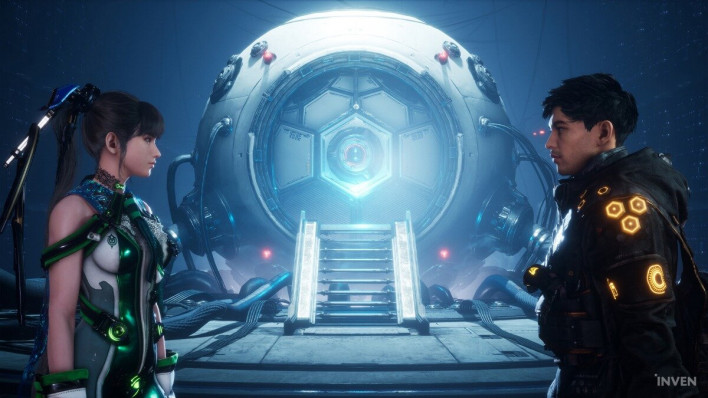
The rest relied on visuals. Atmosphere was built using character appearance, facial expressions, and music, while explicit storytelling was kept to a minimum. The approach was to cut down on explanations by omitting proper nouns and creating situations anyone could intuitively grasp. Still, Kim noted that storytelling in action games is particularly difficult, as even a minor misstep can lead to player complaints that the plot is incomprehensible or foolish.
Another approach is to have no companions at all. If a setting requires no explanation, there is no need for characters to showcase relationships—a path taken by many great games directed by Mikami. However, Kim's setting was unconventional, requiring parts of it to be explained. What he viewed as most dangerous were scenes where main characters talked only amongst themselves about things only they understood.
Mikami started from gameplay experience rather than dialogue. He introduced the iconic scene of the zombie slowly turning around in the original 'Resident Evil' specifically to instill an immediate, shared feeling of dread. After defeating the zombie, a Hunter pounced from a first-person perspective, forcing players to imagine what kind of monster was coming to kill them before initiating combat.
The goal was to throw players into an extreme environment, let them devise their own survival strategy, and ultimately grant them the triumph of feeling "I pulled it off". Mikami explained that he designed the original 'Resident Evil' with this approach to convey stories born of personal experience.
The timing of cutscenes stemmed from the same dilemma: once fully immersed in gameplay, players rarely absorb story details easily. Mikami placed cutscenes right before combat or when a boss's HP dropped to half or one-fifth—moments when players felt they had completed a key milestone in the fight's rhythm.

Ammo at Exactly 1.5x to 2x Pacing Horror and Cutscenes as Rewards
The ammo scarcity in 'Resident Evil' was another mechanic that substituted for storytelling. In a grounded setting where players enter unknown areas searching for bullets to face zombies, limited ammunition feels natural. Scarcity forces players to think carefully about where and how to shoot; zombies become terrifying when ammo is low, while having plentiful rounds gives players an edge. Mikami emphasized that establishing this tension and relief was crucial to game design.
Regarding Ink Ribbons, which limited save files, Mikami offered a different reflection. He confessed, "Looking back, even I'm not so sure about Ink Ribbons," suggesting they might not have been strictly necessary.
The quantity of ammo was calculated rather than guessed. He quantified the total number of enemies and their HP across the entire game, matched it against ammo damage values, and calculated the exact number of rounds needed to kill every enemy. That baseline figure was then multiplied by 1.5 to 2 times to determine total item placement. He carefully placed ammo to help players who missed dropped items, continuously tweaking placements so players wouldn't run out completely.
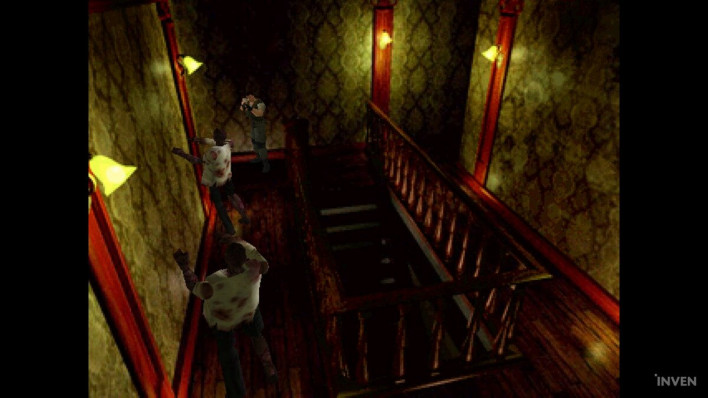
Even so, the systemic risk of players softlocking their progress could not be eliminated completely. Mikami weighed that dilemma against the fear generated by running out of ammo and the freedom players enjoyed, accepting the risk of potential softlocks when making the game at the time.
The dissonance between narrative growth and mechanical progression remains a challenge today. Mikami explained that while developers try to harmonize both initially, a point comes during development where one must take priority for the game to function. Typically, action gameplay is perfected first and story is woven into it, but Mikami admitted it rarely comes together easily and remains a struggle every time.
Scenes where the protagonist suffers a scripted defeat in a cutscene following a grueling boss victory stem from the same issue. Mikami admitted this happens easily when the narrative is rigidly fixed beforehand. Kim expressed a desire to avoid such tropes whenever possible, noting that even in script-mandated defeat battles, skilled players win; in those cases, he preferred having the opponent turn the tables dynamically for a more cohesive outcome.
This is why Kim uses cutscenes as rewards rather than exposition dumps. Creating post-combat cutscenes without taking context into account is risky. Instead, he treats cutscenes as tools to build anticipation for what comes next or to amplify the experiences players have just lived through.
Visuals First, and On-Screen Density Visual-Driven Design, Gameplay Concessions, and Living Cities
Mikami placed immense importance on visual appearance. When creating a protagonist, character lore and design progress together, but art almost always takes precedence. Even if backstory is written first, if a concept illustration turns out exceptional, he often rewrites the lore to fit the art.
Expressing surprise, Kim strongly agreed, sharing that Shift Up also operates on a visual-driven design approach. While a core framework exists, they tend to draw the artwork first and then brainstorm gameplay ideas around it.
Yet that approach left some regrets. Kim reflected that the protagonist's design in 'Stellar Blade' failed to justify certain story elements. Originally, there was a story arc explaining how the protagonist encounters outfit changes and comes to enjoy them, but it was cut due to budget constraints for cutscene production. As a result, only the costume changes remained, turning what was intended as narrative context into mere fan service.
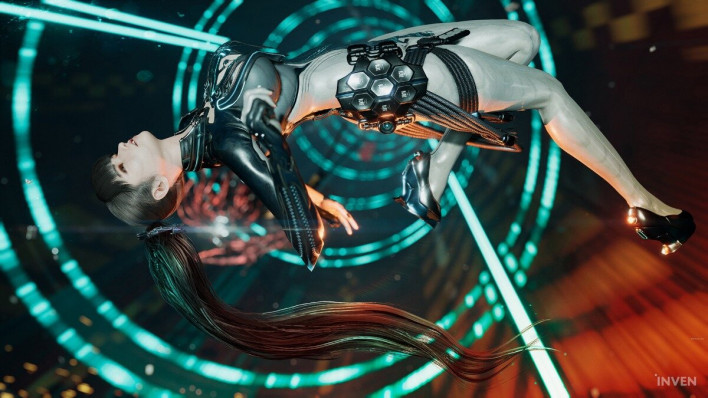
For their next project, Kim is paying extra attention to aligning design with the world. When crafting enemies, the team considers what kind of life this young or middle-aged person lived and how they ended up fighting the player.
Kim brought up the concept of gameplay concessions (game logic abstractions). In the pixel-art era, players could fill in gaps with their imagination, but as visuals advance, less room remains for imagination, making gameplay concessions harder for players to accept. While he finds it somewhat regrettable that developers can no longer design visuals with complete abandon, he believes adapting to this reality is the studio's responsibility.
Kim noted that game environments are often dictated by practical constraints rather than narrative needs. This explains why action games frequently favor isolated settings, ruined dystopias, or post-apocalyptic worlds—scenarios where everything except the protagonist and enemies can be wiped away, maximizing player freedom.
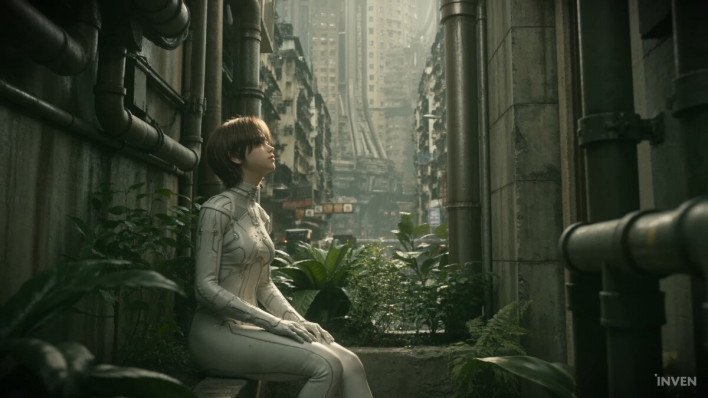
Kim was intrigued by the exact opposite. What if combat took place in inhabited, densely populated, narrow urban spaces? He reasoned that making events feel like they are happening in everyday life rather than a distant stranger's story could drive deep immersion on its own.
This is why the very first shot of the trailer was packed with people. Kim called this a tremendous challenge. While the newly revealed 'GTA6' is set in sprawling American landscapes with empty areas, Shift Up's setting is a cyberpunk-style metropolis dense with crowds. The key is making those NPCs feel like a genuine crowd, though Kim admitted they haven't reached their target yet and are still refining it.
It is a risky venture where even minor missteps can break immersion. Kim quipped, "Why did I choose to do this?" admitting that in development he realized why others avoid it. Still, he wanted to craft a game where the environment tells a story alongside combat, offering a fresh atmosphere distinct from existing titles.
The two held opposing views on how much to fill the screen. Even as graphics advance, Mikami prefers not to overload the screen with information, leaving room for players to imagine character backstories and why the world fell into ruin.
He cited Fumito Ueda's 'Shadow of the Colossus' and 'Ico', as well as 'Journey' and 'Inside', as prime examples. Mikami expressed admiration for games that say little verbally while encouraging players to expand the world in their imagination.
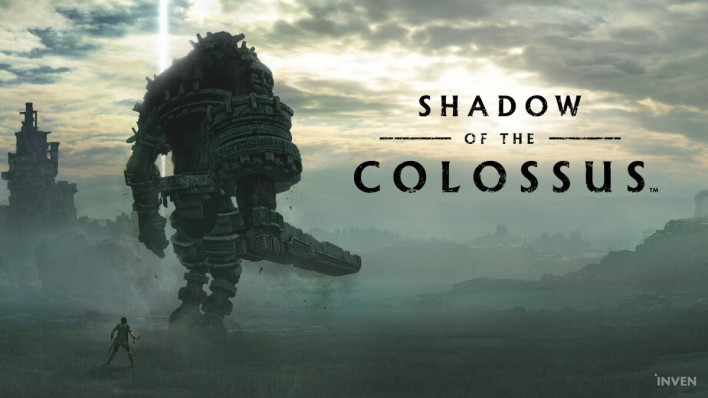
Kim acknowledged that balancing screen detail is a key role of art direction, but stated that his current concept pushes visual density to the absolute max. His mindset is to show players more than they could imagine—though he half-jokingly worried about what would happen if a similar game beat them to market.
Though he chose a difficult path, Kim said he was doing fine—adding with a laugh that "the staff are having a tough time," so he gets scolded frequently by his developers these days.
AI Belongs in Between, Not at the Start or End Principles Learned from a Music Video Backlash
Kim actively experiments with AI. Recently, Shift Up released a music video that sparked significant backlash, which he admitted taught them valuable lessons about how human touches in the final product influence player acceptance.
However, he noted that game development without AI is no longer feasible. AI already drives efficiency across programming pipelines, QA, code review, and debugging, while visually, avoiding AI entirely has become equally difficult.
Following the music video backlash, Shift Up established an internal philosophy: "Handmade from start to finish." Starting with AI puts a project on the same baseline as any casual AI user. Instead, human artistry establishes the foundation to create a gap, with AI utilized in intermediate tasks—such as testing lighting variations, applying texture weathering, or reducing polygon counts through retopology. Finally, human artists refine the work before it goes into the game, taking responsibility for both the beginning and the end to distinguish their games from AI-generated titles.
Mikami offered a candid perspective, admitting that he sometimes wishes AI would vanish entirely—not just from games, but from the world. However, because effectively utilizing AI can yield higher quality within the same budget, he is currently experimenting with various applications.
Kim cautioned against prioritizing "efficiency" and "productivity." Gamers do not love a title simply because it was made efficiently or productively. He emphasized that Shift Up uses AI not to speed up production, but as a supplementary tool to push quality beyond normal limits. Games mass-produced purely for efficiency will become the "slop games" flooding the app store and indie markets by the tens of thousands every year—games he predicts will eventually be wiped out by market self-regulation.
Automating retopology to reduce in-game polygon counts frees up time for high-poly modeling and crafting textures that convey weathering and age. In programming, AI helps compile accuracy and efficiency to write and verify bug-free code, though he stressed they avoid using it purely to boost output numbers.
Kim shared an internal technique regarding concept iteration: when designing monsters, early sketches are rendered photorealistically using AI. Promising details are drawn back onto the sketch and rendered again. This allows the team to save considerable effort compared to the traditional pipeline of modeling in ZBrush and applying textures just to review a draft concept.
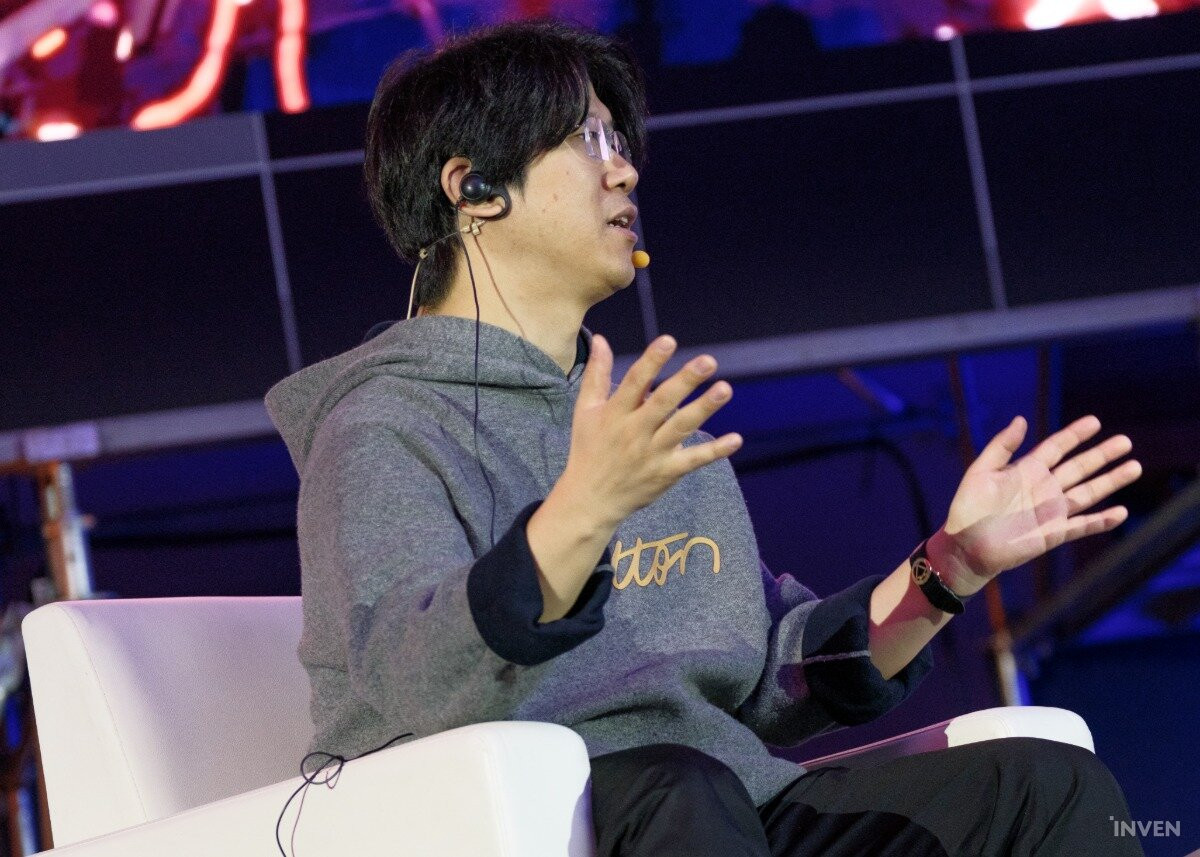
Kim highlighted another benefit: easier feedback. Rejecting a concept created after an all-nighter feels guilty, whereas AI-generated drafts can be reviewed quickly to say, "Not this one, let's try that." Not that he hesitated to reject designs in the past—Kim joked, "It's not that I couldn't cut them before, but I felt bad; now it's just a matter of feeling more or less guilty."
Mikami also refrains from leaving design work to AI. He creates 2D art first, then uses AI to convert it into a 3D preview within the game. Gauging how it looks in 3D takes about 20 minutes; if it works, the design is passed to modelers for final production. In the past, developers could spend nearly a month modeling only to realize it clashed with the 2D art, forcing them to scrap the model and redesign from scratch.
To Mikami, AI is a tool that streamlines production so creators can deliver their vision to players in its best possible form. For now, core tasks remain largely human-driven. However, he noted that five or ten years down the line remain uncertain, acknowledging a real possibility of an era where developers might lose their jobs to AI.
Kim observed that because he speaks often about AI, some assume Shift Up builds games primarily with AI, but clarified that most work is done by human hands. From writing and design to mapping, level design, and systems, tools provide assistance, but creativity is never delegated. AI exhibits a distinct "authorship"—behaving like a single skilled creator—meaning if everyone relies on it, outputs become homogenized. That, he added, is why AI-driven indie games often feel like they were made by the exact same person.
Using AI for story writing is out of the question. While AI writes fluently, its telltale tone is unmistakable. Kim expressed disdain for the artificial cadence of AI YouTube scripts—phrases like "looking back on youth as a rewound clockwork"—noting that even when instructed to revise, the tone remains hard to shake. For him, AI is akin to a highly evolved version of Photoshop or Blueprint.
He added that he can spot AI-generated games on Steam even without AI disclosures. Of course, he cautioned that AI evolves rapidly with each update, so "what I say today might not hold true next week." Nevertheless, he stressed that Shift Up's games—including their collaboration with Mikami—will inherently remain handmade by human hands.
Unbound and Elegant Otherworld Settings Somewhere Between Indie and Mainstream Sensibilities
Mikami's motivation for founding Unbound and tackling original IP was simple: creators crave fresh inspiration [1.2.0]. From a pure business perspective, taking safe, established paths might be wiser, but all of Unbound's projects are original IPs. He emphasized a strong commitment to honoring creators' passion and energy to build what they genuinely want to make.
Kim supports him from the publishing side. Working with creators behind games he adored requires tact, though he shared with a smile that people tell him he still speaks his mind despite his deference. He reaffirmed his commitment to helping deliver exceptional games.
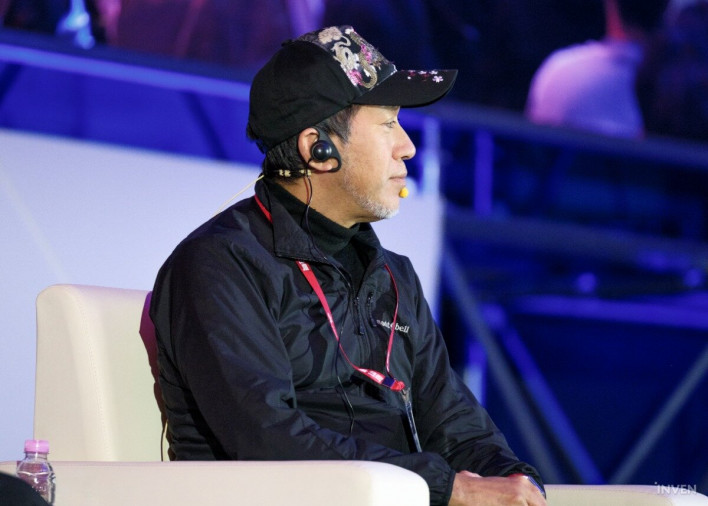
Kim mentioned feeling strongly drawn to Unbound's projects—which are smaller in scale than expected—designed to mentor next-generation directors. Rather than massive AAA or Quadruple-A titles, games that showcase Mikami's full creative charm are currently in production. He stopped short of revealing more, joking that the business team would scold him, adding, "Honestly, I get scolded all the time."
Still, he offered one hint: they will present a project bridging indie and mainstream sensibilities. While not AAA, it is a high-quality game that players will love, asking fans to stay tuned.
2027: Where Are Game Stories Headed? Artisanal Craftsmanship and Conversational AI Characters
The final discussion centered on what kind of stories will move players in 2027. Kim predicted that by 2027, AI-generated games will flood the market, delivering surprising results. Yet amidst that influx, he foresees an era where handcrafted, artisanal titles stand out all the more.
Games crafted meticulously by human hands—rich with artisanal detail and painstakingly invested time—will gain greater appreciation precisely because of the AI era. Conversely, competing solely through AI automation will create a hyper-competitive red ocean where survival is nearly impossible. To survive there, painstaking planning and effort must pair with exceptional mastery of AI technology.
Shift Up is pursuing both paths simultaneously: delivering peak quality leveraging AI where appropriate, while preserving the handcrafted essence of artisanal game development. Kim asked fans to look forward to their efforts to harmonize both approaches.
Mikami highlighted conversational AI characters. Rather than NPCs returning canned responses, he foresees truly reactive, living characters eventually entering games, with such titles gradually increasing. However, he noted that early implementations will likely feature more casual characters.
He then added a side note unrelated to the main topic. Recalling a visit to Kim's office, Mikami observed that while Kim aggressively champions AI, the studio floor steadily crafts everything designed by human hands. Mikami remarked with a smile that he felt a bit sorry for Kim being misunderstood by the public. Having witnessed the studio firsthand, Mikami reinforced Kim's core principle: even when using AI aggressively, the beginning and end must remain strictly in human hands.