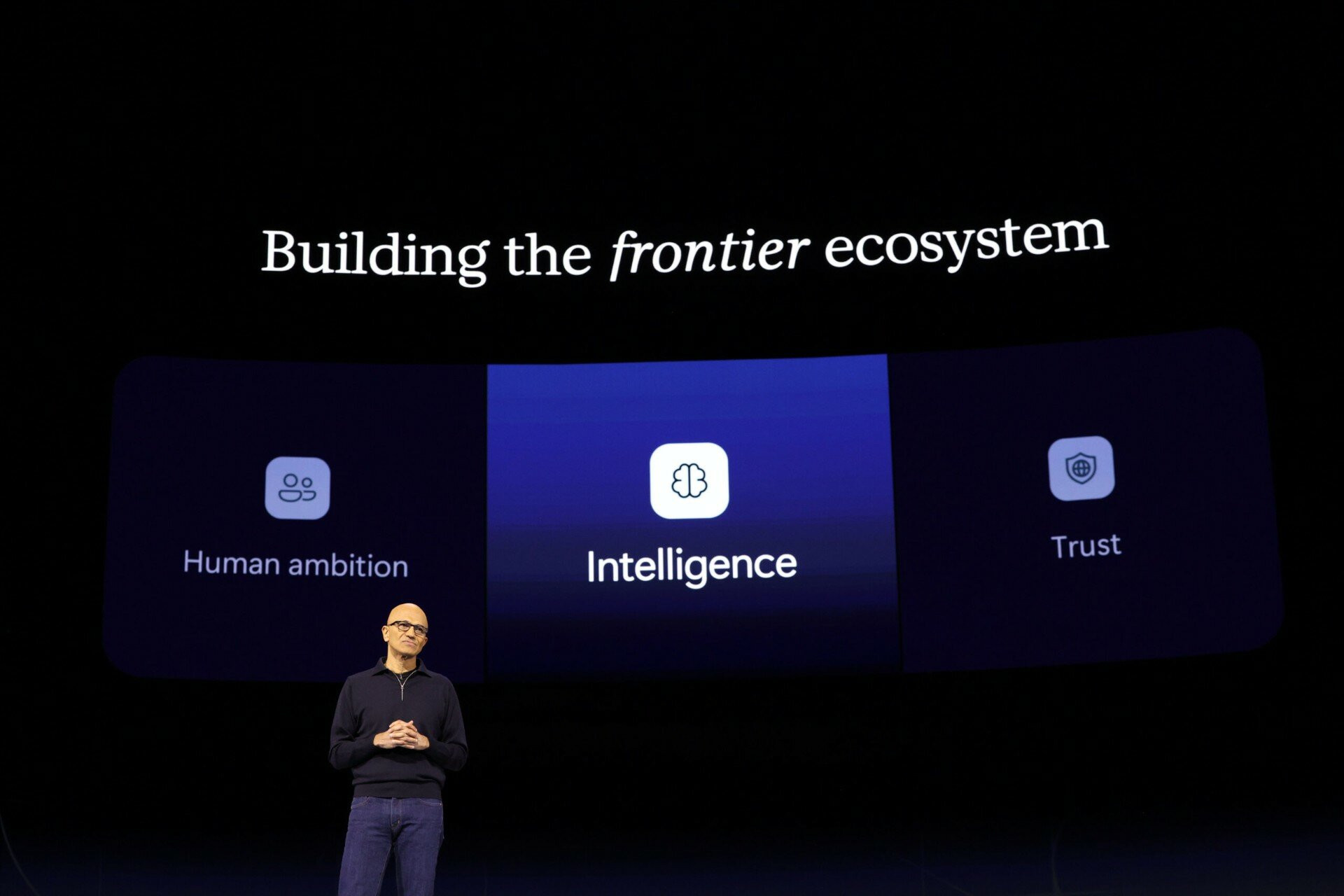
Microsoft opened Microsoft Ignite 2026 on the 17th local time, announcing new technologies spanning enterprise AI, security, and cloud infrastructure. The company also presented its direction to build a frontier ecosystem centered on human ambition, intelligence, and trust.
According to usage statistics revealed by Microsoft, Agent 365 currently hosts over 50 million agents. Microsoft-Decision-1.1, an enterprise decision-making model officially launched at the event, is already being used by more than 4,000 customers. In infrastructure, Microsoft officially released Cobalt 200 virtual machines, which offer up to 50% higher performance than the previous generation.
The frontier ecosystem expands upon the Frontier Transformation concept introduced last year. It focuses on empowering organizations to leverage advanced technologies for business innovation while retaining their unique strengths.
Satya Nadella, Chairman and CEO of Microsoft, emphasized, "We must translate every technological advancement into tangible outcomes and new possibilities for people, organizations, and society as a whole." He added, "To achieve this, it is crucial to place human ambition at the center, ensure each organization retains agency over its intelligence and learning, and build on trust."
For enterprise AI, Microsoft presented Copilot as a new work operating system. The company introduced Copilot Workspaces, where humans and agents collaborate by sharing a common context, and enabled long-running Autopilot to execute repetitive tasks and projects without step-by-step instructions. Copilot Code supports building dashboards, trackers, and applications through natural language, with enterprise-grade security and governance applied by default.
Copilot's understanding of work context is grounded in Work IQ, which processes interpersonal relationships, documents, emails, meetings, chats, and projects. Microsoft plans to expand role-specific skills, connectors, and plugins across Copilot for functions such as sales, legal, finance, and customer service. In addition to integration with Dynamics 365, Microsoft also previewed Salesforce in Copilot, which provides over 38 pre-built sales skills.
As enterprise adoption cases, Microsoft highlighted Volkswagen Group and The Estée Lauder Companies. Over 330,000 employees at Volkswagen Group are equipped with Copilot, while The Estée Lauder Companies expanded its deployment to more than 14,000 employees globally.
Microsoft announced that Microsoft IQ, designed to collect, manage, and reuse organizational knowledge, will offer hundreds of new connectors and business plugins. The system connects contexts across Microsoft Fabric, Microsoft Foundry, Microsoft 365, and third-party systems, structuring them into skills and tools that can be shared across the organization. Publicis Groupe is combining its expertise and proprietary data with Microsoft IQ to develop customized AI skills and test them in client scenarios.
On the model front, Microsoft announced that GPT 6.2 and Meta's latest models will be available on Microsoft Foundry. It is also adding tools to automatically train models based on operational signals. Microsoft-Decision-1.1 received multimodal support and performance enhancements, and is currently used internally at Microsoft across hundreds of use cases, including routing, data labeling, personalization, and content filtering.
Microsoft's proprietary MAI model family is being developed to improve compute efficiency in pre-training and token efficiency during deployment. Through the newly announced MAI Licensed Weights, trusted customers can access Microsoft AI model weights through frontier companies.
The Code 2 family of coding models supports deep debugging, multi-file implementation, repository-level reasoning, and user interface development. Code 2 Flash is tailored for rapid iterative tasks such as code explanation, targeted editing, and error correction. Both models are available via the model selector in GitHub Copilot, Copilot Fusion, and Microsoft Foundry. Microsoft also introduced Cyber 2 Flash, a security model.
In agent management, Agent 365—which extends existing identity, security, and governance frameworks to AI agents—added business analytics capabilities. Agent 365 Business Analytics provides metrics such as task success rates and AI assistance hours to help organizations connect AI costs with outcomes.
Now officially launched, Microsoft Perception handles security operations using Red Team agents that simulate attacks, Blue Team agents that detect threats, and Green Team agents that remediate issues. Users can configure agent teams using Playbooks while retaining ultimate control during autonomous responses. On Windows, Microsoft is applying isolation capabilities via Microsoft Execution Containers and agent IDs based on Microsoft Entra, while expanding Agent 365 policies to all devices.
Microsoft also announced the Microsoft AI Transparency Initiative for independent verification and governance of AI systems. The company plans to expand collaboration with the National Institute of Standards and Technology's (NIST) Agent Standards Initiative and reflect shared ecosystem standards across its own products. Currently, 40 organizations are participating in defining and implementing these standards.
In cloud infrastructure, Cobalt 200 virtual machines will expand to 23 regions by the end of 2026. Microsoft stated that the product is expected to account for a significant portion of Azure's new compute capacity in 2027. CEO Nadella explained that the previously announced Maia 300 is expected to deliver 40% higher token throughput per watt than leading GPU-based systems.
Azure Catalyst connects agentic tools from Azure and GitHub to support the modernization of applications, databases, and infrastructure. Windows hybrid intelligence ensures AI executes in the optimal environment—either on-device or in the cloud—starting with GitHub Copilot and Copilot. Microsoft plans to expand the frontier ecosystem alongside customers and partners, connecting people, data, and processes through intelligence.