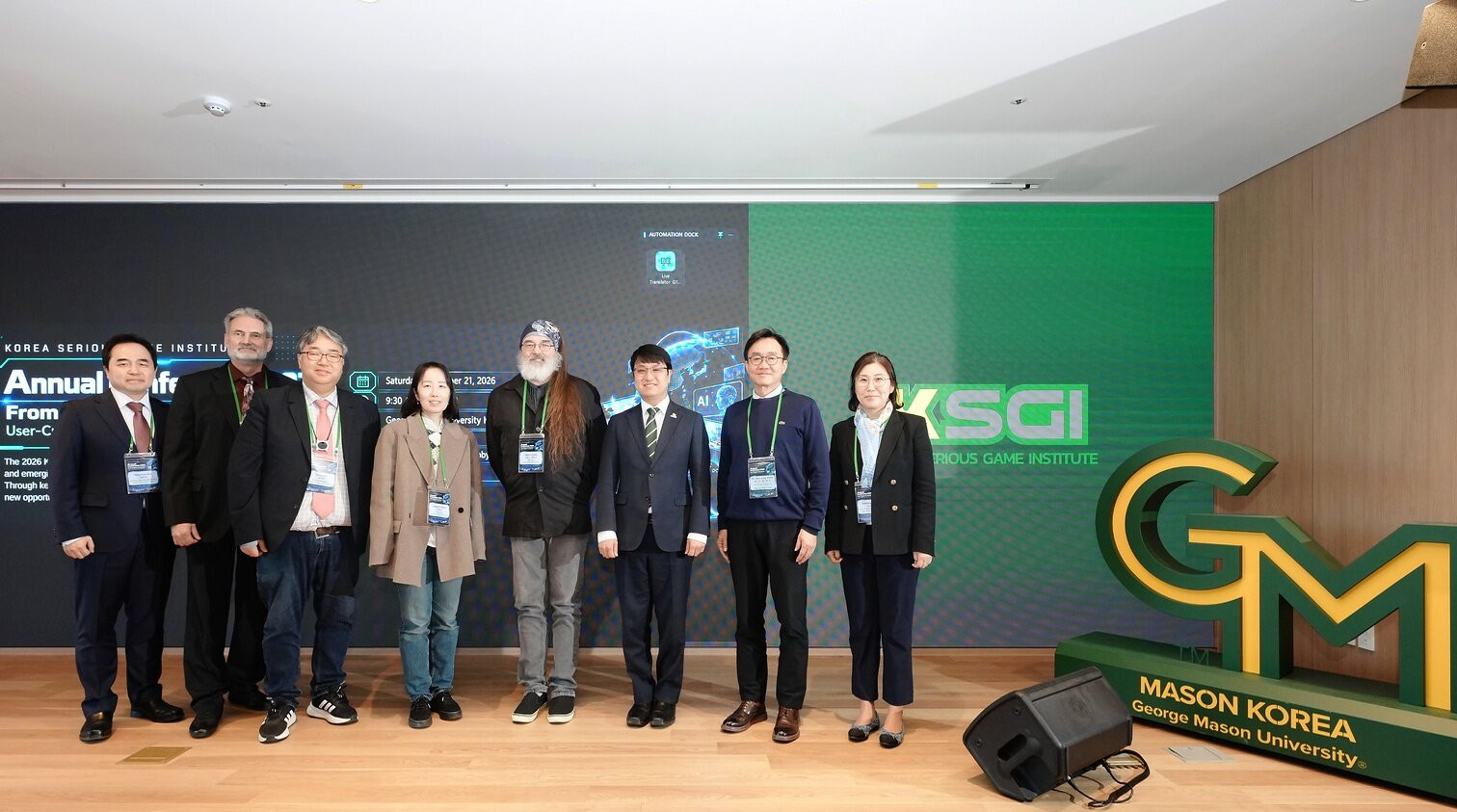
George Mason University Korea announced on November 25 that the Korea Serious Game Institute (KSGI) held its 2nd Anniversary Annual Conference on November 21. The event featured discussions on the role of game creators and content distribution channels in the age of AI.
Held at the Korea campus, the theme of this year's conference was "From Players to Creators: User-Created Games in the Age of AI." Presenters highlighted changes in game and software development methods brought about by AI, as well as the conditions necessary for creative works to reach actual users.
Sang Nam, Director of KSGI and Chair of the Department of Computer Game Design at George Mason University, suggested that attention must be paid not only to production technology but also to distribution infrastructure. While agreeing with discussions on Sovereign AI—securing a nation's own AI technology and infrastructure—he explained that a "Sovereign Publishing Platform" should also be discussed so that creators do not rely solely on specific global platforms.
Director Nam presented the domestic Korean app market ONE Store as an example of a distribution channel. The intent was not merely to emphasize domestic platforms, but to broaden the options for creators to reach users. He noted that compared to game development technologies and developer training, discussions on distribution have been lacking, adding, "Being able to make a game and being able to deliver it to actual users are two different issues."
The keynote presentations addressed the role of human judgment and experience. Sooyong Park, Dean of the College of Software Convergence at Sogang University, delivered the first presentation titled "From Code to Requirements." He explained that even if AI assists with implementation, defining requirements, design, and verifying results remain human responsibilities. Defining problems and deciding what to build are becoming increasingly critical in the development process.
Professor Jungmin Kwon of Seoul National University of Education presented on the topic "Where Does the Heart of a Game Come From? Lessons Learned from Making Games with AI." Sharing her experience developing educational and K-pop-themed games, she explained that even if Vibe Coding reduces the burden of solo production, completing large and complex games remains challenging. She also emphasized that at the heart of any game lie the creator's experiences and ideas.
KSGI expects that advancements in AI development tools will increase individual creator participation in user-created games, indie games, and educational/serious games. At the same time, it noted that as the number of creators grows, promoting games and securing users could become more difficult. Director Nam emphasized, "I hope discussions on Sovereign AI will extend to Sovereign Publishing Platforms as well. Ultimately, what creators need is not just good production tools, but the opportunity to showcase what they have built to the world."
The Korea Serious Game Institute was established at the Korea campus in November 2024. Its core activities include educational innovation and applied research leveraging serious games, AI, and immersive technologies, as well as digital cultural heritage preservation and international industry-academic collaboration. Operating in partnership with the Virginia Serious Game Institute (VSGI) at George Mason University in the U.S., it conducts research on game-based education, AI-driven creation, and interdisciplinary studies.
George Mason University Korea offers the same curriculum and degrees as the U.S. campus. Courses are taught 100% in English, and students spend three years at the Korea campus and one year in Fairfax, Virginia. According to the university, the employment rate for Korea campus graduates one year after graduation is 80%.
George Mason University in the U.S. is a public research university with an enrollment of approximately 40,000 students. Three majors—Economics, Data Science, and Computer Game Design—have received STEM designation, and the university noted that it ranked 32nd among U.S. public universities and 71st overall in the 2025 Wall Street Journal College Rankings.