Compared to any high-tech industry, the pace of change in the gaming sector is by no means lagging behind. In fact, the winds of change blowing from development to service and monetization—both internally and externally—are even fiercer and more tempestuous. In today's era where global service has become the default, keeping pace with regulatory and policy changes across different countries is no easy task.
Xsolla, which opened its Clubhouse at the Grand Josun Busan during G-STAR, focused on the opportunities to be seized amidst these changes. Under the banner of 'Solutions to Grow Games Together,' Xsolla provided a space to discuss game growth strategies with experts and allow industry professionals to network comfortably. At the center of it all was Xsolla as a partner.

Alongside its core offering of game payments, Xsolla highlighted how its role has expanded to encompass Web Shops, commerce, monetization, publishing, and Direct-to-Consumer (D2C) solutions. This is why Xsolla emphasizes providing everything needed from launch to growth and success. In sessions held on November 20 in the same venue's meeting room, discussions focused on global regulatory changes, new strategies, collaborations, and ways to reach more users through partnerships.
Taxes Segmented, App Store Doors Opened Xsolla's Yujin Jung highlights this year's regulations and four key responses
The first session was '2026 Video Game Industry Trends: A Year of Regulation and Opportunity,' presented by Yujin Jung, APAC Regional Director of Customer Success at Xsolla. Having worked at Xsolla for nearly six years providing partners with country-by-country policy updates via email, she noted that no year had seen as many tax-related notices as this year.

Taxes are complex starting from indirect taxes such as VAT. In the United States, tax rates vary by state and local municipality, while Canada subdivides them into GST, HST, PST, and QST. Rates also differ depending on whether the offering is categorized as a digital service or a platform. On top of this are direct taxes levied on payments to foreign entities, such as in Taiwan, and region-specific taxes like Argentina's provincial turnover tax or Ecuador's foreign currency outbound transfer tax.
In addition, the most critical keyword this year was age verification. Countries like Brazil, Indonesia, Australia, the US, and India began regulating age verification by law, while the UK mandated age verification even for platforms like Xbox and Steam. The core requirement is that self-reporting, such as typing in a birth date, is insufficient; users must pass through a government-certified system.
A prime example is Brazil's ECA Digital. Enacted in September 2025, it took full effect in March of this year following the end of its grace period, applying to foreign operators servicing Brazilian users. Operators must verify age through one of five government-certified systems and provide parental control features for minors. Non-compliance can trigger fines of up to 10% of revenue, as well as suspension or prohibition of operations by court order.
Conversely, regulations loosened on app stores. In the United States, Google allowed alternative payments and external links starting June 30, while Apple's case remains under Supreme Court review. In Europe, Apple permits in-app purchases and out-bound app links, while Japan allowed alternative payments, web links, and alternative app markets on both platforms. Of course, fees may still apply depending on regions and terms, so this does not mean fees disappear entirely.
So how is Xsolla responding? On taxes, Xsolla acts as a Merchant of Record (MoR). It calculates and applies taxes, collects them from users, handles filing, payment, and tax audit responses according to each country's reporting cycle and methods, and allows publishers to view global revenue and collected tax details directly in their Publisher Account. Jung emphasized that while many companies claim to be an MoR, Xsolla is the only one covering over 200 regions with more than 20 years of experience. In short, partners build the games, and Xsolla takes care of tax filings.
Xsolla also addresses age verification. Anchored by age-based store controls and parental consent, Xsolla integrates Privo's COPPA and GDPR-certified system. Adults can complete checkout instantly after a brief identity verification. However, if a user indicates they are under 18, they are redirected to a parental consent page, and an email notification is sent to the parent. Payment can only proceed after the parent completes consent, preventing children from making purchases with parents' cards at a system level.
The starting point of D2C is the Xsolla Web Shop. It allows developers to select payment flows, secure user data directly from the first purchase through repeat visits, and establish direct relationships with users through promotions, loyalty, and referral programs. Offering over 1,000 payment methods and local currency payments out of the box, the number of Web Shops has grown by over 700 since launching in 2021. Jung noted that 60 of the top 100 grossing games have adopted Web Shops, asserting that the era of treating Web Shops as 'just something to try' has passed.
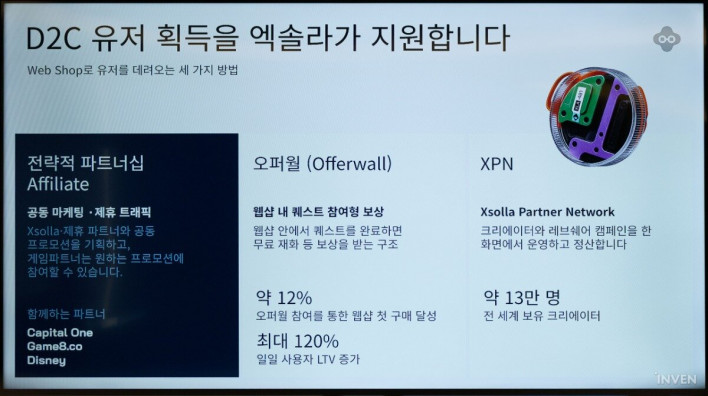
Of course, opening a store is meaningless if customers don't visit. Therefore, Xsolla introduced three methods to bring users to Web Shops: Strategic Partnerships and Affiliates, where Xsolla and partners co-plan promotions; Offerwall, which rewards users with free in-game currency upon completing quests inside the Web Shop; and XPN (Xsolla Partner Network), which manages and settles revenue-sharing campaigns with creators on a single screen. Approximately 12% of Offerwall users made their first Web Shop purchase, daily user Average Transaction Value (ATV) increased by up to 120%, and Xsolla boasts approximately 130,000 creators worldwide. Current partners include Capital One, GameAid, and Disney.
Finally, payment conversion rates. Most people have experienced closing a checkout window mid-way through entering a credit card number thinking, 'I'll do this later.' In many markets, local payment methods hold over 50% market share—for instance, Pix accounts for 51% in Brazil, and UPI holds roughly 55% in India. Payment options themselves directly translate into conversion rates.
The same applies to currencies. According to industry research, sellers adding local currencies typically see conversion rates rise by 5–20%, displaying prices in local currencies increases cross-border revenue by an average of 17.8%, and providing local payment methods as well raises it by up to 30%. Both elements must coexist for full effect, which is why Xsolla added over 50 new local payment methods between 2025 and this year.
The results were proven by numbers. In Japan, revenue grew 46% year-over-year with 63% growth expected by year-end; Indonesia saw 147% growth followed by an anticipated 33%; and the US is eyeing growth from 7% up to 52%. Following the introduction of new payment methods, conversion rates rose by 0.83% in Japan, 4.61% in the US, and 8.62% in Indonesia.
Checkout steps were also reduced. Unlike standard checkout that takes four steps—from selecting payment method to entering card info and identity verification—Instant Flow finishes with a tap of the pay button and biometric authentication. Following its introduction, Google Pay conversion rates rose by 20%, Apple Pay by 5%, and combined revenue from both methods surged 58%.
Powering all of this is Pay Station, which supports over 1,000 payment methods, 200+ regions, 130+ currencies, and 25+ UI languages with a single integration. Jung summarized that Xsolla tackles taxes via MoR, age verification via parental controls, platform shifts via Web Shops and user acquisition, and payment conversion via local payment methods and Instant Flow. Xsolla has worked alongside more than 2,000 game developers for over 20 years, with over 1,000 employees servicing 200+ regions. She concluded her presentation by noting that while regulations will continue to change, having a partner to navigate them together remains constant, hoping Xsolla will be a partner that stays ahead of regulation rather than merely following it.
Web Shops Are Not Checkouts, But Spaces for Retention Three Web Shop revenue growth strategies: from repeat visits to external traffic
The following session addressed Web Shop operation strategies. Driven by policy changes, Web Shops have evolved from an option into an essential element of business growth, though partner responses remain mixed. While some report strong results, many express that performance has fallen short of expectations.
Concerns mainly boil down to three issues: users visit once and never return; the shop feels like a deserted stall disconnected from everything and is forgotten; or traffic comes in, but revenue fails to follow. The speaker identified the root cause as building Web Shops with the perspective of a checkout register that only receives payments. Instead of a register where the relationship ends when checkout completes, a Web Shop must become a retention space that welcomes, engages, and brings users back.
The first strategy is creating reasons for users to return. More than 700 partners have launched Web Shops through Xsolla, and many top-grossing game companies have already adopted them. The key figure the speaker highlighted was 72%, signifying that the vast majority of Web Shop revenue comes from players making repeat purchases after their first transaction.
Thus, the most urgent priority is repeat visits. Developers should encourage regular visits through perks like daily rewards, while lowering the psychological barrier of the first purchase using first-time buyer benefits and offer chains to make buying a familiar experience. In fact, Web Shop A recorded first-purchase conversion rates over 30% higher when applying promotional incentives compared to when listing only virtual currency and items.
It doesn't end there. By integrating MMP (Mobile Measurement Partner), developers must analyze which channels bring users to the Web Shop and track their behavior and payment patterns, feeding those insights into subsequent operations and events. A Web Shop must understand and deliver what users truly want.
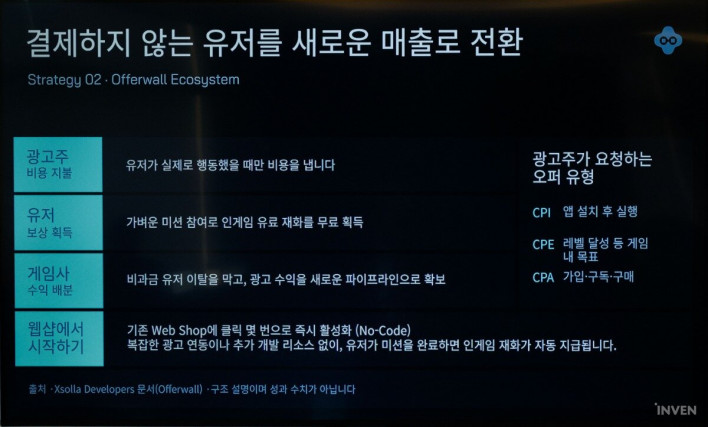
The second strategy is converting non-paying visitors into monetization opportunities. Most users who visit a Web Shop leave without making a purchase, and the speaker's solution to this was Offerwall. Advertisers provide missions, and users voluntarily participate to earn rewards. These rewards foster positive touchpoints with the service, driving repeat visits and revenue.
Missions typically require engagement actions such as CPI, CPE, or CPA, generating advertising revenue for developers while rewarding users accordingly. Integration takes just a few clicks, and ads, missions, and in-game item deliveries are handled automatically within the Web Shop, requiring minimal oversight from developers or publishers. In cases involving overseas game studios, Studio K generated roughly 5% of its total Web Shop revenue from Offerwall, while Studio V saw Web Shop transactions increase by over 10% after implementing Offerwall.
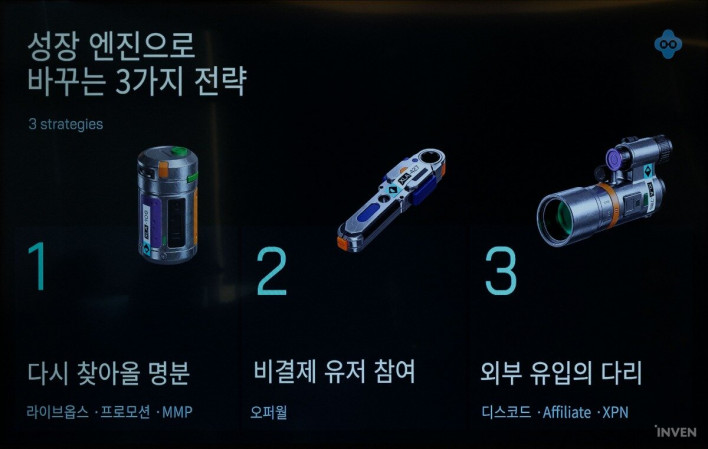
The final strategy involves looking beyond the game itself. One of the most common refrains heard from partners is that UA (User Acquisition) and marketing costs have skyrocketed, consuming earnings as fast as they are generated. Relying solely on waiting for users inside the game presents clear limitations. The speaker advocated building bridges from active external communities directly into Web Shops and game services.
To facilitate this, Xsolla proposes Discord integrations, affiliate platforms, and creator programs. The newly introduced Affiliate Program operates through link partnerships and platform partnerships, promoting games and Web Shops together on portals with large audiences. In an XPN creator program case study, campaigns achieved not only sales and new user acquisition, but also over 7 million hours of watch time. Both programs are performance-based, sharing revenue only when actual sales occur, allowing studios to start without upfront investment or risk.
The speaker advised that studios do not need to implement all three strategies at once. If repeat visits are a struggle, start with the first method; if traffic is present but revenue lags, consider Offerwall; and if external promotion is blocked by UA and marketing costs, explore the third approach. He concluded by expressing his hope that partners' Web Shops—current and future—operate as growth engines driving real corporate revenue.
Brands entering games: rewards instead of ads Three Xsolla executives present methods for cost-effective user acquisition
The third session took the form of a panel talk. Moderated by Berkley Egenes, Chief Marketing & Growth Officer at Xsolla, Nic Ingham, VP of Performance Marketing and Publishing, and Chris Roution, Vice President of Partnerships, discussed whether methods exist to acquire and retain players without heavy financial burdens. The primary challenge highlighted upfront by VP Ingham was discoverability.

Acquiring organic users is becoming increasingly difficult, and the cost of buying users continues to rise. This issue, once prominent on mobile, has begun spreading to PC. While noting that the figures were not exact, VP Ingham pointed out that according to recent Sensor Tower data, UA costs rose 24% this year alone, turning a $10 user into $12.40. This figure applies to new users, excluding retargeting costs.
The reasons behind rising costs are compounding. As the ad-tech industry consolidates, networks acquire other networks, driving up bid prices. For a casual game to buy users of the same genre, it must compete against other casual games in auctions, and user attention for traditional ad formats is limited. Consequently, advertising costs for game developers cannot go down and will inevitably continue to rise.
Furthermore, it is not a structure where spent money is immediately recovered. Spending $10 might seem like it only requires returning $10.01, but the 30% fee taken by Apple and Google alongside creative production costs are not included in that calculation. VP Ingham calculated that for that $10 user to reach break-even, they actually need to generate close to $20, requiring a longer timeframe—often exceeding a year—to turn a real profit.

Buying such users in scale—hundreds of thousands, millions, or tens of millions—is the next hurdle. While the industry has long prepared for game launches, entering the discoverability phase brings daunting questions: will releasing a mobile game cost $50 million or $100 million? Are funds just vanishing into untrackable influencer costs? Even with a great title featuring strong retention and IP, it may fail to connect if it cannot be put in front of an audience.
The situation on the brand side is equally challenging. VP Roution observed that methods previously offered to brands were closer to gameplay-interrupting ads or sponsorships. Surveys showed that users either ignored or skipped ads, developing negative feelings toward the brand. Lacking a unified approach, efforts ended up as one-off activations, leading to prolonged production times and heavy cost burdens for both studios and brands. Above all, proving and measuring effectiveness remained a major obstacle.
Brands no longer seek simple clicks and impressions; they demand measurable attribution. Xsolla chose to shift away from intrusive ads toward intentional engagement. In the program created and introduced by the three executives this year, brand involvement is perceived not as promotion, but as a reward.

At Advertising Week in New York, discussions highlighted how games are evolving beyond media channels for brands into interactive commerce and customer acquisition channels. Roution categorized brand and IP integration into three approaches. The first involves high-profile IP tie-ins like Travis Scott concerts or Nike Land—short-term, expensive activations that yield views but make calculating return on ad spend (ROAS) difficult. The second is interactive brand spaces where users engage within dedicated environments like concert halls or shopping malls.
The third approach, which Xsolla focuses on, is rewarded marketing. Brands connect with gamers by unlocking physical rewards or in-game items. An example cited was Chipotle's activation in Roblox a few years ago, where players created virtual burritos to earn in-game currency and redeem real burritos in physical stores. The campaign generated 1 million plays in its first 24 hours and exhausted 100,000 codes within the first 30 minutes, allowing store visits to be tracked as cohorts. Conversely, McDonald's was highlighted as a reverse example, offering Genshin Impact rewards within its own app.
The key term VP Ingham emphasized for this model was attribution. Traditional mass advertising delivers view counts but leaves actual product sales uncertain, often blurring results with external variables like weather. In contrast, sponsored quests attribute in-game events like level-ups, clears, or battles via MMP or server-to-server integration. Rewards range from physical goods and digital items in backpacks to promo codes, movie tickets, and pizza.
In this model, players receive tangible rewards, studios generate new revenue, and brands gain measurable engagement instead of skipped ads. Standard rewarded video ads—which account for much of traditional UA—offer five gems for watching a video or force video playback before returning players to gameplay without reward. In sponsored quests, players continue their standard gameplay, make purchases, or check out new updates while being rewarded for that time. Just as viewers leave to make tea during TV commercials, ads in games disrupt flow—yet sponsored quests drive up metrics like play time and battle counts together.

Reward design is also critical. VP Roution stressed that prompting users to install an app or offering a 5% discount moves no one; a clear incentive like free pizza is needed. By having users redeem the pizza in the brand's app, the brand gains a new account and payment profile, creating a value exchange where product cost is offset by CPI and UA budgets. Users get pizza while playing their favorite game, and brands acquire engagement data hard to find elsewhere.
It was also emphasized that no single formula fits all games. CMO Egenes noted that goals can range from driving installs to boosting lagging metrics, highlighting the need to A/B test rewards and evaluate game-brand compatibility. He cited potential examples like connecting a 'Winner Winner Chicken Dinner' in PUBG with KFC.
The program itself is the result of six to seven months of preparation by the three executives, with sponsored quests, backpack items, and reward redemptions already live this year. One case featured controllers from a hardware peripheral maker as rewards. On-site discussions touched on promotional talks with Red Bull, Chipotle, and the movie *Resident Evil*, while ideas continue to expand—such as allowing users to select Red Bull with snacks at 7-Eleven or DoorDash offering pre-gameplay delivery. VP Roution concluded the chat by expressing excitement for future collaborations, noting the abundance of Asia-Pacific brands aligned with gaming culture.

Web Shops Are Open; Now It's Time to Bring in Users Disney campaigns and affiliate partnerships introduced by APAC Head Mingu Lee
The fourth session was led by Mingu Lee, Head of APAC Partnerships at Xsolla. His and his team's mission is helping Web Shop partners grow revenue and discover new partnerships to boost engagement and retention. The words he repeated throughout the session were engagement and retention.
He opened by highlighting the scale of the Asia-Pacific market. Gaming revenue in this region, including Korea, Japan, and Southeast Asia, is approximately seven times that of the film box office, boasting 1.9 billion players. The shared question facing game partners, developers, and publishers was how to connect with these users.
Xsolla is known as a payment company. However, it intends to leverage its network and analytics capabilities—built over 20+ years working with thousands of game partners—to directly grow Web Shop engagement and retention beyond payments. Just four to five years ago, the concept of a Web Shop was unfamiliar. Today, that explanation is no longer necessary, leaving the remaining challenge: bringing users to the Web Shop.

He presented three methods. The first is an affiliate program that directs traffic from gaming and non-gaming platforms to Web Shops. The second is platform partnerships that receive traffic in exchange for revenue sharing. The third is customized partnerships, willing to explore new avenues for Web Shop engagement and retention. The first case he highlighted was this third category: collaboration with Disney.
Stacy Oh, Head of Disney Experiences Korea & Southeast Asia at The Walt Disney Company Korea, found significance in this partnership as a way for Disney and Pixar IPs to connect with new consumer demographics. Disney carries over 100 years of history, and Mickey Mouse will turn 100 in 2028. With changing platforms and technologies, the challenge over recent years has been how to reach both older generations who grew up with Disney IP and younger generations.
Addressing that challenge led to the creation of the Digital Experiences department five years ago. In Korea and Southeast Asia, digital revenue has grown rapidly, accounting for over 50% of physical product revenue. She explained that Xsolla's proposed idea creates new consumer touchpoints for the Disney brand, leading to a win-win partnership where brand growth enhances Xsolla's visibility.
Starting with *Toy Story*, the plan is to expand campaigns across Disney and Pixar IPs. Oh expressed a desire to create campaigns and events alongside upcoming series and film releases. Beyond Disney and Pixar, she anticipated opportunities to connect with new consumers across Marvel, Lucasfilm, National Geographic, 20th Century Studios, and ESPN live broadcasts introduced a week prior.

Unlike customized partnerships like Disney, affiliate programs offer a more direct, budget-friendly approach. They reach users of non-gaming enterprises like banks and telcos without requiring new development, incurring costs only when results occur. Among ongoing partnerships, US credit card company Capital One provides Web Shop affiliate access to its 120 million users. Similar traffic channels across North America, Europe, and Latin America are being opened through VP Roution's team.
In Asia-Pacific, partners introduced included Thailand's Online Station, Korea's Inven, Southeast Asia's This is Media, and Japan's Game8. The first affiliate partner highlighted was Game8, which launched its campaign at Tokyo Game Show two months ago. Hisanori Kato, CEO of Game8 Global, stated that its English site reaches roughly 100 million pageviews and 40 million users monthly.
Players visiting to check walkthroughs, tier lists, and rankings for their favorite games view character info and are led to publisher Web Shops. He described it as a 'win-win-win' opportunity benefiting players, publishers, Game8, and Xsolla alike. Lee explained that users visiting strategy guides represent core players dedicated to the game, adding direct links to Web Shops on the platform. When players need extra currency or new skins before a boss fight, they can skip intermediate steps and jump straight to the Web Shop to purchase.

Onboarding is a simple procedure involving reviewing and agreeing to an additional 15% platform fee. The same model is expanding across regions with various partners: in Thailand, Online Station—the No. 1 gaming media under CP Group—was introduced, alongside True Digital. Southeast Asian media outlet This is Media was highlighted with 1.2 million pageviews and 35,000 daily pageviews, featuring official Web Shop icons. In Korea, Web Shop exposure is already available through a partnership with Inven. Lee concluded the session noting that beyond current partnerships, more partners will emerge by 2027 to target desired regions directly.