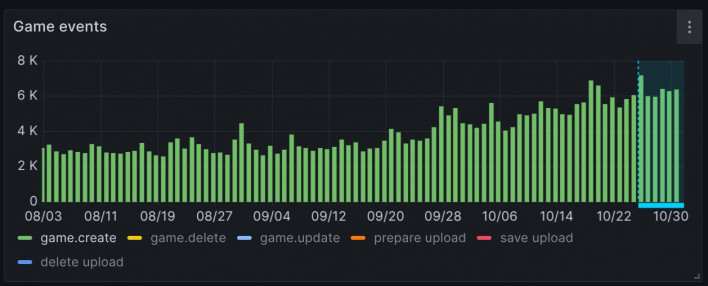
A figure that used to be around 3,000 a day has surpassed 6,000 in just two months. This comes from a graph showing daily new game page creations, posted by indie game distribution platform itch.io on its official Bluesky account on the 1st. The bar chart, which was modest in early August, began surging steeply in late September and settled at roughly double its level from two months prior by late October.
Of course, creating a page does not immediately mean a new game has been released into the world. On itch.io, developers can open a project page for free to upload project descriptions, images, and executable files. Newly created pages are saved as private by default, and only appear in search listings once the developer manually switches them to public and fulfills requirements such as adding cover art and files. Even taking this into account, the number of new project spaces opened on the platform every day has doubled in two months.
What is worth noting is the additional explanation itch.io added right below the original post. The official account succinctly added, "Downloads and purchases did not double." While daily new page creations jumped from 3,000 to 6,000, the frequency with which gamers downloaded files or opened their wallets was not much different from before. It is a phenomenon where supply has doubled while consumption remains stagnant.
When a user in the comments section asked for the reason, the itch.io account replied with "Take a guess," alongside crying face and robot emojis. To another user's direct question asking, "Is it because of AI dreck?", it responded with an exhausted emoji with dark circles under its eyes. Although the published graph does not categorize by production method, the team itself does not view this recent abnormal spike as separate from the spread of generative AI and prompt-based coding.
Easier-to-make games, players not keeping up
The trend of generating code and images with a few lines of prompts to publish games is already confirmed by numbers on Steam as well. According to data from market research firm GameDiscoverCo analyzing October's Steam Next Fest, roughly 7,000 demos flooded into the event, exceeding usual expectations by about 40%. Among them, the proportion of developers disclosing the use of generative AI was 34.4%, steadily rising through February (21.2%) and June (26.5%) of this year. In particular, lower-tier demos with almost no concurrent players showed a noticeably higher share of web frameworks or open-source engines rather than traditional commercial engines—environments heavily utilized by prompt-based coding tools.
Did this surged volume lead to actual sales? The findings from game data analyst Sulka Haro, who conducted a full census of 53,597 games released on Steam over three years starting from mid-2023, are negative. As of mid-this year, roughly one-third of new Steam games disclosed AI usage, accounting for most of the overall growth in releases, but the rate of AI-disclosed games surpassing 100 reviews (estimated at around 3,000 sales) remained at just 55% of non-AI games. This gap has not narrowed at all over the past two years. While the barrier to making and listing games on storefronts has lowered, the resulting output has not translated into the level of quality that makes gamers spend money and time.
A 'No AI' button that doesn't help
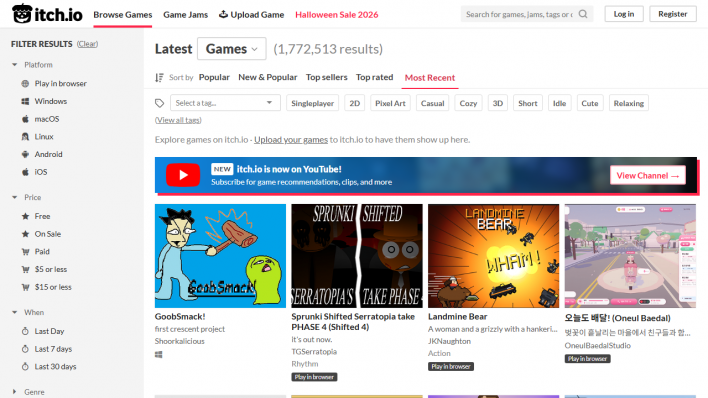
The problem is that while pages nobody visits multiply, the store's discovery functionality is broken. When North American media outlet Game Developer checked itch.io's latest listings on the 2nd, thumbnails seemingly generated by AI were lined up, yet games actually tagged with AI were rare.
itch.io added a field to its project edit screen in November 2024 asking whether generative AI was used. The platform also defines creating pages en masse using AI or automated tools as spam and removes them from search results. However, unlike paid asset sales pages, standard game pages can still be created and published without answering this prompt.
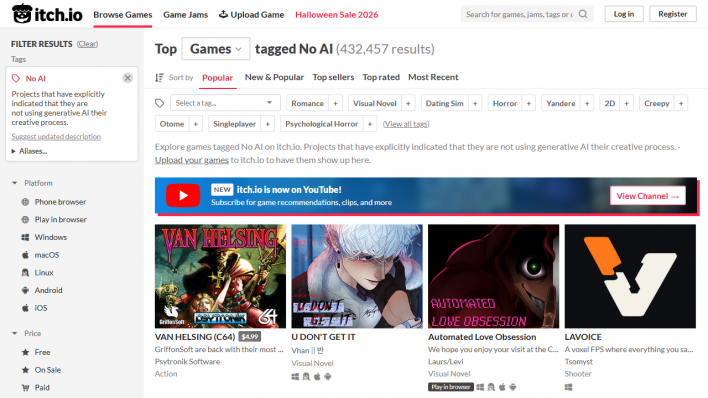
The outcome of relying on voluntary reporting is evident in the numbers. As of early November, out of itch.io's total listing of approximately 1.77 million entries, only around 131,900 pages (7.5%) have been tagged by developers as 'AI Generated'. Conversely, when gamers turn on the 'No AI' filter to avoid AI games, the total listing drastically shrinks to around 432,000 entries. This is because the 'No AI' tag is applied only to pages where developers manually checked that they did not use AI. Combining numerous older titles uploaded before November 2024 with new pages that left the question unanswered, over 1.3 million titles vanish from the screen at once. Turn the filter off, and users must endure mass-produced pages; turn it on, and perfectly fine older games become invisible.
Given this situation, arguments have emerged in comment sections calling for a complete ban on AI-generated games or charging listing fees like Steam does. Steam charges a $100 fee (approx. 140,000 won) when uploading a game, but on itch.io, anyone can open a page for free simply by creating an account.
However, even if ban regulations were instituted, there is no effective way to filter out 6,000 pages arriving daily. AI researcher Mike Cook noted on Bluesky, "Even if you institute a ban, it won't change that graph," adding, "You would need dedicated staff or a reporting system to enforce the rules, but detecting AI usage in actual games is far harder than people think."
Raising barriers by requiring listing fees is also far from itch.io's operational philosophy. Founder and operator 'leafo' wrote in a search index overhaul announcement on the 19th of last month that "malicious uploaders and spammers flock in daily, making response increasingly difficult due to AI and Large Language Models (LLMs)," but drew the line at charging publishing fees or deposits like Steam. At the time, because automated classification criteria meant to block spam were too strict, causing new games from regular indie developers to be omitted from search, itch.io relaxed its standards and unblocked search exposure for 215,000 pending existing pages all at once. During the same period, it also suspended over 10,000 accounts that attempted to distribute spam and malware.
The principle of allowing anyone to show their game to the world without spending money has been itch.io's starting point since the days of Steam Greenlight. However, in an environment where 6,000 pages are created daily due to automated production, the cost of upholding that principle builds up directly as a burden on moderation and search systems. Tighten moderation, and unknown indie developers' debut titles vanish from search; loosen moderation, and pages that don't even generate a single download fill up the listings. This is the dilemma itch.io faces in the era of AI.