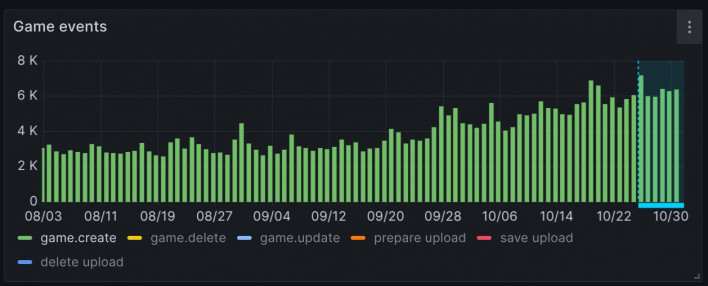
A strange graph was posted on itch.io, the distribution platform known as a haven for indie games. According to data published by itch.io on its official Bluesky account on the 1st, the number of new game pages created per day doubled in just two months. After hovering around 3,000 per day in early August, new page creations spiked sharply starting in late September, easily surpassing 6,000 per day by late October.
Of course, creating a game page does not automatically mean a full release. On itch.io, developers can open a page for free to upload project descriptions and files, and newly created pages are saved as private by default. However, even accounting for private drafts, the number of projects knocking on the platform's door every day has doubled in two months.
The real issue was revealed in a follow-up comment. In a reply to its original post, itch.io admitted that "downloads and purchases have not doubled." This means that while the shelf space for products on display doubles every day, the number of customers actually picking up items or opening their wallets remains unchanged.
Why are so many ignored pages flooding in? Both inside and outside the platform, observers point to generative AI and the trend of "vibe coding"—writing code using only prompts—as the primary cause. When a user asked about the reason for the surge, itch.io's official account gave a brief reply, "Take a guess," accompanied by a crying face and a robot emoji. To another user asking if it was due to "AI slop," it replied with an exhausted face emoji. While the graph itself does not categorize creation methods, this indicates that the operators themselves are feeling the influx of AI-generated content.
Flooded with AI games, but gamers aren't opening their wallets
The phenomenon of AI-assisted games—now easier than ever to make—filling storefronts while being ignored by gamers is not unique to itch.io. The exact same trend is emerging on Steam, the world's largest PC gaming platform.
According to market research firm GameDiscoverCo, October's Steam Next Fest featured over 7,000 demos, far exceeding expectations. Among them, titles where developers disclosed using generative AI accounted for 34.4% of the total, a significant rise from February's figure of 21.2%. Notably, lower-ranked games with virtually no concurrent players had a higher proportion of tools commonly used for prompt coding.
A comprehensive study of over 53,000 games released on Steam over the past three years by game data analyst Sulka Haro paints an even clearer picture. As of mid-this year, one in three new Steam releases disclosed AI usage, driving overall release growth; however, the rate at which these games achieved even modest commercial success (at least 100 reviews and an estimated ~3,000 sales) was only about half (55%) that of non-AI games. In short, while AI tools have reduced the cost of making and uploading a game to near zero, mass-producing games this way does not translate into player enjoyment or purchases.
Ineffective filters and difficult bans... the dilemma of free storefronts
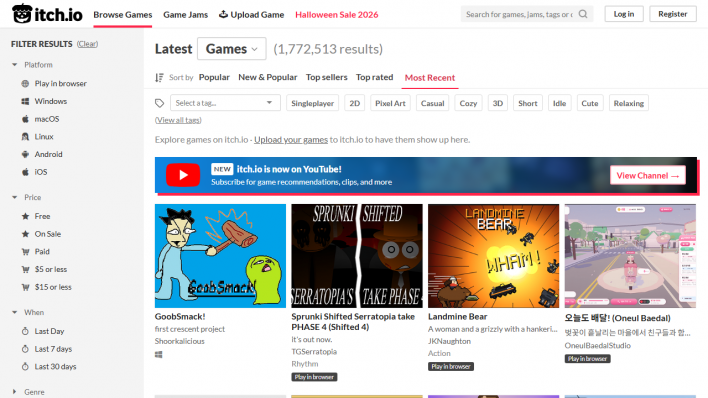
Given this situation, could users simply filter out AI games? The reality is not so simple. When North American gaming outlet Game Developer examined itch.io's latest uploads on November 2, it found numerous cover images that appeared to be AI-generated, yet many did not even carry an AI tag.
itch.io has asked developers to check whether they use generative AI since November 2024 and classified mass-registering pages via automated systems as spam. However, this disclosure remains an honor system reliant on developer honesty. Because it is not a mandatory field, uploaders who intentionally flood the site with AI games simply skip marking it.
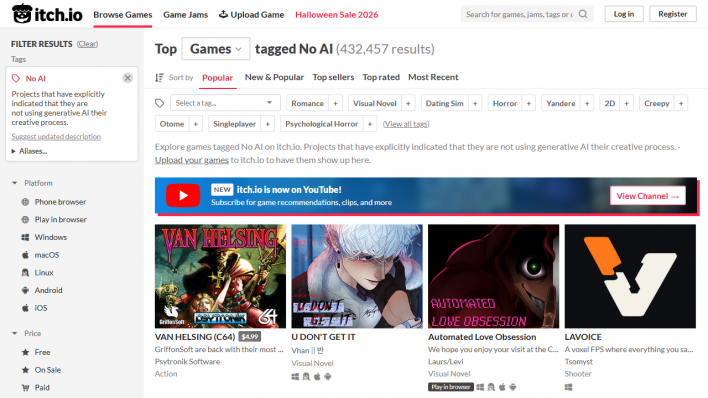
Indeed, out of approximately 1.77 million total listings on itch.io, only 7.5% (around 131,900) carry the developer-assigned 'AI Generated' tag. Conversely, enabling the 'No AI' filter—which collects only works where developers explicitly checked that AI was not used—drastically shrinks the total listings down to 430,000. Because countless classic titles uploaded before the tag system was introduced, as well as un-responded listings, are filtered out entirely, users are left in an awkward dilemma where using or not using the filter both present problems.
Nor is it easy to declare a "total ban on AI games" as demanded by some in the community, or charge submission fees like Steam. AI researcher Mike Cook pointed out on Bluesky that "a ban alone won't change that graph," adding, "ultimately, you would need a large moderation staff or reporting system to enforce rules, but detecting AI usage in actual games is far trickier than people think".
Raising the barrier to entry by charging money also directly conflicts with itch.io's founding philosophy. 'leafo,' the founder and operator of itch.io, lamented in a search system update notice on the 19th of last month that "malicious uploaders and spammers swarm daily, and responding has become increasingly difficult with the spread of AI," yet made it clear there are no plans to charge release fees or deposits like Steam. At the time, automated moderation criteria aimed at stopping spam were so strict that even legitimate indie developers' games were omitted from search results, forcing itch.io to relax the criteria and release 215,000 pending pages into search results all at once.
The freedom for anyone to upload games for free was the greatest asset that grew itch.io. However, in an era where game pages can be mass-produced with just a few clicks, that low threshold is returning as a boomerang that paralyzes storefront displays. Narrowing the door leaves genuine indie developers with nowhere to stand, while keeping it open causes ghost pages no one plays to cover the store. itch.io's graph, which doubled in just two months, vividly illustrates the dilemma facing open marketplaces in the AI era.