In a keynote address at 'gamescom asia x Thailand Game Show 2026', Jinho Oh, former Chief Global Publishing Officer (CGPO) of Krafton, emphasized that "what determines a game's lifespan is not new releases, but the 'boring work' repeated every day." Beyond simple industry advice, this message directly aligns with the challenge currently facing Krafton as it strives to turn new hits into long-term franchises.
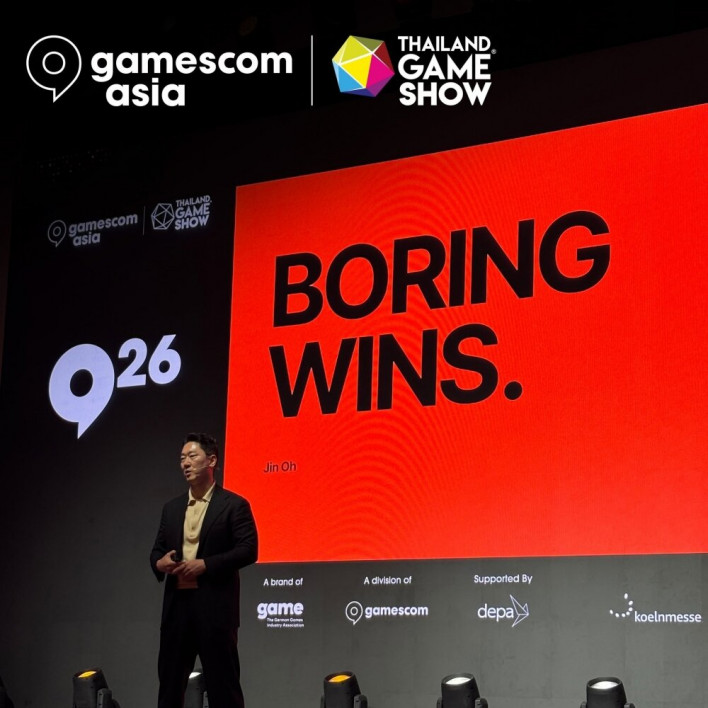
The event was held from October 29 to November 1 at the Queen Sirikit National Convention Center (QSNCC) in Bangkok, Thailand. The presentation was titled "What Makes Great Games Endure? Lessons from the World’s Biggest Titles." Oh opened his lecture with the phrase "Boring Wins" displayed on the first slide.
Oh joined Krafton in September 2024 after serving as Managing Director for Blizzard Entertainment Korea and Southeast Asia, President of Worldwide Publishing at Riot Games, and CEO of Garena. At Krafton, he led global publishing for titles such as 'Subnautica 2' and 'inZOI'. He stepped down from frontline operations in June and served as a strategic advisor through September to handle the transition. The Head of Global Publishing role is currently held concurrently by Tae-seok Jang, Head of the PUBG Franchise. Event organizers noted that Oh is currently preparing a new venture in the gaming industry.
1. Krafton's Dilemma: From 'Launch' to 'Retention'
On July 29, Krafton reported consolidated Q2 2026 revenue of 1.2902 trillion won and operating profit of 410.9 billion won. These figures represent increases of 94.9% and 67.0% year-over-year, respectively, marking an all-time record for a second quarter. According to Krafton, PC revenue for 'PUBG: BATTLEGROUNDS' (hereafter PUBG) exceeded 500 billion won in a single quarter for the first time. 'Subnautica 2', which launched in Early Access on May 15, sold 5 million copies within 22 days. At its annual general meeting of shareholders in March, the company explained that 'inZOI' and 'MIMESIS' had each sold over 1 million copies, demonstrating their potential to grow into new franchises.
However, launch performance is merely the starting line. Earlier this year, Krafton announced plans to release 12 of its 26 pipeline titles within two years. Its strategy is to first validate potential in markets with a clear core fanbase, then scale up proven projects into franchise IPs. In this framework, the "scaling up" phase is defined by years of post-launch live operations. For a company that has relied on the single PUBG IP for most of its revenue, establishing a second and third pillar requires just as much strength in retaining existing players as it does in launching new titles.
Cost pressures are also mounting. According to financial information provider FnGuide, market consensus estimates for Krafton's Q3 performance stand at 1.1268 trillion won in revenue and 280 billion won in operating profit. While revenue would increase by 29.4% year-over-year, operating profit would decline by 18.6%. Increased marketing expenses from showcasing five new titles at gamescom 2026, alongside rising development costs for new projects, are cited as primary causes. The math only works if the lifespan of launched games is extended in proportion to the increased investment.
2. Content Drives Logins, Fundamentals Drive Lifespan
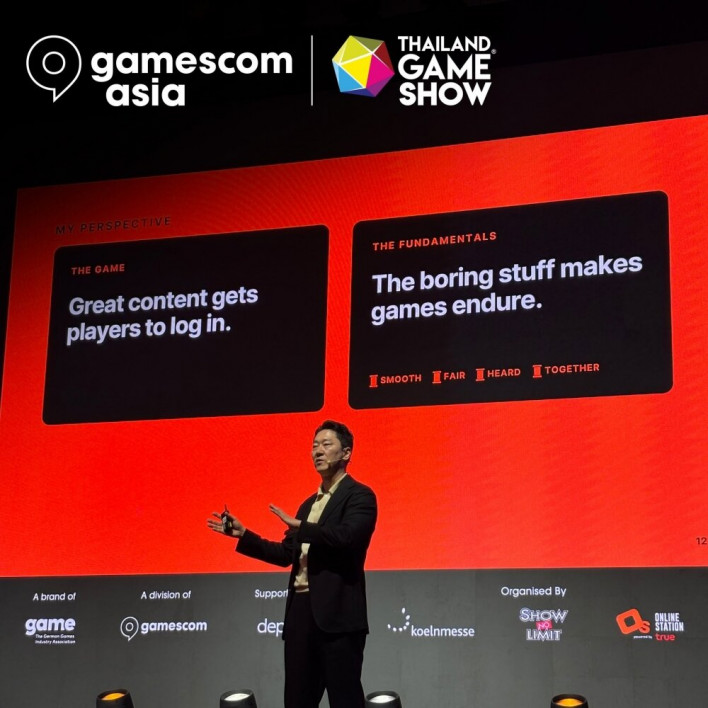
Oh's presentation focused directly on this "post-launch" phase. Early in his talk, he summarized his perspective in two sentences: Great content gets players to log in, but boring work is what makes a game endure. He compared this to maintaining good health. Everyone knows you need to exercise, eat well, and get enough sleep, but maintaining that discipline consistently is difficult. He explained that game operations also rely on these fundamentals, and the starting point is always understanding what players want.
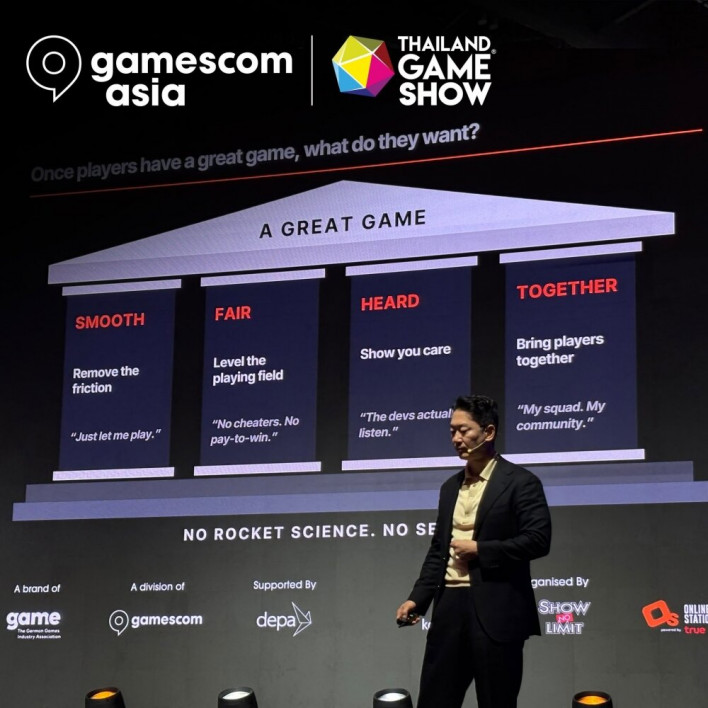
Asking what players want after getting their hands on a good game, he illustrated the fundamentals using four pillars. In this framework, the roof of a "Great Game" is supported by four pillars: Frictionless, Fairness, Listening, and Belonging.
Frictionless means removing friction between the player and the fun—on the player's side, it is simply the demand to "just let me play."
Fairness means leveling the competitive playing field. There must be no cheaters and no pay-to-win mechanics.
Listening means showing players that the developers are genuinely listening.
Belonging means bringing players together to create a space they can call "my squad" or "my community." The presentation slides noted that these fundamentals are not complex technology like rocket science.
However, these tasks are neither new nor flashy, and they never end. Oh pointed out that when executed well, no one notices. He remarked that while no player celebrates simply being able to log in smoothly, everyone notices the moment access is blocked. If the live ops team remains silent without explanation, frustration grows even further. When experiences accumulate where submitting a cheat report yields no visible change, even players who care deeply about the game begin to ask why they should keep tolerating it. The core fun of the game remains intact, but the overall play experience pushes players away.
3. 'Firefighters' vs. 'Fire Preventers'
The core emphasis of the presentation was on how companies evaluate this kind of work. New maps, new characters, and celebrity campaigns are highly visible and widely discussed. On the other hand, preventing server outages for months, dealing with cheaters, and engaging in honest communication with players rarely receive the same applause. Oh asked the audience to reflect on whom they are rewarding: those who put out fires, or those who prevent fires from starting in the first place.
This question takes on a more concrete form within Krafton. The five new titles showcased on the gamescom stage, along with annual new game reveals and launch figures, represent highly visible achievements.
Conversely, polishing 'Subnautica 2' during Early Access based on player feedback or retaining players for 'inZOI' and 'MIMESIS' into the following year rarely make headlines, even when executed exceptionally well.
To be sure, the power of new titles to attract new players is undeniable. However, in Oh's framework, new games are responsible for bringing players in, while boring work is what keeps those acquired players around. Franchises are built from the latter.
4. Pricing, PC Bangs, and PUBG
Oh supported his thesis with case studies from companies he had worked for. According to event summaries, 'World of Warcraft' enjoyed a smooth launch in one market before dropping out of the top 10. Relative to local player income, the financial burden was nearly four times higher than in the United States. Over several months, the team gathered feedback and data to find a price point players felt was fair, and the game returned to the top 3.
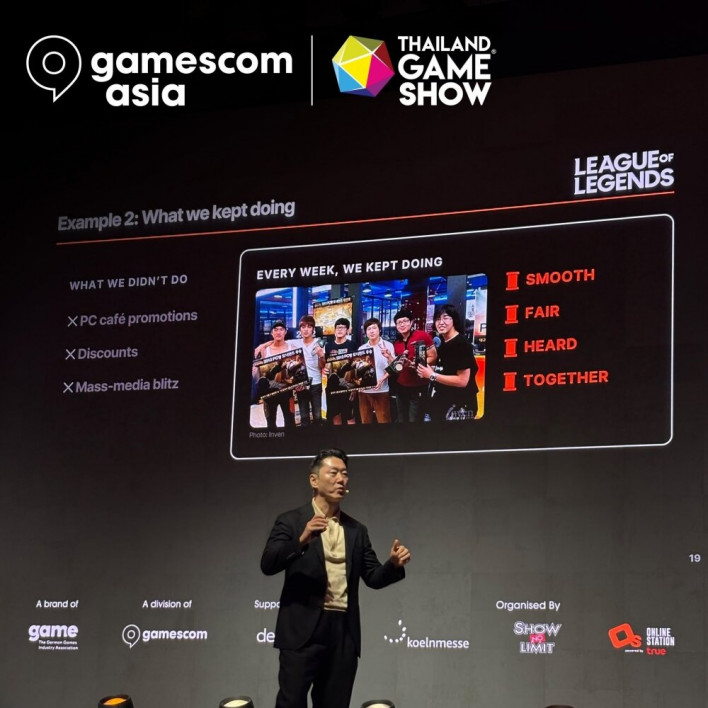
The second case study was 'League of Legends'. When the game fell from #1 to #3 in Korean PC bang rankings in 2012, Oh first highlighted the approaches the team chose not to take: PC bang promotions, discounts, and massive media campaigns. Instead, the team focused on managing the four core fundamentals every week. On screen, he displayed a commemorative photo of the winning team from a 2012 PC bang tournament as an example. He explained that fostering competition among players through local PC bang tournaments served as the foundation for the ranking recovery.
The results translated into numbers. Oh highlighted that 'League of Legends' has held the #1 spot in Korean PC bangs for nearly 700 weeks total since 2012. On the accompanying Gametrics chart as of October 23, 'League of Legends' held 1st place for its 429th consecutive week with a 36.9% market share—nearly four times that of the runner-up. Over this screen, he placed the message: Great games endure when the boring work never stops.
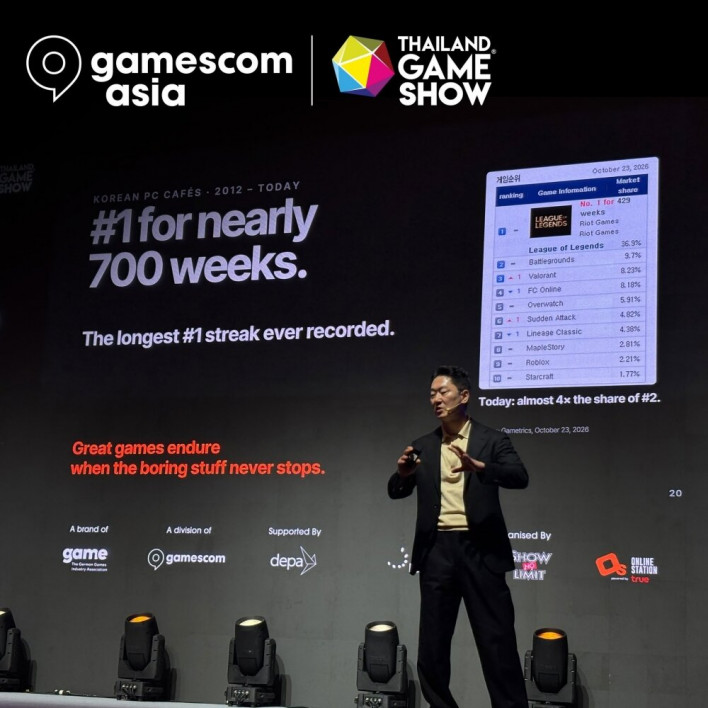
The runner-up on that chart was PUBG with a 9.7% share, effectively bringing his former employer's flagship title into the comparison. Of course, PC bang market share is merely a metric from a single channel in Korea, and PUBG set a new record for quarterly PC revenue in Q2 of this year—its ninth year since release. Krafton's 2026 roadmap released early this year also defined PUBG as an IP with a Product Life Cycle (PLC) built for long-term longevity, focusing on expanding the platform with new modes and user-generated content (UGC). Krafton already possesses one enduring game; the remaining challenge is transferring the operational muscle built with PUBG to its new IPs.
5. 'Why and For Whom' Over 'How Long'
In an interview with Philippine gaming outlet UnGeek following the lecture, Oh stated that how and why a game is made matters more than development duration. While a game that took 10 years to build can be exceptional, developers must clearly understand why they are making it and for whom. This statement aligns with Krafton's strategy of first validating new titles with core fanbases.
He also noted that AAA blockbusters are not always necessary, expressing appreciation for shorter 10-to-30-hour games that focus intensely on the player experience. While acknowledging this was his personal perspective and not representative of the entire industry, he observed that activity in the AA, single-A, and indie spaces has become far more vibrant.
As driving factors, he cited accessible tools like AI and outsourcing, along with difficult market conditions and tight budgets that end up forcing innovation. Mentioning 'Palworld', which he played for 300 hours despite its rough graphics, he added that players are increasingly accepting of unpolished visuals.
To indie developers, he advised establishing big-studio discipline early on. He pointed out that some studios lack structures like R&D processes and milestone reviews, only starting to worry about planning when they have about two months of runway left.
Conversely, he noted that as major studios grow in size, they often unintentionally lose the player-focused passion they once had. For Krafton, which is expanding its pipeline of new titles across various genres and scales by partnering with external creative studios, both points are worth taking to heart.
Regarding the trend of games from Eastern developers receiving critical acclaim, he analyzed that top companies in each region excel at understanding players and executing that understanding through live operations. Chinese companies excel at live-service operations, while Korea contributed significantly to developing free-to-play monetization models. He also highlighted the capabilities of developers on the US West Coast and in Northern Europe, emphasizing that this should not be viewed as a West vs. East divide.
6. Questions Left Behind by the Departing Publishing Chief
The fact that this message comes from the person who previously oversaw publishing at Krafton adds weight while also leaving behind homework. He led publishing during the period when 'Subnautica 2' and 'inZOI' established their launch records, and departed just as those games were entering the long-term operational phase. How deeply he instilled these principles into the organization during his tenure remains a separate question from his presentation. Ultimately, carrying on the "boring work" he spoke of now falls to the team remaining at Krafton.
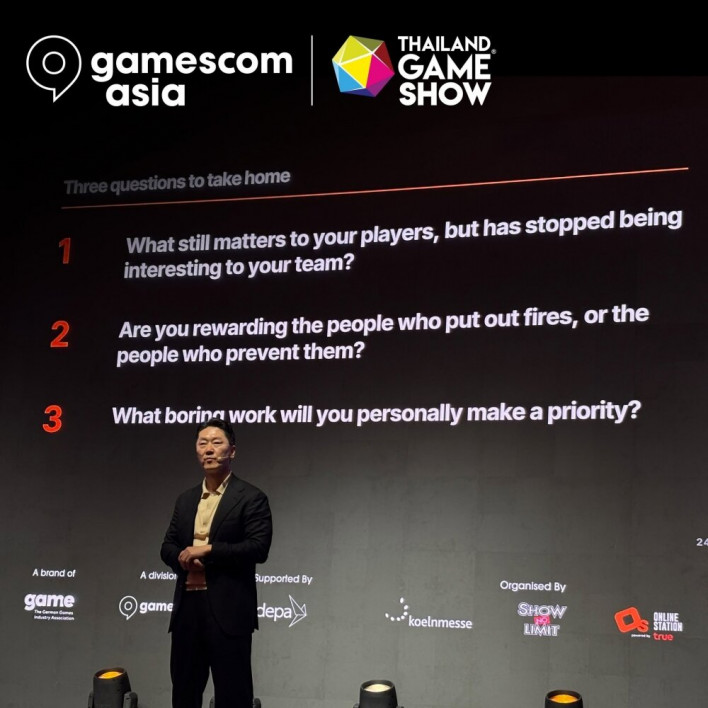
Oh concluded his lecture by leaving the audience with three questions: What tasks are still important to players but no longer exciting to the team? Who are you rewarding—the firefighters or the fire preventers? And which boring work will you choose to prioritize yourself? What Krafton has proven so far is its launch performance. A franchise, however, is built starting from the very next day.