There are countless iconic games that have left a profound mark on gaming history. Some have even come to define entire genres. 'Castlevania' is one of them.
Sharing certain similarities with the Metroid series and helping give birth to the "Metroidvania" genre, the Castlevania franchise served as the spiritual forefather to countless Metroidvania games over many years. Yet, the main series itself went dormant for a long time. While spin-offs and side games released regularly, the last mainline-style entry was 2008's 'Order of Ecclesia.' Now, 18 years later, 'Castlevania: Belmont's Curse' has finally been released.
As a result, ever since its announcement, 'Belmont's Curse' became a subject of coexisting anticipation and anxiety—a Schrödinger's cat wrapped in unknown possibilities. On one hand was the expectation that the father of the genre, long absent, would return to set things straight; on the other was the worry over whether a legacy series could still compete now that the Metroidvania formula has reached maturity.
So how does it actually deliver? Let's take a closer look.
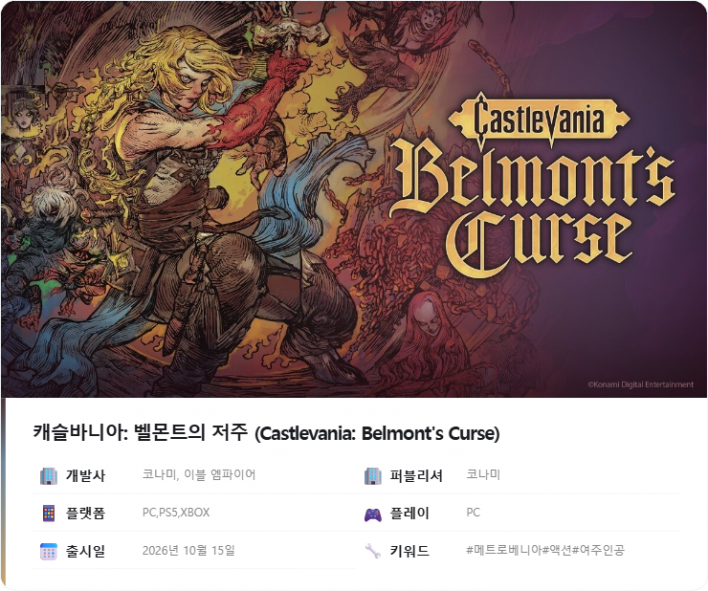
Rose Belmont's First Steps A Trifecta of Weapons, Whip, and Tarot Cards
The game opens on a Paris engulfed in flames. Though eerily reminiscent of the modern city, this in-game Paris has been transformed into a living hell overrun by undead and monsters born of an unidentified darkness. After exhausting every means to restore order without success, the Archbishop of Paris turns to the legendary vampire-hunting lineage for help: the Belmont family.
Answering the call and arriving in Paris are Trevor Belmont, known as the last survivor of the Belmont clan, and his previously unknown daughter, Rose Belmont. From this point on, players step into Rose's shoes to explore Paris and uncover the truth behind the darkness looming over the city.
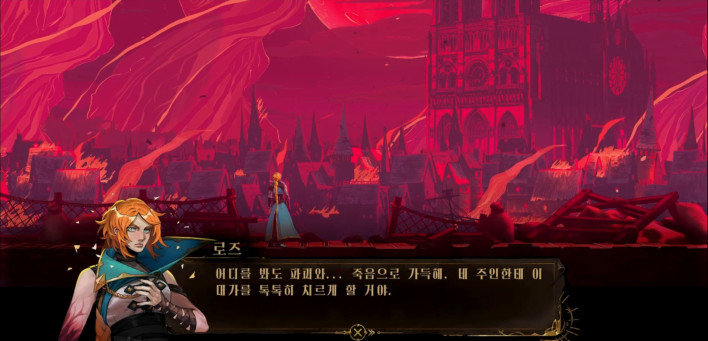
The core structure follows traditional Metroidvania design. Hidden secrets are scattered across a single, intricately interconnected map, and Rose uses various mobility abilities to forge new pathways. Along the way, players confront bosses, discover hidden treasures and weapons, and advance the narrative.
Rose's primary tools for this journey consist of seven weapon categories alongside the series' iconic Whip. Divided into straight swords, dual blades, spears, sword and shield, greatswords, gauntlets, and the whip, each weapon type features its own distinct actions and playstyle. For instance, while the straight sword is a well-rounded weapon balancing attack power and speed, the spear excels in reach, and the greatsword excels in raw power and range.
While functioning as a weapon, the whip also plays a vital role as a traversal tool. It can grapple onto latches to cross terrain quickly, or latch onto enemies to close the distance as a combat utility. In 'Belmont's Curse,' most movement and map exploration revolve around the whip.
Just as important as her weapons and whip, however, is the game's unique mechanic: Tarot Cards.
In 'Belmont's Curse,' Tarot Cards fulfill three distinct roles. First, they act as magic spells consumed via mana; acquiring a new card unlocks its corresponding skill. Second, they drive exploration; gathering clues about cards and deciphering them to track down specific characters forms a major objective of overall game progression.
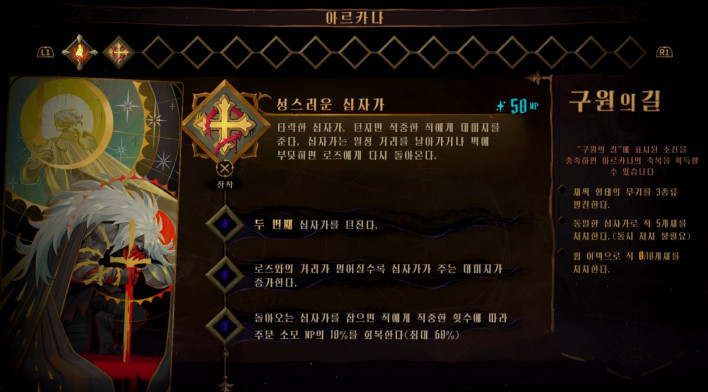
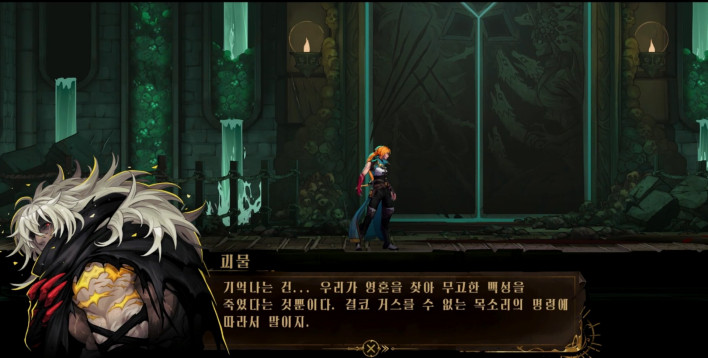
Third and finally, they represent characters. Rose starts with only a single card representing herself, but defeating bosses awards new cards. When a boss is vanquished, its consciousness is absorbed into its card, allowing it to converse continuously with Rose. While some spirits offer encouragement and counsel, others goad her anxieties and weaknesses or project outright hostility.
Ultimately, weapons, the whip, and Tarot Cards form the essential keys to unraveling 'Castlevania: Belmont's Curse.' Together, they form a holy trinity driving combat, traversal, exploration, and story.
Too Much Platforming Rose Belmont or Super Meat Rose?
Once hands-on, however, these systems do not always flow as smoothly as hoped. While 'Belmont's Curse' possesses a strong core framework, not every element feels polished enough to fully satisfy players.
For starters, the controls are quite complex. Scattered across the map are "Chaos Shards" that block pathways, which can be bypassed using the "Holy Light" ability unlocked during play. Holy Light only activates while holding down the L2 button (on DualSense), and releasing the button while passing through a shard causes it to slam shut, instantly killing Rose.
The problem is that mechanics built around these two features infest every platforming section. Fail to activate Holy Light on time and you plummet into spikes; fail to deactivate it in time and you also head straight into spikes; deactivate it at the wrong moment and you get crushed inside a shard for a game over. On top of that, the game demands precise whip controls using the analog stick and R2 button, making every trap section induce an immediate sigh. Even when you finally clear a section after countless falls, your energy—both in-game and in real life—is utterly depleted. Checkpoints are also poorly placed, meaning failing right near the finish line frequently sends you all the way back to the start.
To make matters worse, the whip controls feel sluggish. Platforming puzzles demanding precise execution and rhythm are easiest to adapt to when input responses are snappy and intuitive, but the whip in 'Belmont's Curse' feels noticeably slow by that metric. Time is required for the whip to extend and hook onto a target, and additional time is needed to build momentum and move. In short, the game demands exacting timing while saddling players with sluggish controls to achieve it.
Compounded together, these factors turn the platforming sections of 'Belmont's Curse' into a major source of frustration. The issue is that skipping them is hardly an option. Clearing these brutal trap gauntlets rewards players with upgrade items that permanently raise attack and defense, as well as new weapons and Relics. While EXP and levelling exist, levelling up itself has a surprisingly negligible impact on character growth.
This progression system not only heightens the burden of conquering platforming sections but also leaves the overall structure feeling awkward. Even if attack power increases through level-ups, the number of hits needed to defeat a given enemy often remains identical, with few alternative means to offset this.
During the Koji Igarashi era, Castlevania games featured diverse progression systems such as equipment farming, soul synthesis, and glyph absorption. Even when encountering a difficult section, players could grind levels to overpower obstacles through raw stats, or acquire new weapons, armor, and useful abilities to forge a way forward. Faced with the same hurdle, there were multiple ways to solve it.
By contrast, 'Belmont's Curse' heavily scales back stat-based RPG growth and narrows the solution paths. Progress hinges primarily on acquiring new weapons, gear, mobility skills, and personal mechanical execution. Since weapon and gear stats offer no assistance in platforming challenges, players have no choice but to grit their teeth and swing their sluggish whip to muscle through unforgiving puzzles.
Other nagging flaws surface during play. Even the weakest minor enemies rarely stagger from attacks and deal surprisingly high damage, while clues for finding Tarot Cards are written in vague, poetic phrasing, leading to frequent moments of getting lost.
An Excellent Metroid-like But How Is It as a 'Vania'?
Of course, these shortcomings do not make 'Belmont's Curse' a bad game. Quite the opposite. Setting aside the frustration of platforming segments, 'Belmont's Curse' is an exceptionally well-crafted Metroidvania game. Combat styles differ distinctly between weapon types, and acquiring new traversal abilities naturally expands the scope of exploration. Exploration feels consistently rewarding, as searching any corner of the map is bound to yield something.
The narrative also achieves respectable success. While Rose Belmont is the daughter of a legendary hero, she is constantly tested on whether she lives up to the name. She must escape her father's shadow while also coping with the curse inherited from her mother. Meanwhile, spirits sealed inside Tarot Cards encourage or taunt Rose, adding depth to the story. Although the overarching plot of defeating Dracula is familiar, the premise of defeated foes continuing to accompany the protagonist on her journey proves quite clever.
The question remains, however: just how "Castlevania" is this well-made game? In truth, Castlevania was never a series bound to a single design formula. Early entries emphasized mechanical mastery and execution, while titles following 'Symphony of the Night' combined exploration with RPG growth to forge a new direction. Thus, it would be unfair to claim it isn't "Castlevania" simply because it departs from past iterations.
That said, 'Belmont's Curse' clearly chooses which tradition to prioritize. Instead of gear farming, stat progression, and the RPG satisfaction of solving challenges through various builds, it doubles down on precise mechanics, movement skills, and puzzles. Judged against the exploration-focused Castlevania games established since 'Symphony of the Night,' it swings closer to the "Metroid" half of Metroidvania, stepping somewhat away from the "Vania."
What makes this shift even more interesting is its direction.
While Castlevania laid the groundwork for the genre before stepping away for years, countlessly many successors refined and evolved the Metroidvania blueprint. Now returning after a long absence, Castlevania has actively embraced the design language forged by those very successors. It feels like a master returning to learn new techniques from the students he once taught.
Of course, there is nothing inherently wrong with that. Adopting modern, effective ideas is far more productive than resting on past laurels and repeating outdated systems. Yet whether the game introduces something uniquely "Castlevania" in the process remains open to question. While 'Belmont's Curse' is a well-crafted title, it feels less like a conqueror returning to reclaim the genre's throne and more like a veteran stepping back into today's competition.
Returning to the Schrödinger's cat metaphor: before opening the box, 'Belmont's Curse' could have been a genre-redefining masterpiece or a relic left behind by time. Upon opening it, it proved to be neither. Inside was a Castlevania that faithfully studied modern Metroidvania design—quite impressive, yet retaining a stubborn streak of its own.
A title returning after 18 years does not necessarily need to rewrite genre history. Still, coming from a series that played so pivotal a role in writing that history, expecting a little more was only natural. 'Belmont's Curse' proves that Castlevania can still be crafted into a great Metroidvania game. Now, the remaining challenge for Konami is to forge that foundation into a distinct new identity that is uniquely Castlevania.

- Level design that faithfully delivers the joy of exploration
- Solid balance between weapons, whip, and Tarot Cards
- Colorful cast of characters and appealing visual presentation
- Sluggish controls and overly complex platforming
- Minimal sense of character growth and limited build freedom
- Unforgiving exploration routes and vague progression clues
Reviewed on: PC (Release Build)