
Epic Games released a newly built launcher created with vibe coding and boasted that it was "faster than Steam." However, Steam had already boosted its startup speed just one day prior. Notably, test results revealed that the updated Steam recorded startup speeds matching or even beating Epic's claims.
On October 14, Epic Games unveiled its new Epic Games Launcher in preview via an official blog post. Right from the opening sentence of the announcement—stating "programming is hard"—Epic caught attention by revealing that it built the launcher using vibe coding, delegating code creation to AI instead of writing it manually. In addition to Windows and macOS, the new launcher natively supports Linux for the first time, highlighting features such as search and filters, download monitoring, and reduced background resource usage.
The speed comparisons were explicit. On its official account, Epic encouraged users to test it out themselves, stating the new launcher is "faster than the competitor." On the preview page, it posted numbers showing a cold start (time taken on initial launch without prior preparation) of 5.47 seconds—roughly 46% faster than Steam's 10.07 seconds. Epic also explained that restoring the library from the system tray took 0.36 seconds, faster than Steam's 0.42 seconds. These figures were measured in October by Keywords Studios at Epic's request, representing average values from five tests across 13 PCs.
However, Valve had distributed an official Steam Client update just one day prior, on October 13. The very first line under the "General" section of the patch notes read: "Improved Steam Client startup performance." A fix preventing the Steam window from stealing focus from other windows upon opening was also included.
In post-update tests of launching Steam directly, results such as roughly 5 seconds or 5.23 seconds followed one after another—times that are comparable to or even faster than the 5.47 seconds touted by Epic. One gaming outlet noted an average of 6.52 seconds across multiple Windows, Linux, and macOS devices, pointing out that Epic's 46% comparison was based on Steam before the update.
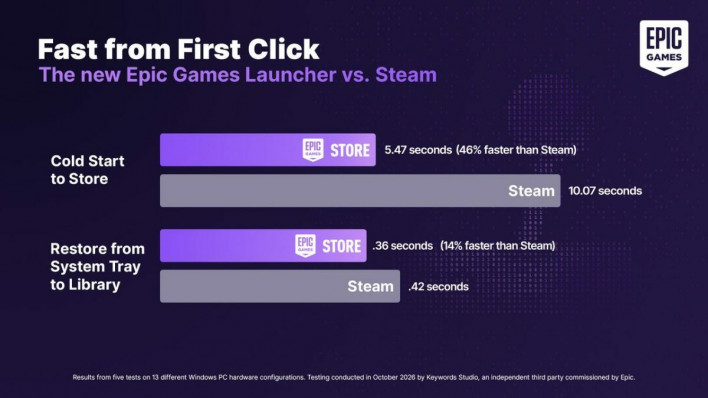
Of course, directly comparing both sets of numbers is difficult. Epic's figures come from third-party testing commissioned externally, whereas the Steam records were measured by individual users on different PCs and environments, meaning they were not tested under identical conditions. Furthermore, the new launcher is still in its preview stage, with Epic itself describing it as a feature-light initial build that aims to reach feature parity with the existing launcher. Nevertheless, at the very moment Epic emphasized its speed reduction, Steam had already cut its cold start times to a similar level, rendering Epic's highlighted speed gains moot.
Earlier, Epic CEO Tim Sweeney stated on X that a "huge pivot" was underway, explaining that the company was reorganizing structure and reallocating developers to maximize AI acceleration. Subsequent reports also indicated that Epic was setting an AI-first direction, entrusting code and many other operations to AI tools.
Meanwhile, this Steam update included many improvements beyond startup speed. Big Picture mode added a "Big Art Mode" that displays game art prominently, along with a personal calendar shortcut and screensavers. Fixes were also made to the Steam Input configurator, in-game overlay, Remote Play, and Linux support.