An analysis shows that the sales volume generated by a single Steam wishlist has fallen by nearly half in recent years. However, the report also noted that when it comes to predicting launch performance, nothing remains as effective as wishlists.
On October 13, game marketing consultant Chris Zukowski published an analysis of Steam game sales data on his blog, 'How To Market A Game'. Using data submitted directly by developers from their Steamworks sales reports, he compared 34 titles released between 2020 and 2022 against 126 titles released between 2023 and 2025. 2026 releases were excluded due to their shorter sales history.
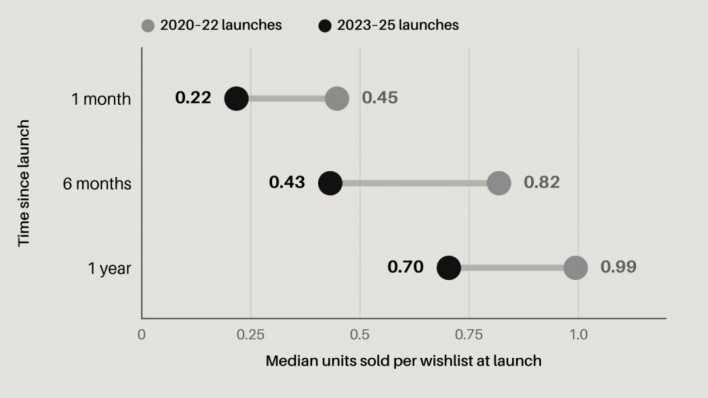
According to the analysis, first-month sales per wishlist averaged 0.45 copies for 2020–2022 releases and 0.22 copies for 2023–2025 releases. At the six-month mark, sales per wishlist similarly halved from 0.82 to 0.43 copies, though the gap narrowed somewhat after one year, showing 0.99 copies versus 0.70 copies. Zukowski referred to this phenomenon as "wishlist inflation".
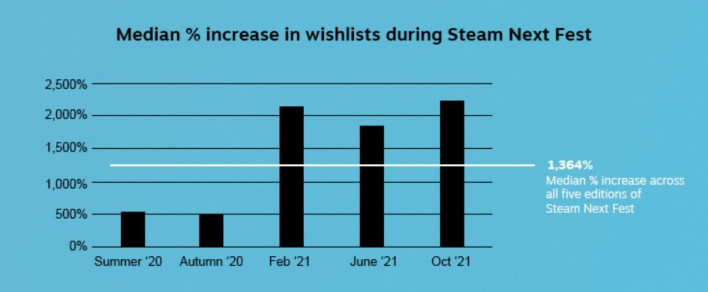
Changes to Valve's store features were cited as a primary factor. Because users can now add games to their wishlist directly from hover tooltips without visiting the store page, wishlists have become closer to "bookmarks" rather than a list of games users intend to purchase. The study also pointed out a sharp increase in online events, including Steam Next Fest, since 2020; Zukowski notes that wishlists accumulated during festivals are less likely to convert into actual purchases. Additionally, more developers now cover the marketing fundamentals—such as participating in Steam Next Fest—which has also contributed to this shift.
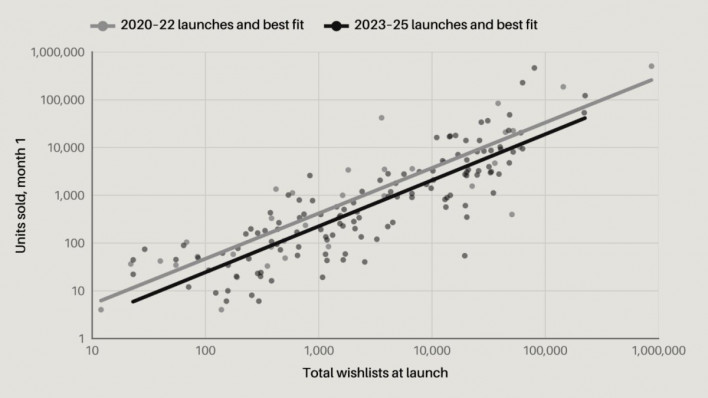
Conversely, the predictive power of wishlists has remained virtually unchanged. The coefficient of determination ($R^2$) between launch-day wishlist counts and first-month sales was 0.77 for 2020–2022 and 0.72 for 2023–2025, a difference Zukowski regarded as within the margin of error. The core relationship—that games with more wishlists sell more copies—holds true, but the volume of sales yielded per wishlist has declined.
The theory that the velocity of wishlists—the number of wishlists accumulated in the 30 days prior to launch—is more important than total wishlists was also unsupported. For 2023–2025 releases, the coefficient of determination for velocity was 0.70, lower than that of total wishlists, and combining both metrics yielded only a minor increase to 0.75. Zukowski offered an analogy: "Just because the cost of living has gone up doesn't mean you stop paying rent."
These figures also diverge significantly from older rules of thumb used by indie developers. At GDC 2020, Mike Rose of No More Robots shared a rule of thumb where multiplying pre-launch wishlists by 20–30% estimated first-week sales. That same year, Simon Carless reported median first-week conversion rates ranging from 15% to 25%, depending on wishlist size. Unlike these formulas based on first-week sales, Zukowski's data measures first-month performance, where recent releases average only 0.22 sales per wishlist even after a full month.
Steam market research firm GameDiscoverCo analyzed this trend using a different metric, measuring first-week sales as a multiple of launch-day wishlists. For games released in 2024–2025 with at least 25,000 wishlists, the median multiple was 0.15x. Comparing this to a 0.17x median from a 2024 survey of games with over 10,000 wishlists, GameDiscoverCo concluded that conversion rates have not drastically plummeted, placing more emphasis on the idea that acquiring wishlists has become harder due to increased competition. Indeed, according to SteamDB data, new Steam releases grew from approximately 14,000 in 2023 to nearly 21,000 in 2025.
While direct comparisons are difficult due to differing measurement periods, if this trend holds, developers setting launch wishlist targets based on 2020-era benchmarks may see lower sales than expected. Since the predictive value remains intact, the fundamental rule stands: games with more wishlists still sell better than those without.