More than eight out of 10 Japanese game developers were found to be using generative artificial intelligence (AI) in their work. Computer Entertainment Supplier's Association (CESA) of Japan announced on the 17th that it published the 'CESA Game Industry Report 2026 Preview Edition' containing these findings.
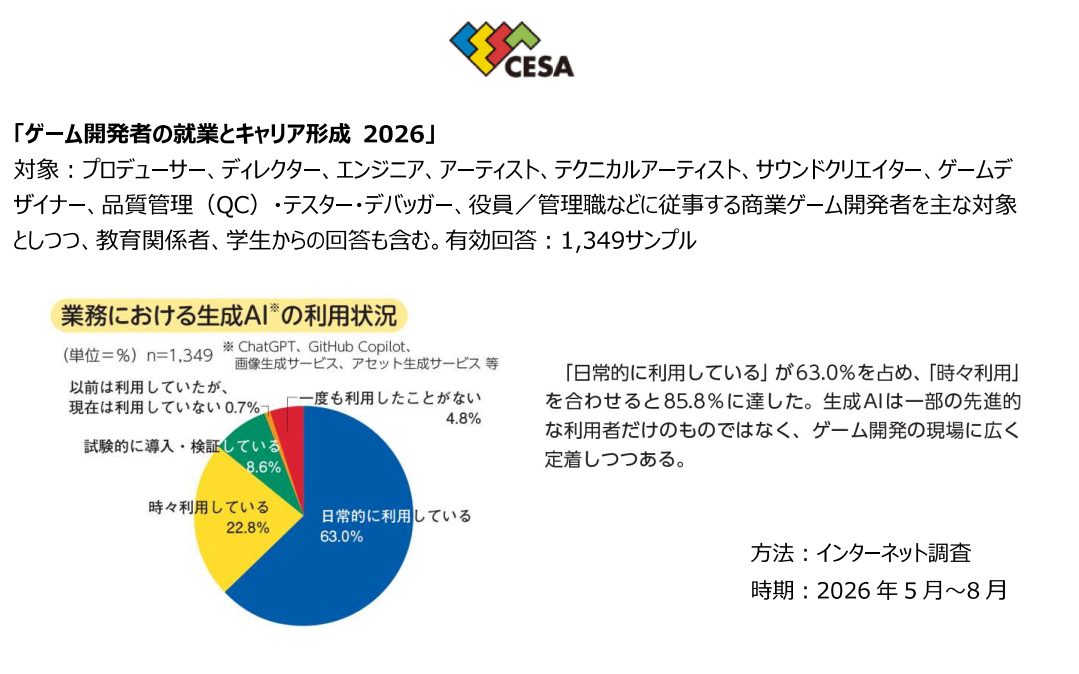
This report includes the results of two surveys on generative AI adoption conducted by CESA for the first time this year. In the 'Game Developers' Employment and Career Formation 2026' survey targeting game developers (1,349 valid responses), 85.8% responded that they use generative AI in their work. Specifically, 63.0% said they 'use it daily,' and 22.8% said they 'use it occasionally'. Additionally, 8.6% said they were 'introducing/verifying it on a trial basis,' 4.8% had 'never used it,' and 0.7% 'used it in the past, but do not currently use it'. CESA analyzed that generative AI is no longer a tool exclusive to early adopters, but is becoming broadly established across game development sites.
The trend of AI adoption was also confirmed in a corporate survey. In the '2026 CESA Member Companies Survey' targeting CESA member companies (48 out of 220 member companies responded), the most expected benefit of using generative AI was 'work efficiency and productivity improvement' (38 companies). This was followed by 'shorter development cycles' (30 companies), 'reduced development and operational costs' (29 companies), 'multilingual support and accelerated global expansion' (24 companies), 'creation of new expressions and ideas' (22 companies), 'content and service quality improvement' (21 companies), and 'addressing labor shortages' (20 companies).
In terms of management and operations, the most common response was that 'humans handle verification, correction, and supervision'. Restricting or specifying which tools to use and avoiding using generated outputs as-is also accounted for a majority. CESA interpreted this as the gaming industry striving for productivity improvements while establishing a secure operational framework centered around human supervision.
CESA Executive Director Tsutomu Masuda stated that while generative AI is being widely and steadily adopted in development environments, concerns regarding rights, including copyright infringement, have been pointed out, requiring careful consideration during its use. He added that accepting the possibilities of new technology while balancing rights protection and enhancing the quality of human-centered game development will be an important task for the game industry moving forward.