
GPU Makes a Comeback Amid Memory Shortages: Palit Launches New RTX 3060

메모리 부족에 역주행 시작한 GPU... 팰릿, RTX 3060 신제품 출시
©Palit

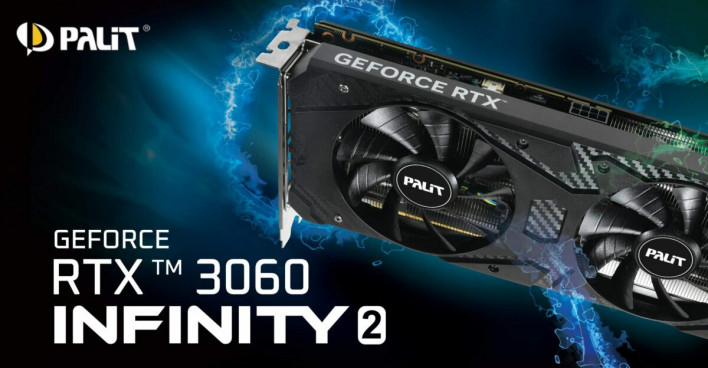
Palit, a graphics card partner of NVIDIA, has unveiled the 'GeForce RTX 3060 Infinity 2 OC,' a new graphics card based on the GeForce RTX 3060. As a brand-new model based on the RTX 3,060, which first launched in 2021, this is not a simple clearance of old stock but a product featuring a new cooling design and aesthetic. The reappearance of a five-year-old graphics card as a new product has drawn significant attention to the reasons behind this move.

The new card uses the same NVIDIA GA106 GPU as the original RTX 3060. It features 3584 CUDA cores, 12GB of GDDR6 memory, and a 192-bit memory bus, while introducing new elements such as a dual-fan cooler, a metal backplate, and '0dB Tech' that stops the fans during low-load environments. The boost clock is 1792MHz, slightly higher than the reference specification, though pricing and release dates have yet to be announced.

What is most striking is not the product itself, but the fact that the RTX 3060 is being produced again. Industry observers believe NVIDIA is ramping up production of the RTX 3060 to maintain supply in the entry-level graphics card market. The GDDR7 memory used by the latest RTX 50 series is in tight supply due to surging demand for AI servers and AI accelerators. In contrast, the RTX 3060 uses GDDR6 memory, which has a relatively stable supply chain, allowing NVIDIA to sustain the entry-level market with minimal impact on the production of its latest flagship products.

The semiconductor production structure is also believed to be a factor. The RTX 3060 GPU was originally produced using Samsung Electronics' 8nm process. Recent industry speculation suggests that NVIDIA is once again utilizing Samsung Foundry for RTX 3060 production. Unlike the latest RTX 50 series, which uses TSMC's advanced nodes, the RTX 3060 can leverage the already-proven Samsung 8nm line, avoiding competition for capacity with AI GPUs and other advanced-node products. This is expected to help distribute the supply burden resulting from the expansion of AI semiconductor production.

The continued competitiveness of the RTX 3060 is another reason for its re-release. With 12GB of VRAM, it offers more memory than the 8GB configurations found in newer entry-level cards like the RTX 5050 or RTX 5060. As PC game memory requirements continue to rise and use cases for local AI models and generative AI grow, many consumers now prioritize memory capacity over raw computational performance. This is why the RTX 3060 remains a practical choice years after its initial launch.

The RTX 3060 has long been one of the most widely used graphics cards in the Steam Hardware Survey, earning it the nickname 'the people's graphics card.' Palit's new release is significant not merely as a revival of an old product, but as an unusual case where a proven, older-generation GPU is being reintroduced to the market because the expansion of the AI sector has fundamentally altered semiconductor production and memory supply structures. In a sense, the AI era has revitalized the value of a past-generation graphics card.

This article was originally written in Korean and translated with the help of NC AI. It was then edited by a native English-speaking editor. All AI-assisted translations are reviewed and refined by our newsroom. [Read Original]

Sort by:

Comments :0

Insert Image

Add Quotation

Add Translate Suggestion

Language select

Report

CAPTCHA